Semax is one of the few research peptides with a real regulatory approval. Russia approved it for stroke recovery, backed by 20+ studies from the Kurchatov Institute. Where to buy Semax in 2026 turns on three questions. Is the lab paperwork legit? Are you getting the right form? And is the vendor crossing legal lines you don't want to cross with them?
Semax is a 7-amino-acid synthetic peptide. CAS number 80714-61-0. Molecular weight 854.0 g/mol. It's sold legally in the U.S. as a research reference compound, not as a drug. Russia approves it as a nasal-drop for stroke and certain cognitive disorders. Research-grade pricing runs $40-$80 per 10 mg vial. A credible Certificate of Analysis (CoA, the one-page lab report) shows HPLC purity ≥98%, mass-spec mass 855.0, and water content under 8%. Two Semax-specific red flags: pre-mixed nasal sprays sold without cold-chain shipping, and vendors making stroke or cognitive-treatment claims.
- CoA. Certificate of Analysis. A one-page lab report showing the specific lot's purity, identity, and water content.
- ISO/IEC 17025. The international quality standard for testing labs. A 17025-accredited lab has been audited by a third party for technical competence.
- 503A pharmacy. A U.S. compounding pharmacy that's licensed to make custom prescription medications for individual patients. Operates under section 503A of the Federal Food, Drug, and Cosmetic Act.
- Lyophilized. Freeze-dried into a stable powder. Lyophilized peptides survive shipping at room temperature for short periods and store for years frozen.
- HPLC. High-performance liquid chromatography. The standard purity test for peptides. The chromatogram is the squiggly line that shows how clean the batch is.
Quick answer. Research-grade Semax should cost $40-$80 per 10 mg vial. It should ship as lyophilized powder. It should come with a third-party CoA from an ISO 17025-accredited lab. Buy the powder, not the pre-mixed nasal spray, unless the vendor publishes formulation buffer and stability data plus uses cold-chain shipping.
What you're actually buying
Semax was developed at the Institute of Molecular Genetics (now part of Russia's Kurchatov Institute) by Myasoedov and Andreeva. It's a synthetic copy of a 4-amino-acid piece of ACTH (the body's stress hormone signal). The Russian designers added three extra amino acids and an acetyl group to make it stable in the body. The result is a 7-amino-acid peptide that keeps ACTH's brain-supportive effects but doesn't crank up cortisol the way the parent hormone does (Sudarkina et al., 2021).
The Kurchatov Institute's stroke-genomics group has run a long series of rat-model studies. Their finding: Semax appears to push brain gene expression back toward normal after a stroke (Filippenkov et al., 2024). A 2025 study in the British Journal of Pharmacology extended the work into spinal cord injury. It found Semax helped female mice recover function after spinal injury (Liu et al., 2025). That paper matters because it landed Semax in a Western peer-reviewed journal, not just the Russian-only literature.
The three places people buy Semax
Research-grade Semax is available through three channels, each with different regulatory and quality implications.
1. Research-supply vendors (the most common channel)
This is where most U.S. buyers get Semax. The vendor sells the peptide as a lyophilized powder labeled "for laboratory research use only." This is legal under U.S. law. The catch: it's not legal for human use, and the vendor isn't a pharmacy.
Documentation to verify: a third-party CoA from an ISO 17025-accredited testing lab named on the report, HPLC purity ≥98%, mass-spec mass 855.0, and cold-pack shipping when ambient temperatures are elevated.
2. 503A compounding pharmacies (rare for Semax)
A 503A pharmacy can in principle compound a peptide under a doctor's prescription for an individual patient. In practice, Semax is hard to find this way. It's not on FDA's approved-for-compounding bulk substance lists, which means most U.S. compounding pharmacies won't touch it. Expect the price to run several times higher than research-grade if you do find one.
3. The Russian prescription channel
In Russia, Semax is a prescription nasal-drop solution sold under the Russian Ministry of Health pharmaceutical register. It's the only place you can buy it as a real, approved drug. Not relevant unless you're in Russia or working with a Russian collaborator.
The Semax-specific checks
The standard eight criteria for any peptide vendor apply. Four are sharper for Semax specifically.
1. CAS number and N-acetylation verification
The CAS Registry Number for Semax is 80714-61-0. A CAS number is a unique ID that identifies a specific chemical. Semax is also "N-acetylated," meaning there's an acetyl group attached at one end of the peptide. That tag adds 42 daltons to the mass and is required for the stability the Russian literature reports.
If the CoA is missing the CAS number, or if the structural drawing skips the acetyl group, that's a critical gap. The non-acetylated version is a different molecule with different stability. It's not the Semax cited in the research.
2. Mass-spec at the expected weight
The theoretical mass of Semax is 854.0 g/mol. Mass-spectrometry on the CoA should report the observed mass at 855.0 (the peptide picks up one hydrogen during the test, called [M+H]+). The observed mass should be within 0.5 daltons of the target.
A reading of 812.0 indicates the non-acetylated version rather than Semax. Any other significantly different mass indicates the vial does not contain Semax. The mass match is the single most direct identity check available on a CoA.
3. The Russian approval is real, but it doesn't transfer
Semax is one of a small handful of research peptides with a real regulatory approval somewhere. Russia approved it for stroke and certain cognitive disorders, sold as a nasal-drop solution in clinical settings.
That's not FDA approval. Semax hasn't been tested by Western regulatory standards. No PubMed-indexed Western randomized trial of Semax has been published in 2020-2026. Don't let a vendor blur "Russian-approved" into "FDA-approved." Those are different things.
4. Form: nasal spray vs powder
Russian clinical protocols use the nasal route. Vendors sell Semax in three forms:
- Lyophilized powder for reconstitution. The most flexible form for research use. Reconstitutable into either intranasal or subcutaneous delivery formats to match the delivery route used in published protocols. Stable at -20°C for years.
- Pre-mixed nasal spray. A convenience format matching the Russian-approved clinical delivery route. Requires cold-chain shipping; only acceptable when the vendor publishes formulation buffer and stability data.
- Pre-reconstituted solution. Uncommon for Semax. Same in-use shelf-life concerns as the pre-mixed nasal spray format.
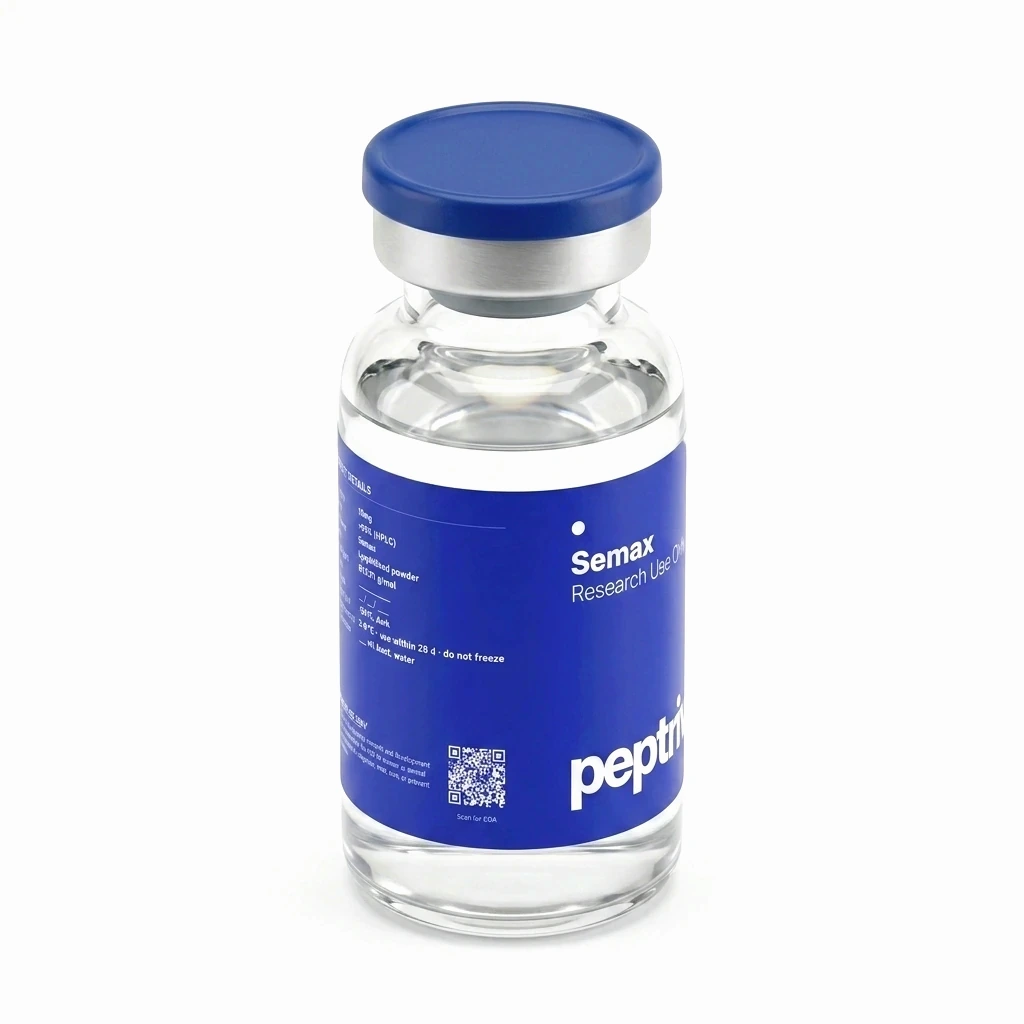
Semax
The same N-acetylated heptapeptide cited across the Kurchatov Institute’s 2021–2024 stroke RNA-seq series and the 2025 spinal-cord-injury study in the British Journal of Pharmacology. CAS 80714-61-0, observed mass [M+H]+ 855.0, ≥99% HPLC purity, ISO 17025 third-party CoA on every lot.
2026 pricing benchmarks
Semax is a relatively cheap peptide to make. Seven residues plus one acetyl group is on the easy end of synthesis. Here's what research-grade retail looks like in 2026:
- 5 mg vial: $25-$50 ($5-$10/mg). Common entry size from smaller suppliers.
- 10 mg vial: $40-$80 ($4-$8/mg). The standard retail size. Best per-mg value at most vendors.
- 30 mg vial: $90-$150 ($3-$5/mg). The per-mg value plateaus here.
- Multi-vial discounts: 10-25% off on 3-packs and 6-packs at most vendors.
Pricing meaningfully below $25 per 10 mg vial deserves a question. The HPLC purification step is what separates crude Semax (right sequence, impurities included) from research-grade Semax (purified to ≥98%). The cheap end of the market typically cuts that purification step, not finds efficiency breakthroughs.
Above $15/mg, you're paying retail markup rather than synthesis cost. Pre-mixed nasal sprays cost a small premium over the equivalent powder mass because of the extra formulation work.
Legal status: FDA, Russia, and customs
Semax sits in a different regulatory position in each country:
- United States (FDA): Not approved for any indication. Not a controlled substance. Legal to buy and sell as a research reference compound labeled for laboratory use only. Selling for human consumption is illegal; buying as research material is not.
- European Union (EMA): Not approved.
- Russia: Approved for ischemic stroke and certain cognitive disorders. Available as a prescription nasal-drop formulation under the Russian Ministry of Health pharmaceutical register.
- WADA: Not explicitly listed on the Prohibited List. (WADA Prohibited List for current categorizations.)
- Major sports leagues: Not explicitly prohibited.
The Russian approval is real, but it doesn't transfer across borders. Research interest outside Russia has concentrated on cognitive and neuroprotective models, but that area remains outside both the Russian evidence base for approved indications and any published Western RCT record.
Where this falls short. The Semax evidence base is heavy on rodent stroke models from one institution (Kurchatov). Western RCTs on humans don't exist in the 2020-2026 window. Cognitive and neuroprotective claims in vendor marketing are not backed by Western trials in healthy research subjects. This is a compound with real Russian regulatory weight and real rodent mechanism data, but the Western human evidence is thin.
Red flags specific to Semax
- Missing N-acetylation on the structural drawing. The unmodified heptapeptide has a different mass (812.0 vs 854.0) and different stability. The CoA must show the N-acetyl group on the methionine N-terminus, and the mass-spec must read 855.0 ([M+H]+).
- Pre-mixed nasal spray sold at room temperature. The lyophilized powder is what survives shipping. Pre-mixed Semax solution sold without cold chain has a much shorter in-use stability window than the powder and the in-transit degradation profile is poorly characterized.
- Clinical claims on the product page. “Semax treats stroke.” “Semax improves cognitive function.” “Semax accelerates recovery from TBI.” The Russian approval does not authorize U.S. clinical marketing, and a supplier making clinical claims has crossed into FDA jurisdiction.
- Conflation of Russian approval with FDA approval. Vendors who lead with “Semax is an approved stroke drug” without specifying the jurisdiction are obscuring the regulatory landscape.
- Missing CAS number on the CoA. CAS 80714-61-0 is the unique identifier. Its absence from the CoA is a red flag.
- Mass-spec mass not matching 855.0 [M+H]+. If the mass is wrong, the molecule is wrong.
- Single-source documentation. Internal QC is not sufficient. Third-party ISO 17025 verification is the standard.
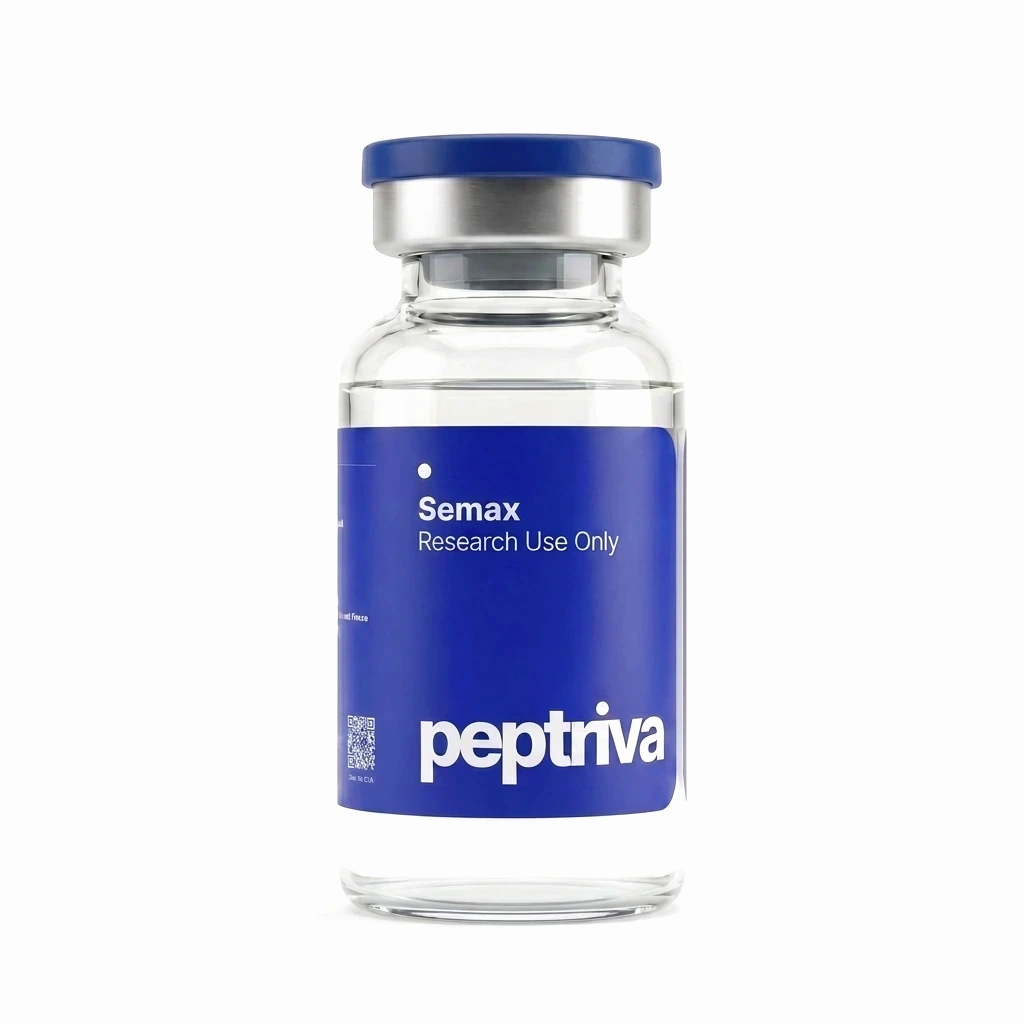
Semax
N-acetylated heptapeptide, CAS 80714-61-0. The same reference compound used across the Russian preclinical stroke literature and the 2025 spinal cord injury study in British Journal of Pharmacology. Research-grade reference compound; COA with HPLC trace and mass-spec on every lot.
Semax is one of a small handful of research peptides with real regulatory weight in some jurisdiction. Russia approved it for stroke recovery. Western regulators have not tested it. That's a fact you need to keep straight in your head when reading vendor pages.
— Our reading of the Russian Ministry of Health register, 2026
Frequently asked questions
Is Semax legal to buy in the USA?
Yes, as a research reference compound labeled for laboratory use only. It's not FDA-approved as a drug. It's not a controlled substance. Selling Semax for human consumption is illegal. Buying it as research material is not.
Why is it approved in Russia but not the United States?
The Russian approval rests on clinical trials that mostly predate PubMed and aren't indexed in Western databases. FDA approval needs trials run to ICH-GCP standards. Those haven't been completed for Semax outside Russia. We've found no PubMed-indexed Western RCT for Semax in the 2020-2026 window.
Are the "nootropic" claims supported by evidence?
The Russian rodent literature has reported effects on brain growth-factor signaling (BDNF and NGF) and measures of cognitive performance in rat stress and learning models. A 2020 fMRI study in 52 research subjects observed changes in brain connectivity between specific regions following Semax administration (Panikratova et al., 2020).
What the literature does not contain: a Western RCT testing cognitive performance in healthy humans on validated outcome measures. The preclinical mechanism is characterized; controlled human evidence for cognitive outcomes in healthy research subjects is not available in the published record.
How does Semax compare to Selank?
Same Russian research lineage, different investigational focus. Semax has been studied in stroke recovery and cognitive models; Selank has been studied in anxiety models. The two share a neuropeptide lineage but have distinct mechanisms. Detailed comparison: Selank vs Semax.
What role does BDNF play in Semax's mechanism?
Preclinical studies have investigated Semax's effects on BDNF and NGF expression in rodent brain tissue. A 2024 chronic-stress study reported that Semax (60 nmol/kg/day) attenuated stress-induced behavioral changes in rats (Inozemtseva et al., 2024). Deeper dive: Semax ACTH/BDNF mechanism.
Nasal spray or injectable powder?
The Russian-approved clinical formulation uses the nasal route. Most research-grade Semax ships as lyophilized powder for reconstitution — the most flexible form for matching published protocols. Pre-mixed nasal sprays without cold-chain shipping have a shorter in-use stability window. Researchers should match the delivery format to the published literature being replicated.
How does it compare to Cerebrolysin?
Different categories. Semax is a defined synthetic peptide. Its mass and identity are verifiable on a CoA. Cerebrolysin is a pig-brain-derived peptide preparation registered in some European and Asian countries for stroke and dementia. The Western trial record is heavier for Cerebrolysin (the CASTA and CEREHETIS studies). The mechanism evidence is heavier for Semax. They're not interchangeable.
What to know now
- CAS 80714-61-0, MW 854.0, observed [M+H]+ 855.0. The numbers a credible CoA should show, with N-acetylation visible on the structural drawing.
- $40–$80 per 10 mg vial. Seven residues with one N-acetyl modification — lower-cost synthesis than longer or more-modified peptides.
- Russian regulatory approval is real but does not transfer. Russian-approved for stroke and cognitive disorders; not FDA- or EMA-approved.
- Lyophilized powder is the most flexible form. Reconstitutable into the delivery format used in the target protocol (intranasal per the Russian clinical literature, or other routes per the specific study design).
- Pre-mixed nasal sprays need cold chain. Acceptable when the supplier publishes formulation buffer and stability data.
- Evidence base is concentrated in one institution. 20+ Kurchatov Institute stroke studies, 1 Western fMRI study, 0 Western RCTs in 2020-2026. Set expectations accordingly.
What we’re watching
The most important Semax development to track is whether a Western RCT — randomized, blinded, with validated outcome measures — ever publishes. The 2020 Panikratova fMRI study is the most rigorous Western human evidence to date, but it characterizes brain connectivity rather than a clinical endpoint. The Russian approval rests on clinical trials that predate the PubMed-indexed range and are largely outside Western pharmacovigilance databases. Separately, the 2025 Liu et al. spinal cord injury paper in British Journal of Pharmacology is notable because it places Semax in a Western peer-reviewed pharmacology journal with a mechanistically novel finding (μ-opioid-receptor-mediated USP18/FTO deubiquitination) — whether this opens a Western research program for Semax in indications beyond Russian stroke care is worth watching.
References
- Filippenkov, I. B., Shpetko, Y. Y., Stavchansky, V. V., Denisova, A. E., Yuzhakov, V. V., Sevan’kaeva, L. E., Valieva, L. V., Remizova, J. A., Gubsky, L. V., Myasoedov, N. F., Dergunova, L. V., & Limborska, S. A. (2024). ACTH-like peptides compensate rat brain gene expression profile disrupted by ischemia a day after experimental stroke. Biomedicines, 12(12), 2830. https://doi.org/10.3390/biomedicines12122830
- Liu, R., Chen, Y., Huang, H., et al. (2025). Semax peptide targets the μ opioid receptor gene Oprm1 to promote deubiquitination and functional recovery after spinal cord injury in female mice. British Journal of Pharmacology, 182(22), 5489–5516. https://doi.org/10.1111/bph.70122
- Sudarkina, O. Y., Filippenkov, I. B., Stavchansky, V. V., Denisova, A. E., Yuzhakov, V. V., Sevan’kaeva, L. E., Valieva, L. V., Remizova, J. A., Dmitrieva, V. G., Dergunova, L. V., Myasoedov, N. F., & Limborska, S. A. (2021). Brain protein expression profile confirms the protective effect of the ACTH(4–7)PGP peptide (Semax) in a rat model of cerebral ischemia–reperfusion. International Journal of Molecular Sciences, 22(12), 6179. https://doi.org/10.3390/ijms22126179
- Sciacca, M. F. M., Naletova, I., Giuffrida, M. L., & Attanasio, F. (2022). Semax, a synthetic regulatory peptide, affects copper-induced Aβ aggregation and amyloid formation in artificial membrane models. ACS Chemical Neuroscience, 13(4), 486–496. https://doi.org/10.1021/acschemneuro.1c00707
- Panikratova, Y. R., Lebedeva, I. S., Sokolov, O. Y., Rumshiskaya, A. D., Kupriyanov, D. A., Kost, N. V., & Myasoedov, N. F. (2020). Functional connectomic approach to studying Selank and Semax effects. Doklady Biological Sciences, 490(1), 9–11. https://doi.org/10.1134/S001249662001007X
- Inozemtseva, L. S., Yatsenko, K. A., Glazova, N. Y., Kamensky, A. A., Myasoedov, N. F., Levitskaya, N. G., & Grivennikov, I. A. (2024). Antidepressant-like and antistress effects of the ACTH(4-10) synthetic analogs Semax and Melanotan II on male rats in a model of chronic unpredictable stress. European Journal of Pharmacology, 984, 177068. https://doi.org/10.1016/j.ejphar.2024.177068
- U.S. Food and Drug Administration. (2024). Research Use Only (RUO) and Investigational Use Only (IUO) labeling under 21 CFR § 809.10(b)(9). https://www.fda.gov/medical-devices/ivd-regulatory-assistance/research-use-only-and-investigational-use-only-ruoiuo-labels
- International Organization for Standardization. (2017). ISO/IEC 17025:2017 — General requirements for the competence of testing and calibration laboratories. https://www.iso.org/standard/66912.html