Research on Selank vs Semax has characterized two distinct functional profiles: Selank as an anxiolytic, Semax as a nootropic/neuroprotective agent. Same lab, same length, two mechanistically different molecules.
Both peptides are 7 amino acids long and emerged from the same Russian research group. Studies have distinguished their indications: Selank has been investigated and approved in Russia for generalized anxiety disorder; Semax has been studied and approved for ischemic stroke and cognitive disorders. They share a stability tail (Pro-Gly-Pro) but their active cores engage different molecular targets. Neither is FDA-approved.
One Moscow lab — the Institute of Molecular Genetics — developed both peptides in the 1990s. The research goal was to produce short, stable peptide compounds from neuroactive natural sequences.
Both share the same scaffold. Both share the same stability design. The active core of each peptide derived from a different natural starting point, which accounts for their distinct mechanisms and approved indications.
How do the structures compare?
Both peptides share the same architecture. Active 4-amino-acid core, plus a Pro-Gly-Pro tail. The core engages receptors in the central nervous system. The tail confers enzyme resistance, keeping the molecule intact long enough to reach its targets. Both also carry an N-acetyl cap at the N-terminus, which further protects against proteolytic degradation.
The cores are where they diverge:
- Selank's core: Thr-Lys-Pro-Arg. This sequence is tuftsin — a natural human tetrapeptide produced in the spleen by proteolytic cleavage of IgG. Discovered at Tufts University in the 1970s, tuftsin has been studied primarily for its immunomodulatory signaling activity.
- Semax's core: Met-Glu-His-Phe. This is a fragment of ACTH(4-7). Research has established that this fragment retains brain-active properties distinct from ACTH's cortisol-releasing activity, engaging neuronal targets independently of the HPA axis.
The differing origins account for their distinct pharmacological profiles. Selank carries tuftsin-derived immunomodulatory activity; Semax carries ACTH-derived neuroactive properties. Same structural shell, different active cores.
How do the mechanisms compare?
Studies have characterized Selank as acting primarily through calming (GABAergic/serotonergic) and immune-modulatory pathways. Semax research has focused on neurotrophic and neuroprotective pathways. Some overlap has been reported (both have shown GABA-related activity; both modulate stress cytokines), but the primary mechanistic profiles are distinct.
Where this falls short. Most of what we know about how these peptides work comes from rodent studies, mostly run by the original Russian team. Independent Western replication is thin. The one solid Western human study is a 2020 fMRI trial with 52 healthy adults — a brain-imaging measurement, not a clinical outcome. Neither peptide has a Western randomized clinical trial for any indication. The mechanism story is plausible. The clinical proof in humans isn't there yet.
Selank's mechanism. A 2022 rat study by Konstantinopolsky reported that Selank reduced anxiety-like behavior in rodent models at a level comparable to diazepam. A 2021 study reported reductions in stress-driven inflammatory cytokines (IL-1β, IL-6, TNF-α) in preclinical stress models. Together, these findings form the preclinical basis for Selank's anxiolytic and immunomodulatory classification.
Semax's mechanism. A 2024 Filippenkov study reported that Semax restored near-normal expression of ~1,171 genes in rat brain tissue 24 hours after experimental stroke. Italian researchers reported that Semax binds copper and inhibits copper-driven amyloid-beta aggregation in membrane models. A 2025 spinal-cord-injury study identified opioid-receptor binding activity. Across these studies, Semax has been characterized as a multi-pathway neuroprotective compound.
Both stories are coherent. Semax has more papers behind it. Not because Selank is poorly characterized — because the same lab put more effort into Semax over the last five years.
Regulatory status: Russia yes, the West no
Both have Russian regulatory approval — placing them ahead of most compounds commonly marketed as "research peptides." Neither is approved by the FDA or EMA.
- Selank. Approved in Russia since 2009. Intranasal (nasal-drop) formulation. Approved indication: generalized anxiety disorder. Russian clinical protocols used short-course administration (days to weeks).
- Semax. Approved in Russia for ischemic stroke (acute treatment and recovery phase) and cognitive disorders (post-stroke cognitive deficit, acquired brain injury). Intranasal formulation. Applied in acute stroke care and the post-stroke recovery window per Russian clinical protocols.
Outside Russia, both are available as research-grade reference compounds. The most commonly studied off-label application in preclinical and observational contexts is cognitive function in healthy subjects — also the application with the thinnest controlled evidence for either compound.
Dose ranges reported in the literature
Russian clinical studies have employed intranasal nasal-drop administration for both peptides. Published preclinical studies have reported dose ranges spanning 0.3 mg/kg (single-dose anxiolytic models, Konstantinopolsky) to 5–450 µg/kg across Semax stroke and chronic-stress protocols. These figures appear in the cited literature and are noted here as reference data for researchers reviewing the preclinical record.
The Panikratova 2020 fMRI study administered both peptides intranasally to healthy adult research subjects using standard Russian nasal drops. Measurable brain-imaging changes were observed within 20 minutes of administration — the most relevant Western proxy for assessing pharmacodynamic onset in humans.
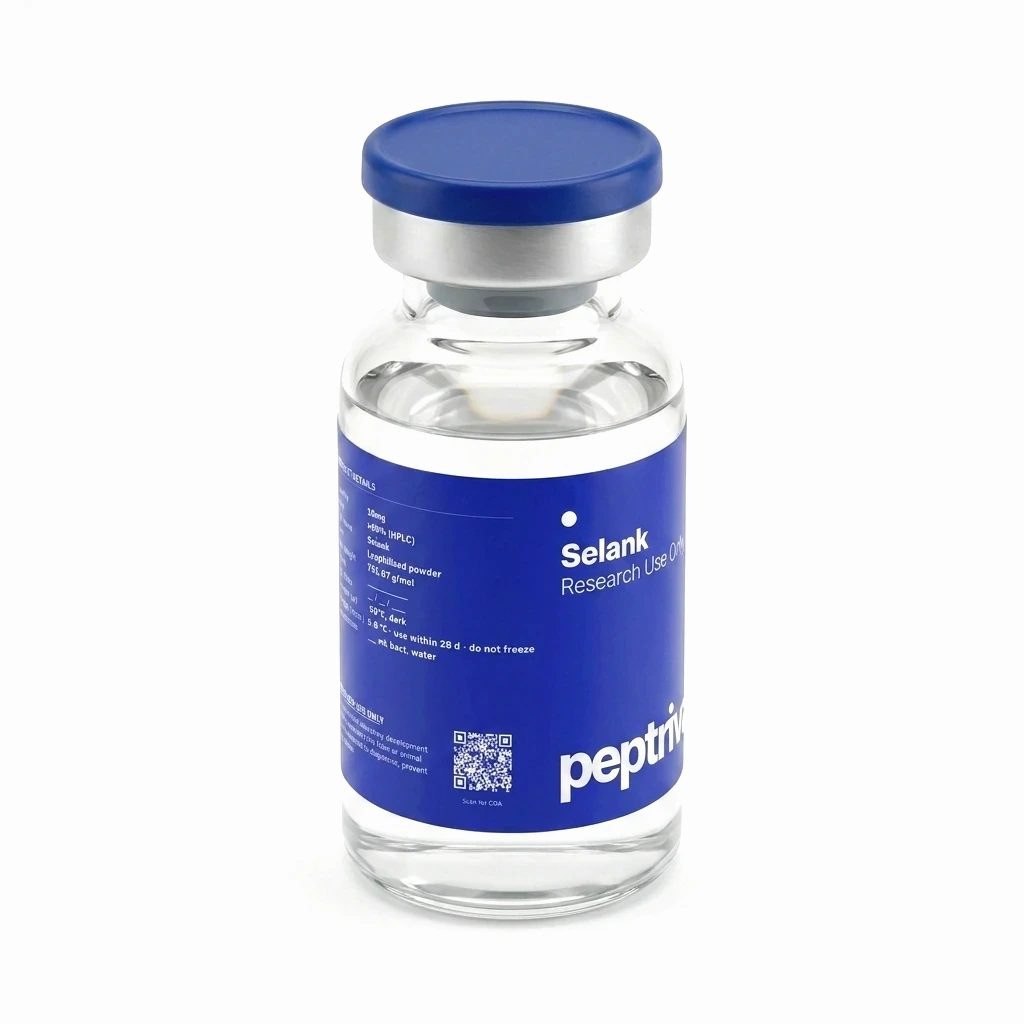
Selank
The same Russian-school anxiolytic peptide cited across the comparative literature in this article. Lab-verified identity and purity.
Administration routes in the literature: intranasal vs parenteral
Russian clinical validation for both peptides used the intranasal (nasal-drop) route. Pharmacologically, intranasal delivery bypasses first-pass hepatic metabolism and enables partial direct olfactory/trigeminal transport to the CNS — a pathway supported by the Pro-Gly-Pro stability tail, which preserves both peptides against proteolytic degradation long enough to traverse the mucosal surface.
A distinct pharmacokinetic profile has been reported for parenteral administration. Subcutaneous delivery produces different peak plasma concentrations, eliminates the direct nose-to-brain transport component, and alters the absorption half-life. Studies comparing intranasal and parenteral routes directly for these two peptides have not been published in the Western literature as of the time of writing.
The Panikratova fMRI study and Russian clinical approvals both rely exclusively on intranasal administration. Parenteral dosing regimens reported in grey-market research contexts have not been validated by controlled trial evidence in either Russian or Western programs.
Selank vs Semax: the side-by-side reference
For quick reference, here is the comparison in one place.
| Attribute | Selank | Semax |
|---|---|---|
| Sequence | Thr-Lys-Pro-Arg-Pro-Gly-Pro | Met-Glu-His-Phe-Pro-Gly-Pro |
| Parent peptide | Tuftsin (TKPR) | ACTH(4-7) (MEHF) |
| Length | 7 aa | 7 aa |
| Stability extension | Pro-Gly-Pro | Pro-Gly-Pro |
| Clinical positioning | Anxiolytic (non-sedating) | Nootropic / neuroprotective |
| Russian approval | GAD (since 2009) | Ischemic stroke, cognitive disorders |
| Primary mechanism | GABAergic, serotonergic, immune-modulatory | BDNF/NGF, anti-inflammatory, transcriptome modulation |
| Cytokine signature | ↓ IL-1β, IL-6, TNF-α; ↑ IL-4 (stress model) | ↓ IL-1α, IL-1β, IL-6, CCL3, CXCL2 (stroke model) |
| Independent replication | Limited outside Russian groups | Italian (copper/Aβ), UK/China (SCI 2025) |
| Best Western human study | Panikratova 2020 fMRI (n=52) | Panikratova 2020 fMRI (n=52) |
| Validated route | Intranasal nasal drops | Intranasal nasal drops |
| Off-label route (observed) | Subcutaneous (unvalidated) | Subcutaneous (unvalidated) |
| Western RCT | None in any indication | None in any indication |
Indication mapping: how Russian approvals distinguish them
The Russian regulatory record provides the clearest framework for distinguishing how each compound has been studied and approved.
- Anxiety models — Selank. Russian clinical trials and approvals target generalized anxiety disorder. The Konstantinopolsky (2022) rat model reported diazepam-comparable anti-anxiety effects without sedation — the preclinical basis for the anxiolytic classification.
- Stroke and cognitive deficit models — Semax. Russian approval covers acute ischemic stroke and post-stroke cognitive deficit. The Filippenkov (2024) transcriptomics study reported restoration of ~1,171 disrupted genes in rat brain 24 hours post-stroke, supporting the neuroprotective classification.
- Cognitive enhancement in healthy subjects. Neither peptide has been validated by controlled trial for enhancement in neurologically intact subjects. Semax is more frequently studied in this context, but Russian approval is restricted to deficit models.
The two peptides are not interchangeable. Different parent molecules, different mechanisms, different approved indications constitute distinct research profiles requiring separate evaluation.
Co-administration: what the literature covers
The Panikratova 2020 fMRI study examined Selank and Semax as separate arms (vs placebo) — not as a combined administration. No published Western study has examined the two peptides in combination.
Russian clinical programs do not document routine co-administration protocols for these two compounds. Combination regimens reported in observational or grey-market contexts represent extrapolations from the single-compound literature rather than controlled co-administration evidence.
Pharmacologically, the two peptides engage distinct receptor systems, and no direct pharmacokinetic or mechanistic interaction has been reported in the published literature. The absence of a reported interaction is not equivalent to a characterized safety profile for co-administration.
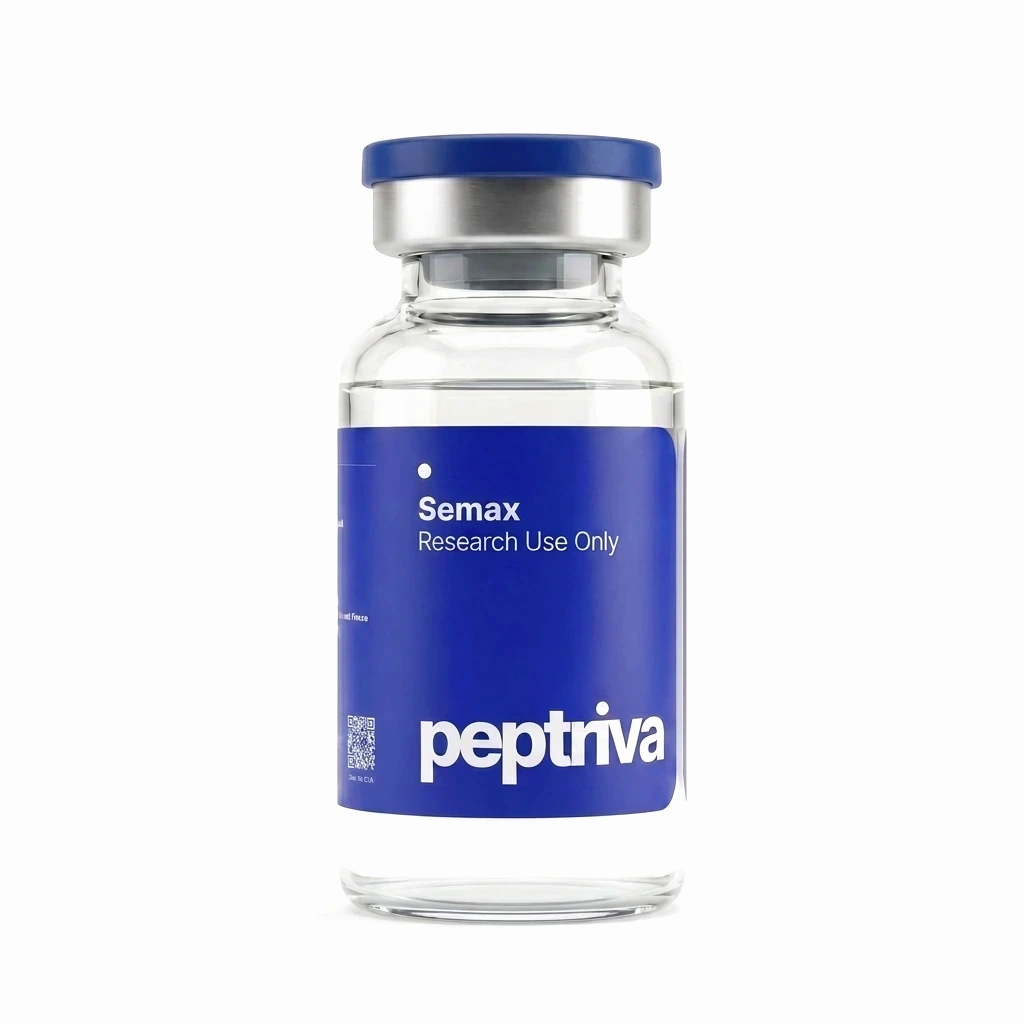
Semax
ACTH(4-10) analog · 7 aa, N-acetylated. The same reference compound used across the comparative literature. COA available with each lot.
Both Selank and Semax produced measurable but distinct patterns of right amygdala connectivity modulation in healthy adults within 20 minutes of intranasal administration, supporting their differentiated clinical positioning as anxiolytic and nootropic agents respectively.
— Panikratova et al., Doklady Biological Sciences, 2020
Safety: similar profile, one difference
Russian clinical trials have reported both peptides as well-tolerated at intranasal doses used in the approved short-course indications. The most commonly reported adverse event in those trials was mild nasal irritation. No major drug interactions, dependence liability, or sedation have been documented in the Russian clinical record at approved doses.
The same limitations apply to both compounds. Russian regulatory approval is confined to short-course use (days to weeks). Long-term safety data for extended off-label use have not been published. Theoretical pharmacodynamic interactions have been identified (GABAergic agents for both; opioid receptor activity for Semax; serotonergic and other neuroactive agents for both), but none have been characterized in controlled clinical studies.
One distinction in the emerging literature: a 2025 spinal-cord-injury study identified Semax opioid-receptor binding activity. This mechanistic finding has not been evaluated in the context of co-administration with opioid medications in a clinical study. No analogous opioid-receptor signal has been reported for Selank.
What to know now
- Same design template. Both are 7-amino-acid peptides with the Pro-Gly-Pro stability tail, developed at the Institute of Molecular Genetics in Moscow.
- Different parent sequences. Selank's core is tuftsin (TKPR — an immunomodulatory tetrapeptide). Semax's core is ACTH(4-7) (MEHF — a brain-active hormone fragment).
- Different research classifications. Studies position Selank as an anxiolytic; Semax as a nootropic and neuroprotective agent.
- Different Russian regulatory approvals. Selank: approved for generalized anxiety disorder (2009). Semax: approved for ischemic stroke and cognitive disorders.
- Different primary mechanisms. Selank research has focused on GABAergic, serotonergic, and immune-cytokine pathways. Semax research has focused on neurotrophic factors (BDNF/NGF), stroke gene-expression restoration, and copper-mediated amyloid aggregation.
- Shared evidence gap. Neither has a Western RCT in any condition. The Panikratova 2020 fMRI study (n=52) is the strongest Western human evidence for both.
- Route notes. Russian clinical approvals used intranasal administration. The pharmacokinetics of parenteral routes have not been validated by controlled studies for either compound.
- Co-administration. No published controlled data on combined use exists. Observed combination regimens in the literature are observational extrapolations, not study-derived protocols.
What we're watching
Three areas in the literature to follow. First, whether any Western research group initiates a head-to-head efficacy trial in a defined clinical population. The 2020 fMRI study established measurable CNS activity for both compounds; a controlled efficacy trial would substantially advance the evidence base. Second, whether independent non-Russian groups continue replicating Semax findings (Italian copper/Aβ work; UK/China spinal-cord data) and whether similar independent replication emerges for Selank. Third, whether the mechanistic framing — cytokine-modulating anxiolytics, neurotrophin-modulating neuroprotective agents — attracts sufficient interest to position either compound in Western drug development pipelines.
References
- Panikratova, Y. R., Lebedeva, I. S., Sokolov, O. Y., et al. (2020). Functional connectomic approach to studying Selank and Semax effects. Doklady Biological Sciences, 490(1), 9–11. https://doi.org/10.1134/S001249662001007X
- Konstantinopolsky, M. A., Chernyakova, I. V., & Kolik, L. G. (2022). Selank, a peptide analog of tuftsin, attenuates aversive signs of morphine withdrawal in rats. Bulletin of Experimental Biology and Medicine, 173(6), 730–733. https://doi.org/10.1007/s10517-022-05624-x
- Filippenkov, I. B., Shpetko, Y. Y., Stavchansky, V. V., et al. (2024). ACTH-like peptides compensate rat brain gene expression profile disrupted by ischemia a day after experimental stroke. Biomedicines, 12(12), 2830. https://doi.org/10.3390/biomedicines12122830
- Sciacca, M. F. M., Naletova, I., Giuffrida, M. L., & Attanasio, F. (2022). Semax, a synthetic regulatory peptide, affects copper-induced Aβ aggregation and amyloid formation in artificial membrane models. ACS Chemical Neuroscience, 13(4), 486–496. https://doi.org/10.1021/acschemneuro.1c00707