The proposed Semax BDNF mechanism has more substance behind it than most research-peptide claims. We're talking multiple RNA-seq studies from a single institute, independent Italian work confirming a separate mechanism, and a 2020 brain-scan trial in 52 healthy adults. That's a deeper mechanism trail than 90% of the peptides we cover.
Semax is a 7-amino-acid peptide (a heptapeptide) built off a fragment of ACTH, the hormone that normally signals the adrenal glands to release cortisol. Studies indicate Semax retains the brain-active fragment while omitting the cortisol-triggering sequence. The proposed mechanism centers on upregulation of BDNF (brain-derived neurotrophic factor) and NGF (nerve growth factor). Preclinical and clinical research has also identified activity at dopamine, serotonin, melanocortin, GABA, and opioid pathways. Russia approved it for ischemic stroke and cognitive disorders as a nasal spray. Intranasal delivery is the route validated in the published literature and by Russian regulators, on the basis of documented nose-to-brain transport efficiency.
This article unpacks the molecular biology behind those claims. We'll walk through the ACTH parent fragment, the engineered stability tail, the BDNF arm, the Russian stroke transcriptomics, the Italian copper-chelation work, and why the nose-to-brain route matters.
Where Semax comes from: an ACTH fragment, surgically edited
Start with ACTH. Adrenocorticotropic hormone is a 39-amino-acid peptide the pituitary releases in response to stress. Its primary role is to signal the adrenal glands (via the MC2 receptor) to release cortisol into circulation.
But ACTH does more than one thing. The first 13 amino acids drive cortisol release. The middle stretch, ACTH residues 4 to 10, has been known since the 1960s to affect learning, memory, and attention without touching cortisol. That middle stretch reads Met-Glu-His-Phe-Arg-Trp-Gly.
Russian chemists at the Institute of Molecular Genetics took ACTH(4-10) and edited it. They kept the first four amino acids (Met-Glu-His-Phe), which carry the cognitive activity. Then they swapped the last three (Arg-Trp-Gly) for Pro-Gly-Pro, a chemical "tail-cap" that resists digestion by enzymes called carboxypeptidases. The result is Semax: Met-Glu-His-Phe-Pro-Gly-Pro.
A key structural distinction: Semax does not raise cortisol. The cortisol-triggering portion of ACTH was not retained in the final sequence. The literature classifies Semax as "noncorticotropic" for this reason. It is more precisely described as an ACTH fragment with the corticotropic tail removed, rather than a full ACTH analog.
Russia approved Semax as a nasal-drop formulation for acute ischemic stroke and certain cognitive disorders. The Russian preclinical mechanism program is the deepest in this entire peptide encyclopedia we maintain. Multiple RNA-seq studies, protein-expression studies, behavioral models, all from a single coordinating institute.
The BDNF and NGF mechanism: feeding neurons
The central proposed mechanism is that Semax raises levels of BDNF and NGF. Both are neurotrophins — "growth factor" proteins the brain produces to support neuronal survival and synaptic connectivity. These are among the most studied molecular targets in neuroprotection and cognitive research.
BDNF specifically supports adult hippocampal neurogenesis, synaptic plasticity, and is one of the most-studied molecular signatures of antidepressant action in preclinical models. NGF supports cholinergic neurons, the cell population most affected in Alzheimer's pathology. A peptide with reported activity at both targets intersects two of the most investigated pathways in neuroprotection and cognitive research.
The 2024 Inozemtseva paper in European Journal of Pharmacology tested Semax at 60 nmol/kg/day in a rat chronic-unpredictable-stress model, the standard rodent depression paradigm. The result: Semax reversed the stress-induced loss of hippocampal BDNF. It also reversed anhedonia (loss of pleasure), weight loss, and adrenal swelling. That's a direct, in-vivo demonstration that Semax operates at the BDNF axis under conditions where BDNF normally crashes.
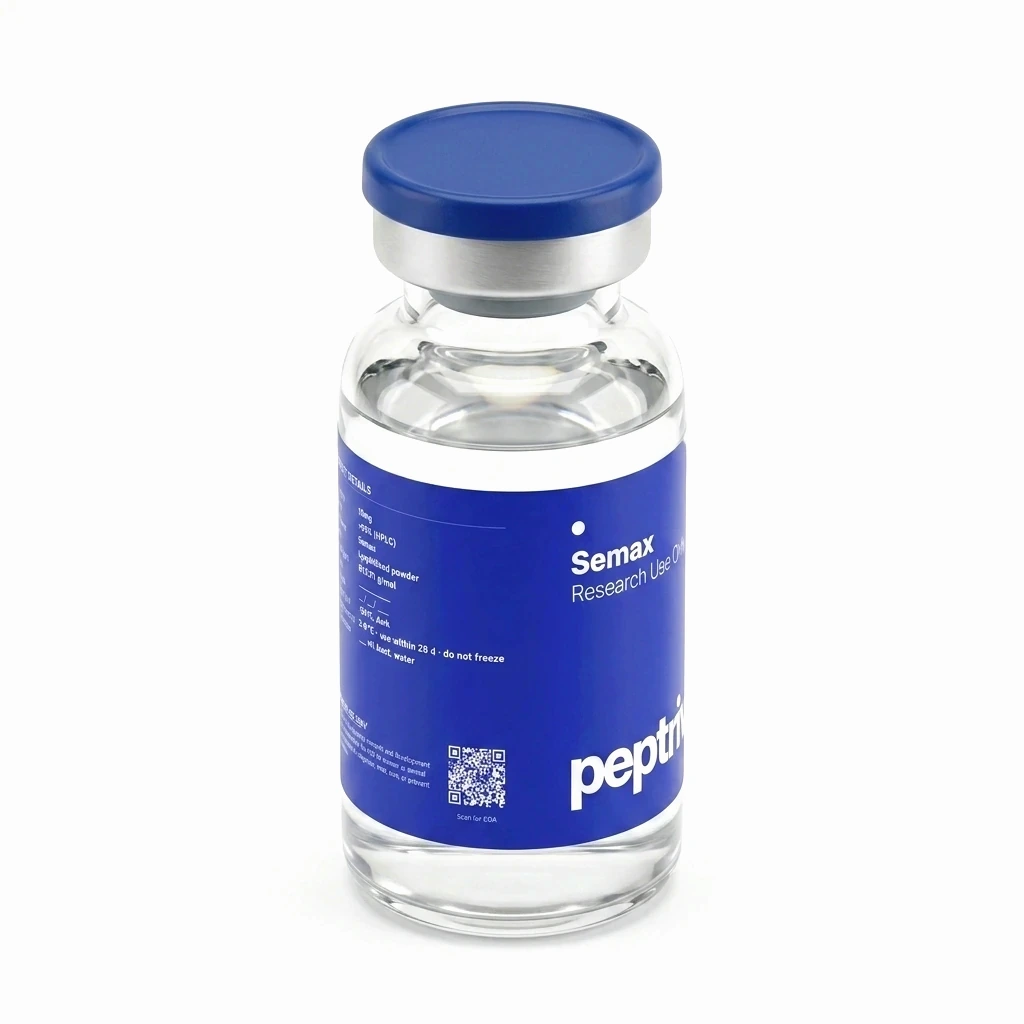
Semax
The same N-acetylated heptapeptide cited across the 7 mechanism studies in this article — including the Kurchatov stroke-transcriptomics work and the Italian copper-chelation studies. Lab-verified identity and purity.
The Kurchatov stroke transcriptomics: what RNA-seq actually showed
The deepest Semax mechanism work comes from one Russian lab, the Limborska / Dergunova / Filippenkov group at the Kurchatov Institute. They've published a sustained series of papers using a rat stroke model called tMCAO (transient middle cerebral artery occlusion). It works exactly how it sounds: temporarily clamp the artery, induce a stroke, then study what changes.
The 2021 Sudarkina IJMS paper tracked protein-level effects on four signaling molecules (CREB, MMP-9, c-Fos, and JNK) at 24 hours post-stroke. Semax shifted all four toward healthy patterns.
The biggest paper is the 2024 Filippenkov Biomedicines study. The team ran RNA-seq, which means they read out every gene the rat brain was expressing at 24 hours post-stroke, and counted the changes Semax produced. The result: Semax shifted 1,171 stroke-disrupted genes back toward baseline. That's a broad rewiring, not a single-target effect.
The caveat: all this work comes from one institute. The methodology is solid, the replication across time points is real, but a single research group is always weaker than independent replication. And the Russian RCTs that would normally back the regulatory approval aren't in PubMed.
The Italian copper-chelation work: independent replication, different mechanism
The Italian Alzheimer's research groups picked up Semax for a completely different reason than the Russians. They were looking for molecules that could break up copper-amyloid complexes, and Semax turned up as a hit.
Why copper? In Alzheimer's brains, sticky amyloid-β plaques bind copper ions. The copper-amyloid pairing generates reactive oxygen species (ROS), which damage neurons. A drug that can pry the copper away from amyloid would, in theory, reduce that damage. The technical name for "pries metal ions off other molecules" is chelation.
The 2022 Sciacca paper in ACS Chemical Neuroscience showed Semax binds copper(II), blocks copper-amyloid complex formation, cuts copper-driven ROS production, and protects SH-SY5Y cells (a human neuron-like cell line) from oxidative stress. The 2025 Tomasello paper extended it: Semax acts as a "copper chelator peptide," reducing both ROS and the toxicity amyloid causes when combined with copper.
This matters for three reasons. First, the Italian groups have zero overlap with the Russian developers, so it's truly independent confirmation. Second, copper-amyloid neurotoxicity is a real Alzheimer's mechanism, so the activity is biologically meaningful. Third, copper chelation has nothing to do with BDNF, which means Semax is hitting at least two distinct molecular pathways.
Semax shifted 1,171 stroke-disrupted genes back toward baseline at 24 hours post-tMCAO, substantially restoring the transcriptional state of ischemic brain tissue.
— Filippenkov et al., Biomedicines, 2024
The other pathways: dopamine, serotonin, GABA, opioid
Beyond BDNF and copper, the Semax literature catalogs effects across several other systems. None of them is dramatic on its own. Together they paint a "broad-activity" picture.
The 2024 Inozemtseva paper compared Semax against Melanotan II in chronic-stress rats. Both molecules are derived from ACTH fragments. Both bind melanocortin receptors (the receptor family that responds to ACTH and α-MSH). Both reversed stress-induced damage. That's evidence Semax is at least partially acting through melanocortin pathways, which would explain part of the antidepressant-like profile.
The 2023 Vyunova paper in Chemical Biology & Drug Design reported Semax acts on GABA receptors (the brain's main calming system) with both immediate and delayed effects.
The 2025 Liu paper in British Journal of Pharmacology extended the mechanism to spinal-cord injury. In mice, Semax improved recovery by binding µ-opioid receptors (the same family morphine binds), then triggering an enzyme cascade (USP18 and FTO) that blocks pyroptosis, a form of inflammatory cell death.
Pull these together and the pattern is: Semax doesn't have one receptor. It has several. That's unusual for a small peptide, and it's consistent with the broad behavioral effects the Russian literature describes.
Why the nose route matters: bypassing the blood-brain barrier
Route of administration matters more for Semax than for most peptides. The Russian-approved form is a nasal spray. Not injection, not pill. The reason is something called nose-to-brain transport.
The nasal lining has direct anatomical connections to two regions of the brain: the olfactory bulb and the trigeminal nerve. Small molecules can travel up these channels and reach brain tissue without entering systemic circulation — a documented route around the blood-brain barrier, the tight cellular layer that excludes most compounds from the CNS.
Semax uses this route effectively. The 2020 Panikratova fMRI study (the same one in the Selank article) enrolled 52 healthy adults and recorded amygdala-cortex connectivity changes within 5–20 minutes of a single intranasal dose. That timing is consistent with nose-to-brain delivery, not blood-mediated delivery.
Non-intranasal administration routes (subcutaneous injection, oral) are not validated for CNS delivery in the published literature. CNS bioavailability via those routes is expected to be substantially lower than the intranasal route studied and approved by Russian regulators.
Where this falls short. Semax has zero PubMed-indexed Western RCTs for stroke recovery, cognitive impairment, anxiety, or any other indication in 2020–2026. The Russian clinical data underpinning the regulatory approval sits outside PubMed. The 2020 Panikratova fMRI is rigorous human science, but it's a healthy-subjects connectivity study, not a treatment trial. The Italian copper work is independent and impressive, but it's in cells and test tubes, not animals or humans. Western evidence-based stroke care (tPA, thrombectomy) has overwhelmingly stronger trial data than Semax. The mechanism story is real and unusually deep. The clinical validation by Western standards is not.
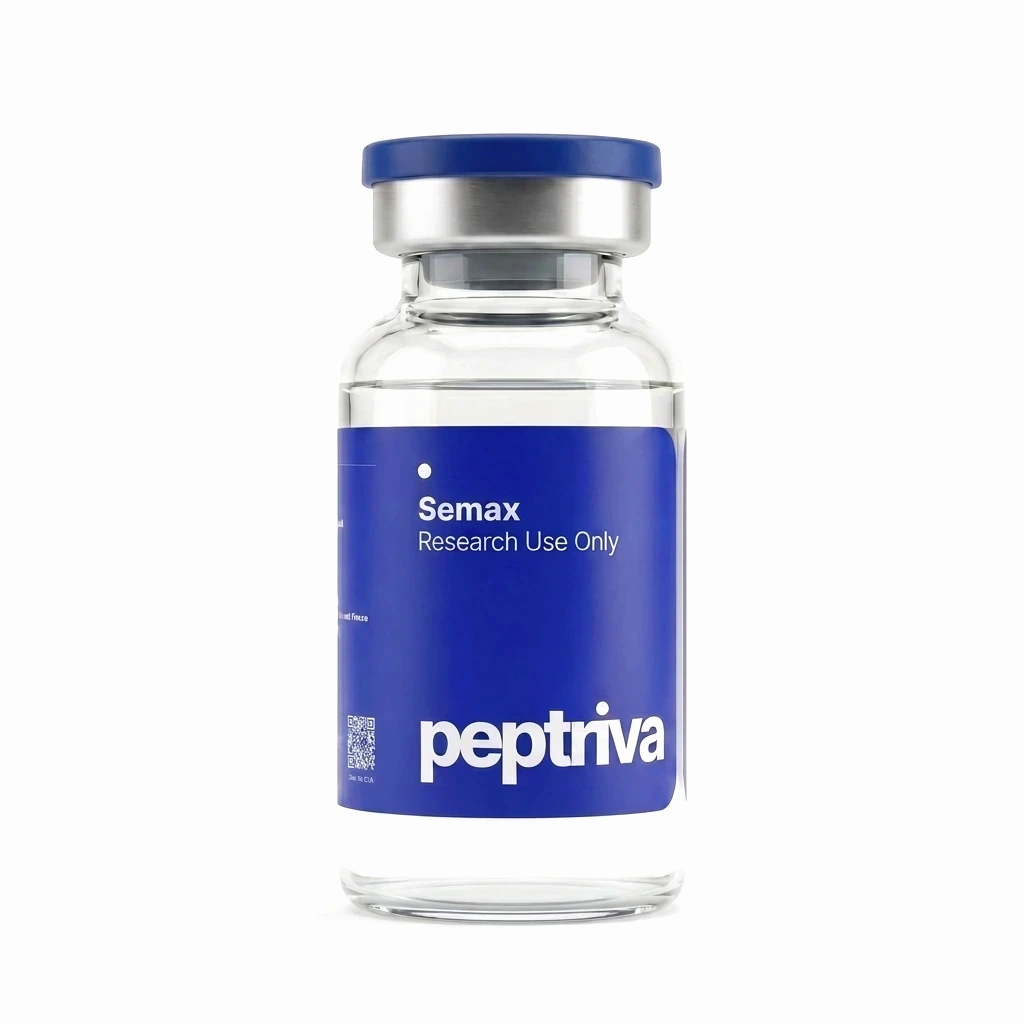
Semax
N-acetylated heptapeptide ACTH(4-10) analog with terminal Pro-Gly-Pro. The same reference compound used across the cited Kurchatov, Italian, and fMRI mechanism studies. COA available with each lot.
How should you read the Semax literature?
Hold two truths together. Semax has one of the deepest preclinical mechanism trails of any peptide we cover. Multiple RNA-seq studies, independent Italian work confirming a separate mechanism, a rigorous human imaging study, and 30 years of Russian clinical use. That's not nothing.
It also has one of the thinnest Western clinical trial bases, given the depth of the mechanism work. Both characterizations are accurate. The preclinical biology is substantive. The Western RCT-grade efficacy data for any specific indication has not yet been established. Neither half of that picture should be omitted in a fair reading of the literature.
What the literature supports: Semax as a BDNF and NGF upregulator with broad multi-system activity in preclinical models, investigated via the intranasal route. What it does not support: specific efficacy claims for cognitive enhancement in healthy subjects based on Western RCT-grade data, or use as a replacement for evidence-based stroke interventions such as tPA or thrombectomy.
What to know now
- Structure: 7 amino acids (Met-Glu-His-Phe-Pro-Gly-Pro). An edited ACTH(4-7) fragment with a stability tail.
- Doesn't raise cortisol: the corticotropic part of ACTH was deliberately left behind.
- BDNF and NGF upregulation: the central mechanism. Reverses stress-induced BDNF loss in rat depression models.
- Russian stroke RNA-seq: shifts 1,171 stroke-disrupted genes back toward normal in tMCAO rats. Single-institute data.
- Italian copper chelation: independent confirmation. Semax pulls copper off amyloid plaques and cuts ROS damage.
- Multi-system activity: dopamine, serotonin, melanocortin, GABA, and µ-opioid effects across different models.
- 2020 fMRI human study: 52 healthy adults. Amygdala-cortex connectivity changes within 5–20 minutes of a nasal dose.
- Nasal-only delivery: non-intranasal routes have much lower CNS bioavailability. Don't expect the same effects from injection or oral.
- No Western RCTs: Russian regulatory approval is real but rests on trials outside PubMed.
What we're watching
Two questions over the next 24 months. First, will anyone follow up the 2025 Liu spinal-cord-injury paper? That work pinned Semax to a specific receptor (µ-opioid) and a specific enzyme cascade (USP18 / FTO) for the first time. That's the most mechanistically precise finding in the Semax literature and the one most likely to enable real pharmacological development. Second, will the Italian copper-chelation work move from cells into animal models of Alzheimer's? Test-tube and cell-line activity is interesting. In-vivo efficacy is the real test.
References
- Filippenkov, I. B., Shpetko, Y. Y., Stavchansky, V. V., et al. (2024). ACTH-like peptides compensate rat brain gene expression profile disrupted by ischemia a day after experimental stroke. Biomedicines, 12(12), 2830. https://doi.org/10.3390/biomedicines12122830
- Sudarkina, O. Y., Filippenkov, I. B., Stavchansky, V. V., et al. (2021). Brain protein expression profile confirms the protective effect of the ACTHPGP peptide (Semax) in a rat model of cerebral ischemia-reperfusion. International Journal of Molecular Sciences, 22(12), 6179. https://doi.org/10.3390/ijms22126179
- Sciacca, M. F. M., Naletova, I., Giuffrida, M. L., & Attanasio, F. (2022). Semax, a synthetic regulatory peptide, affects copper-induced Aβ aggregation and amyloid formation in artificial membrane models. ACS Chemical Neuroscience, 13(4), 486–496. https://doi.org/10.1021/acschemneuro.1c00707
- Panikratova, Y. R., Lebedeva, I. S., Sokolov, O. Y., et al. (2020). Functional connectomic approach to studying Selank and Semax effects. Doklady Biological Sciences, 490(1), 9–11. https://doi.org/10.1134/S001249662001007X
- Inozemtseva, L. S., Yatsenko, K. A., Glazova, N. Y., et al. (2024). Antidepressant-like and antistress effects of the ACTH(4-10) synthetic analogs Semax and Melanotan II on male rats in a model of chronic unpredictable stress. European Journal of Pharmacology, 984, 177068. https://doi.org/10.1016/j.ejphar.2024.177068
- Liu, R., Chen, Y., Huang, H., et al. (2025). Semax peptide targets the µ opioid receptor gene Oprm1 to promote deubiquitination and functional recovery after spinal cord injury in female mice. British Journal of Pharmacology, 182(22), 5489–5516. https://doi.org/10.1111/bph.70122
- Vyunova, T. V., Andreeva, L. A., Shevchenko, K. V., et al. (2023). Synthetic corticotropins and the GABA-receptor system: Direct and delayed effects. Chemical Biology & Drug Design, 101(6), 1393–1405. https://doi.org/10.1111/cbdd.14221