Glutathione is the cell's master antioxidant: a 3-residue tripeptide that cycles between a reduced form (GSH) and an oxidized form (GSSG) at roughly 100:1 inside the cell. Sourcing research-grade material is straightforward. The complication comes one click later. Oral GSH is largely hydrolyzed in the gut. IV GSH has documented safety warnings. The skin-whitening cosmetic market has built an industry around a delivery route that has zero controlled-trial efficacy support. This guide covers where to buy glutathione as a research reference compound in 2026 — which form to verify, which channel carries the strongest analytical documentation, and how research-grade pricing compares across sourcing tiers.
Glutathione (GSH) is a tripeptide redox cofactor. CAS 70-18-8, MW 307.32 g/mol. The reduced form (GSH) is the active one. The oxidized dimer (GSSG, MW 612.63) is a different molecule. Research-grade pricing runs $30-$60/gram bulk and $60-$80/vial at the 1,500 mg tier. IV clinics bill $150-$400 per session on $20-$60 of material. The Philippines FDA and US FDA have both issued formal warnings against IV GSH for skin whitening.
This guide addresses the key sourcing questions: which channel to use, which form to verify on the Certificate of Analysis, and how GSH compares to its precursor NAC as a research reference compound.
Quick reference
Research-grade GSH is typically priced at $30-$80 per vial. It ships lyophilized in light-protected packaging. A credible CoA (Certificate of Analysis: a one-page lab report from an accredited third-party lab) should show ≥99% HPLC purity, mass-spec at observed mass 308.1, and an explicit reduced-form designation. IV-clinic markup ($150-$400 per session) is largely labor and overhead, not material cost. Research into intracellular GSH elevation has also investigated N-acetylcysteine (NAC) — the cysteine precursor — which carries established pharmacokinetics and FDA-approved indications in distinct clinical contexts.
The three buying channels.
Glutathione reaches buyers through three distinct channels. Each has different products, different rules, and different gaps.
1. Prescription / compounded IV
Compounding pharmacies operating under 503A rules (a section of US drug-compounding law that lets pharmacies prepare custom doses for a specific patient with a prescription) can prepare sterile injectable glutathione. A doctor writes the prescription. The pharmacy mixes and ships. This is the route used by IV-therapy clinics that bundle the prescription, the compounding, and the infusion into a single $150-$400 session.
What this channel does not provide: FDA approval for any indication, controlled trial efficacy data for the marketed uses (skin whitening, "detox," anti-aging), or resolution of the Philippines FDA and US FDA warning letters specifically targeting unapproved IV glutathione products.
2. Dietary supplement (oral)
Oral GSH is sold as a dietary supplement in the US under the Dietary Supplement Health and Education Act (DSHEA, the 1994 law that lets companies sell supplements without FDA pre-approval if they don't claim to treat disease). Liposomal formulations (GSH wrapped in lipid spheres to protect it through the gut) compete in the same shelf.
What this channel does not resolve: the gut-hydrolysis problem. Most oral GSH is broken down by gamma-glutamyltransferase before reaching systemic circulation. Liposomal formulations partially mitigate this. The comparative pharmacokinetic data remains thin.
3. Research-supply (laboratory use only)
Research-supply vendors sell GSH as a reference compound labeled "for laboratory research use only." The product is the same molecule used in published in-vitro antioxidant assays and GSH/GSSG redox studies. This channel reflects industrial fermentation economics rather than solid-phase synthesis costs, and CoA documentation quality is typically most rigorous at this tier.
What this channel does not provide: any human-use indication. The label restricts material to laboratory work. Research-supply GSH is legal to buy and sell as a reference compound, and its use is bounded by that scope.
Limitations across channels
None of these channels delivers what IV-clinic marketing claims: a route to elevated intracellular GSH with controlled-trial evidence. Compounded IV bypasses gut hydrolysis but lacks RCT efficacy data and carries formal FDA warnings. Oral supplements face the gut-hydrolysis problem. Research-supply is for laboratory use only. Studies investigating intracellular GSH modulation have generally found that NAC (the cysteine precursor) has better-characterized pharmacokinetics than direct oral GSH administration.
The compound: what the research-grade material is.
Glutathione is a three-residue peptide. The structure is γ-L-glutamyl-L-cysteinyl-glycine. The unusual gamma-carboxyl link on glutamate makes GSH resistant to most peptidases, but doesn't protect it from the gut enzyme that breaks it down. The molecule's biological work is done by the cysteine thiol group. That's what scavenges reactive oxygen species and serves as a cofactor for the glutathione peroxidase enzyme family.
The 2009 Forman review in Molecular Aspects of Medicine is the canonical reference for GSH biology. The 2013 Lu review covers the biosynthetic pathway.
Unlike most research peptides, GSH is produced by industrial enzymatic biosynthesis (microbial fermentation), not solid-phase synthesis. That's why bulk research-grade material is among the cheapest reference compounds per milligram you'll see. Reduced GSH oxidizes to GSSG (the dimer) when exposed to air or moisture, so credible material ships lyophilized in light-protected packaging.
IV vs oral vs liposomal: bioavailability differs sharply.
The three delivery routes have very different pharmacokinetic profiles, with distinct implications for the fraction of intact tripeptide reaching systemic circulation:
- Oral GSH: mostly hydrolyzed by gut gamma-glutamyltransferase before absorption. Very little intact tripeptide reaches plasma.
- Liposomal GSH: reduced GSH wrapped in lipid vesicles to protect it through the gut. The mechanism is plausible. Published comparative PK data is thinner than the marketing implies.
- IV GSH: bypasses gut hydrolysis entirely. This is the route used in skin-whitening clinic protocols at 600-1,200 mg doses. It's also the route with the regulatory warnings.
The 2025 Zhang PK study measured oral NAC bioavailability in chickens at 17-22%. Similar limits apply in humans. That's why high oral NAC doses (600-1,200 mg/day) are needed for effect.
Studies have investigated NAC in preference to direct oral GSH because cysteine is the rate-limiting building block for intracellular GSH biosynthesis — supplying the precursor allows cells to synthesize GSH endogenously rather than relying on intact tripeptide absorption across a peptidase-rich gut.
The Philippines FDA skin-whitening warning.
The most consequential regulatory fact about glutathione sourcing is one the cosmetic-medicine market doesn't advertise. IV glutathione for skin whitening has been the subject of formal regulatory warnings due to documented serious adverse events.
The Philippines FDA issued an initial advisory in 2011 and reissued it multiple times since. The reports they cite include:
- Stevens-Johnson syndrome and toxic epidermal necrolysis (severe skin reactions where the outer layer separates from the body underneath).
- Hepatotoxicity (liver damage) and nephrotoxicity (kidney damage).
- Anaphylactic reactions (severe allergic responses).
- Loss of skin barrier function.
- Reported deaths.
The US FDA has issued warning letters against unapproved IV glutathione products, particularly when marketed for skin whitening.
The strongest controlled human evidence for GSH skin lightening is the 2021 Wahab RCT in International Journal of Dermatology. It randomized 46 participants to combined topical-plus-oral GSH versus monotherapy. The combination arm showed lightening on the melanin index and L* score (skin-lightness scale). That's modest evidence. It's modest evidence for topical and oral routes. It doesn't support the leap to IV that the cosmetic market has made.
Pricing: cheap per gram, expensive per IV session.
Glutathione is biosynthesized at industrial scale by fermentation, not chemically synthesized residue-by-residue. That collapses the per-milligram cost. Here are the 2026 benchmarks across the three buying channels:
- Bulk research-grade reduced GSH: $30-$60 per gram. Fermentation economics. Appropriate for in-vitro cellular assays.
- 1,500 mg research vials, higher-purity tier: $60-$80 per vial. Lyophilized reduced GSH, ≥99% HPLC purity, third-party CoA per lot.
- IV-clinic infusions: $150-$400 per session for 600-1,200 mg dosing. Actual material cost is roughly $20-$60. The rest is clinic markup: IV bag, nursing labor, overhead, profit.
GSH priced above $80 per gram reflects retail markup rather than synthesis cost. Material priced below $20 per gram from an unknown source warrants verification: the form-and-purity question is whether the vial contains reduced GSH at ≥99% purity, or oxidized GSSG, or a partially degraded preparation.
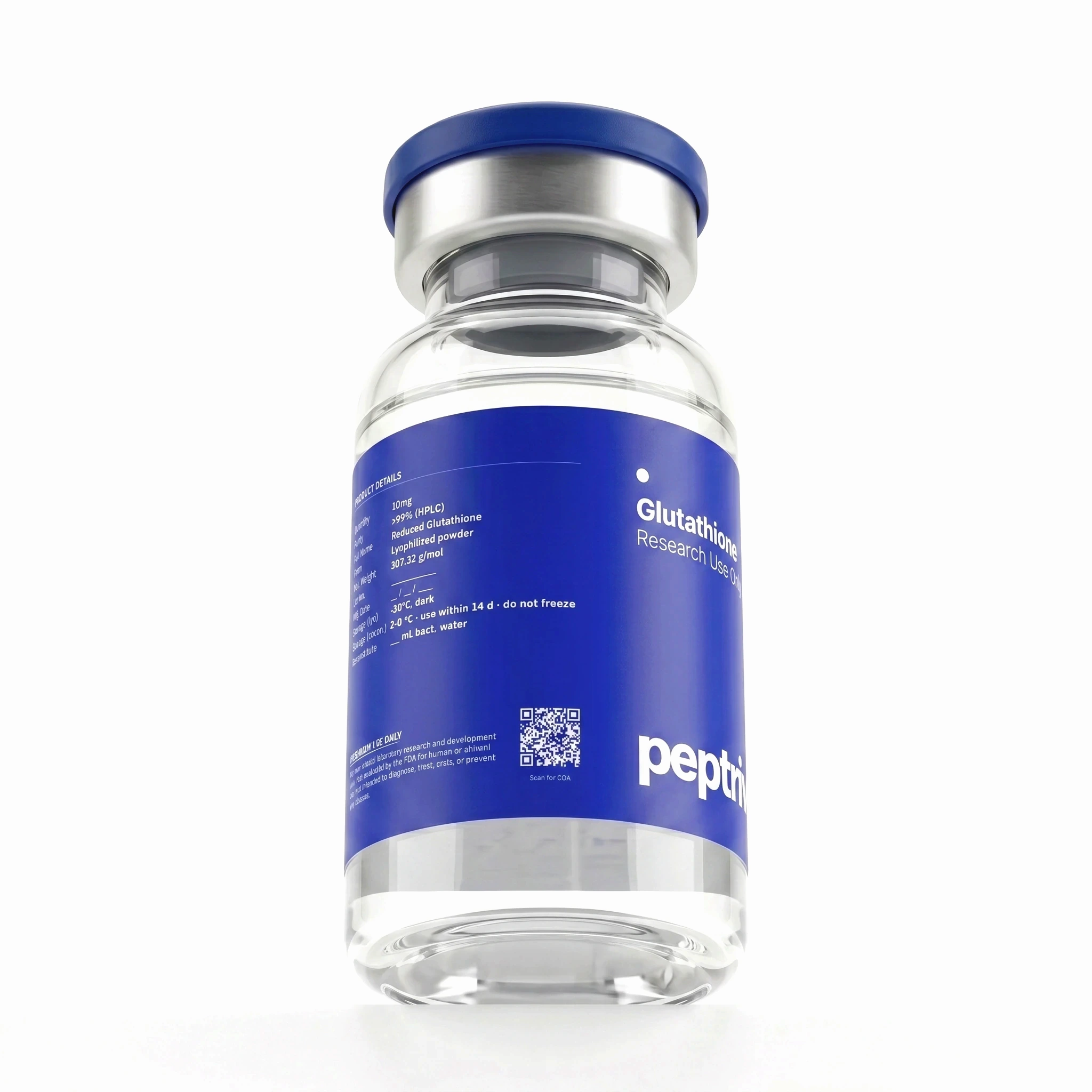
Glutathione
The reduced active tripeptide cited across the 2009 Forman review and the 2021 Wahab RCT. CAS 70-18-8, observed mass [M+H]+ 308.1, ≥99% HPLC purity, ISO 17025 third-party CoA on every lot.
Identity check: reduced GSH vs oxidized GSSG.
Two molecules go by the name "glutathione" on different labels. They're not interchangeable.
Reduced GSH has MW 307.32 and CAS 70-18-8. It is the biologically active form with the free cysteine thiol that performs the redox work. Oxidized GSSG has MW 612.63 and CAS 27025-41-8. It is the dimer formed when two GSH molecules join through a disulfide bond. GSSG serves as a reference standard for measuring the GSH/GSSG ratio in cells, but is not the appropriate compound for antioxidant or detoxification assays.
A CoA that lists "glutathione" without specifying reduced or oxidized is a critical gap. Don't accept it.
The unambiguous discriminator is mass-spec. An observed [M+H]+ at 308.1 confirms reduced GSH. An observed mass at 612.6 means the vial is GSSG. Ask for the trace.
Significant lightening was observed in the combination group on melanin index and L* score — modest, real evidence for topical and oral routes. The leap to intravenous administration that the cosmetic-medicine market has made is not supported by controlled trial data.
— integrated summary, Wahab et al., International Journal of Dermatology, 2021
Red flags specific to glutathione.
- Form not designated. Reduced GSH (MW 307.32) and oxidized GSSG (MW 612.63) are different molecules. A CoA without an explicit form designation is a critical gap.
- IV protocols marketed for skin whitening. This is the route with the Philippines FDA formal warning and US FDA warning letters. Documented Stevens-Johnson syndrome, hepatotoxicity, anaphylaxis, and reported deaths.
- Pre-reconstituted liquid GSH at room temperature. Reduced GSH oxidizes to GSSG in solution. The lyophilized form is what ships stably.
- "Injectable glutathione" without sterility documentation. Parenteral preparations require sterility, isotonicity, and pH control that grey-market manufacturing may not meet.
- Clinical skin-whitening claims on the product page. Vendors making these claims with IV protocols have crossed into FDA jurisdiction.
- Missing CAS 70-18-8, or mass-spec not matching 308.1. Wrong identity line, wrong mass: wrong molecule.
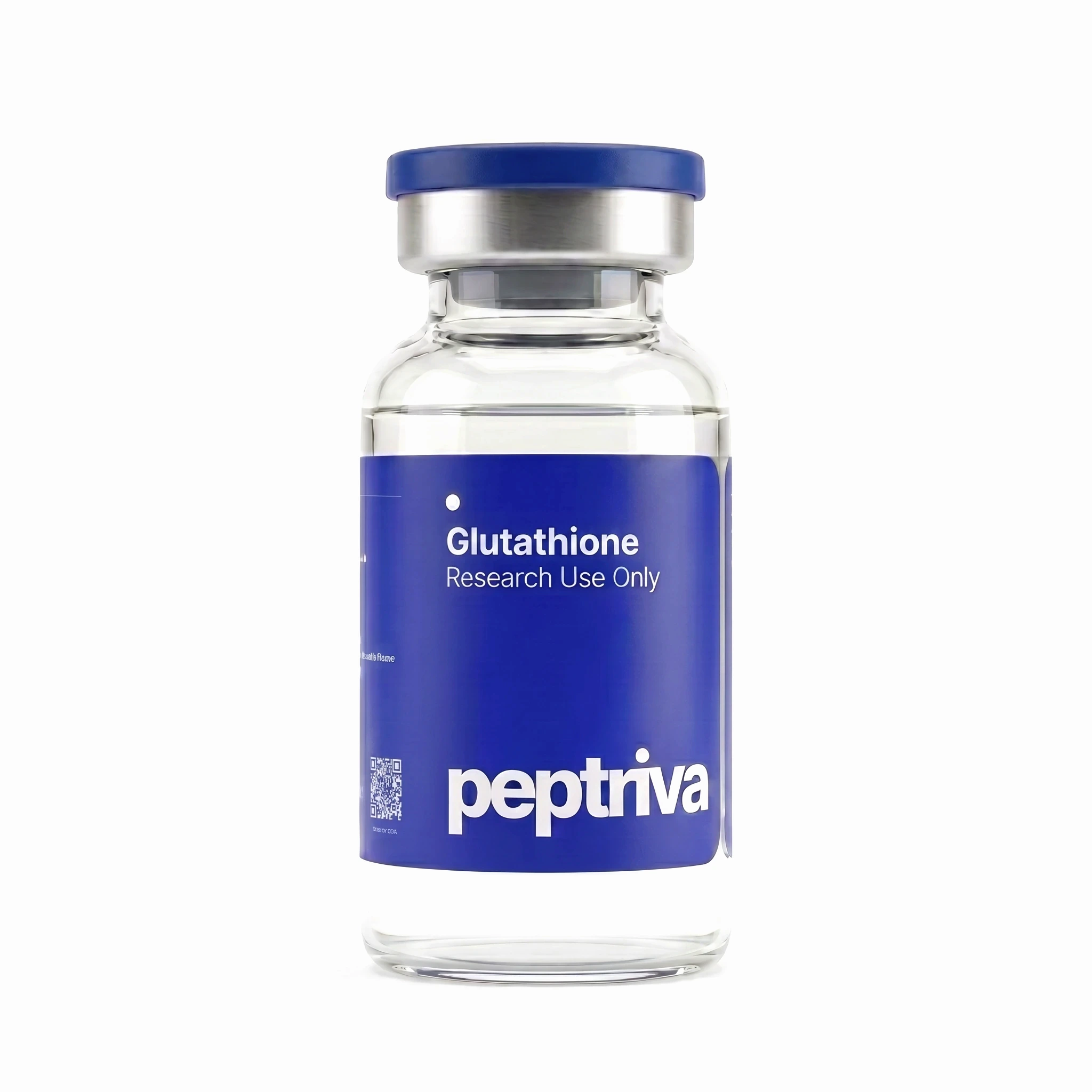
Glutathione
Reduced active form (GSH), CAS 70-18-8. The reference compound for cellular antioxidant assays, the GSH/GSSG redox-ratio biomarker, and the tyrosinase-inhibition mechanism cited in the Wahab 2021 RCT. COA with HPLC trace and mass-spec ships with every order.
Frequently asked questions.
Is glutathione legal to buy?
Reduced GSH is legal to buy and sell as a research reference compound. It's also legal as an oral dietary supplement under DSHEA. IV glutathione has no FDA approval for any indication. The US FDA has issued warning letters against unapproved IV GSH products. The Philippines FDA has issued formal advisories against IV GSH for skin whitening.
How does IV glutathione bioavailability compare to oral?
Bioavailability differs sharply by route. Oral GSH is largely hydrolyzed by gut gamma-glutamyltransferase before systemic absorption. Liposomal GSH modestly improves on that, though comparative PK data is limited. IV bypasses gut hydrolysis entirely — and is also the route against which the US FDA and Philippines FDA have issued formal warnings for serious adverse events. Research investigating intracellular GSH elevation has noted that NAC (the cysteine precursor) carries established oral pharmacokinetics and FDA-approved indications in distinct clinical contexts.
What does the research literature report on glutathione and skin pigmentation?
The tyrosinase-inhibition mechanism has been documented in the biochemical literature. The 2021 Wahab RCT (n=46) reported significant lightening on melanin index and L* score for the combined topical-plus-oral GSH arm versus monotherapy — representing modest controlled evidence for topical and oral routes. The IV protocols promoted in the cosmetic market are not supported by controlled blinded efficacy trials at the doses used in clinic settings, and the Philippines FDA and US FDA have issued formal warnings citing documented serious adverse events.
How much should research-grade glutathione cost?
2026 pricing: $30-$60 per gram bulk, $60-$80 per 1,500 mg vial at ≥99% purity. IV-clinic sessions bill $150-$400 on $20-$60 of material. Above $80 per gram is retail markup. Below $20 per gram raises form-and-purity questions.
What should a glutathione CoA show?
HPLC purity ≥99%. Mass-spec at observed [M+H]+ 308.1 (MW 307.32). CAS 70-18-8 on the identity line. Explicit reduced-form (GSH) vs oxidized-form (GSSG) designation. Karl Fischer water content, residual solvents per ICH Q3C, and bacterial endotoxin testing for parenteral-grade material. ISO/IEC 17025-accredited lab named on the report.
Glutathione vs NAC: which is the appropriate research reference compound?
Different molecules with different evidence bases. Glutathione (GSH, MW 307.32) is the tripeptide cofactor itself. N-acetylcysteine (NAC, MW 163.20) is the rate-limiting precursor. NAC carries FDA approvals for acetaminophen overdose and as a mucolytic, and published PK studies have characterized its oral absorption at 17–22%. For research into the GSH/GSSG redox cycle, GSH is the appropriate reference compound. For research into intracellular glutathione modulation via precursor supplementation, NAC has the established pharmacology and regulatory precedent in the published literature.
What to know now
- CAS 70-18-8, MW 307.32, observed [M+H]+ 308.1. The numbers a credible reduced-GSH CoA should show.
- $30-$80 per gram or per 1,500 mg vial. Industrial fermentation economics. Among the cheapest research reference compounds per milligram.
- Reduced GSH (MW 307.32) vs oxidized GSSG (MW 612.63) are different molecules. The CoA must explicitly designate the form.
- IV GSH for skin whitening carries Philippines FDA and US FDA warnings. Stevens-Johnson syndrome, hepatotoxicity, anaphylaxis, reported deaths.
- Oral GSH is largely hydrolyzed by gut gamma-glutamyltransferase. Bioavailability of intact tripeptide is low.
- NAC is the cysteine precursor with established oral pharmacokinetics and FDA-approved indications. Published research has investigated NAC as an indirect approach to intracellular GSH modulation.
What we're watching
The most important glutathione development to track is whether controlled blinded RCTs of IV GSH for skin whitening ever publish. The cosmetic-medicine market has built an industry on a route with zero efficacy RCTs at clinically relevant endpoints and documented serious adverse events at the doses promoted. Separately, the liposomal-GSH bioavailability literature continues to develop. A well-controlled crossover PK study comparing liposomal GSH against oral NAC at equivalent doses would provide comparative pharmacokinetic data across oral delivery strategies for GSH modulation research. The broader regulatory question — whether the US FDA escalates from warning letters to formal enforcement against unapproved IV glutathione — would also shift the IV-clinic landscape and the research community's sourcing context.
References
- Wahab, S., Anwar, A. I., Zainuddin, A. N., et al. (2021). Combination of topical and oral glutathione as a skin-whitening agent: A double-blind randomized controlled clinical trial. International Journal of Dermatology, 60(8), 1013–1018. https://doi.org/10.1111/ijd.15573
- Forman, H. J., Zhang, H., & Rinna, A. (2009). Glutathione: Overview of its protective roles, measurement, and biosynthesis. Molecular Aspects of Medicine, 30(1–2), 1–12. https://doi.org/10.1016/j.mam.2008.08.006
- Lu, S. C. (2013). Glutathione synthesis. Biochimica et Biophysica Acta — General Subjects, 1830(5), 3143–3153. https://doi.org/10.1016/j.bbagen.2012.09.008
- Zhang, Y., Chen, J., Lin, W., et al. (2025). Quantitative LC-MS/MS profiling of N-acetylcysteine in chicken plasma: Method validation and pharmacokinetic characterization. Poultry Science, 104(11), 105777. https://doi.org/10.1016/j.psj.2025.105777
- He, Y., Bu, Y., Chiang, C. F., et al. (2025). Multi-plant concentrated powder improved skin whitening: A double-blinded, randomized, and placebo-controlled clinical study. Journal of Cosmetic Dermatology, 24(2), e70011. https://doi.org/10.1111/jocd.70011
- U.S. Food and Drug Administration. (2023). Compounding and the FDA: Questions and Answers. https://www.fda.gov/drugs/human-drug-compounding/compounding-and-fda-questions-and-answers
- International Organization for Standardization. (2017). ISO/IEC 17025:2017 — General requirements for the competence of testing and calibration laboratories. https://www.iso.org/standard/66912.html