The glutathione skin-lightening market is one of the largest grey-market cosmetic-injection economies in the world. The market is built on biology that is partially real and a clinical evidence base that mostly is not.
Glutathione (GSH) is a real tripeptide and a real antioxidant. Its inhibition of tyrosinase (the rate-limiting enzyme of melanin production) gives a mechanistically plausible basis for skin lightening. The strongest controlled evidence is a 2021 RCT in 46 participants showing topical + oral GSH lowered melanin index versus placebo. The IV market has been the subject of formal regulatory warnings — including a Philippines FDA warning citing Stevens-Johnson syndrome, toxic epidermal necrolysis, hepatotoxicity, nephrotoxicity, anaphylaxis, and deaths. Honest framing: real molecule, partial mechanism, very small evidence base, serious safety warnings for the most-marketed route.
Glutathione really is a tripeptide — gamma-L-glutamyl-L-cysteinyl-glycine (γ-Glu-Cys-Gly). But functionally, it’s a redox cofactor, not a signaling peptide like most other entries in the peptide space. Its biology centers on scavenging reactive oxygen species, supporting glutathione peroxidase enzymes, and maintaining cellular redox balance. None of that has anything inherently to do with skin pigmentation.
The skin-lightening pathway is a side route. Glutathione inhibits tyrosinase, the rate-limiting enzyme in melanin synthesis. Reducing tyrosinase activity reduces melanin output. That mechanism is the conceptual foundation of the entire glutathione skin-whitening market and the starting point for evaluating the evidence.
What the tyrosinase biology actually predicts.
Melanin synthesis happens in melanocytes via the conversion of tyrosine to dopaquinone, catalyzed by tyrosinase. Tyrosinase activity is the rate-limiting step. Compounds that inhibit tyrosinase (hydroquinone, kojic acid, arbutin, certain peptides, glutathione) can reduce melanin output if they reach melanocytes at sufficient concentration. The field has decades of experience with topical tyrosinase inhibitors and a reasonable framework for what effect sizes look like.
What the mechanism does not automatically predict is large effects on overall skin tone from systemic administration of an antioxidant tripeptide that’s being rapidly degraded by gut enzymes or rapidly cleared after IV administration. The bridge between “inhibits tyrosinase in a tube” and “produces visible cosmetic lightening in a person” is where the marketing keeps overstating the evidence.
A 2025 review by He and colleagues in Journal of Cosmetic Dermatology studied a multi-plant antioxidant powder with glutathione peroxidase as one endpoint. The test compound wasn’t glutathione itself, but the design illustrates how the literature often uses glutathione-pathway biomarkers rather than direct glutathione measurements. That distinction matters when you read the literature. “Glutathione-pathway activity correlates with lightening” is not the same claim as “exogenous glutathione produces lightening.”
What the controlled human evidence shows.
The strongest piece of controlled human evidence for glutathione skin lightening is the 2021 Wahab et al. RCT in International Journal of Dermatology published from a research group in Indonesia. The design enrolled 46 participants in a double-blind randomized comparison of topical + oral GSH combination versus topical or oral monotherapy over 8 weeks. The headline results:
- The combination group showed significantly lower melanin index than placebo at endpoint.
- The combination group showed significantly higher L* (skin lightness) score than placebo.
- The combination was superior to either monotherapy.
The authors’ bottom line — “topical and oral glutathione were effective skin-lightening agents” — is the most-cited conclusion in modern glutathione lightening literature. It’s also worth reading carefully. The trial was small (n=46), single-center, in a specific population, with a short follow-up window. The effect sizes, while statistically significant, were modest compared to standard depigmenting agents like hydroquinone.
The combination of topical and oral glutathione was effective at producing measurable skin-lightening outcomes versus placebo over the trial duration. The effect was incremental rather than dramatic; participants in the combination group did not become uniformly lighter than baseline observers would have predicted.
— paraphrased summary of Wahab et al., Int J Dermatol, 2021
That’s the entire load-bearing modern controlled evidence. There are observational data, small case series, and clinic-reported outcomes from cosmetic-dermatology practice. But the controlled-trial RCT base for glutathione as a depigmenting agent (the way hydroquinone or laser therapy is) is one positive small trial. Not zero. Not large. One.
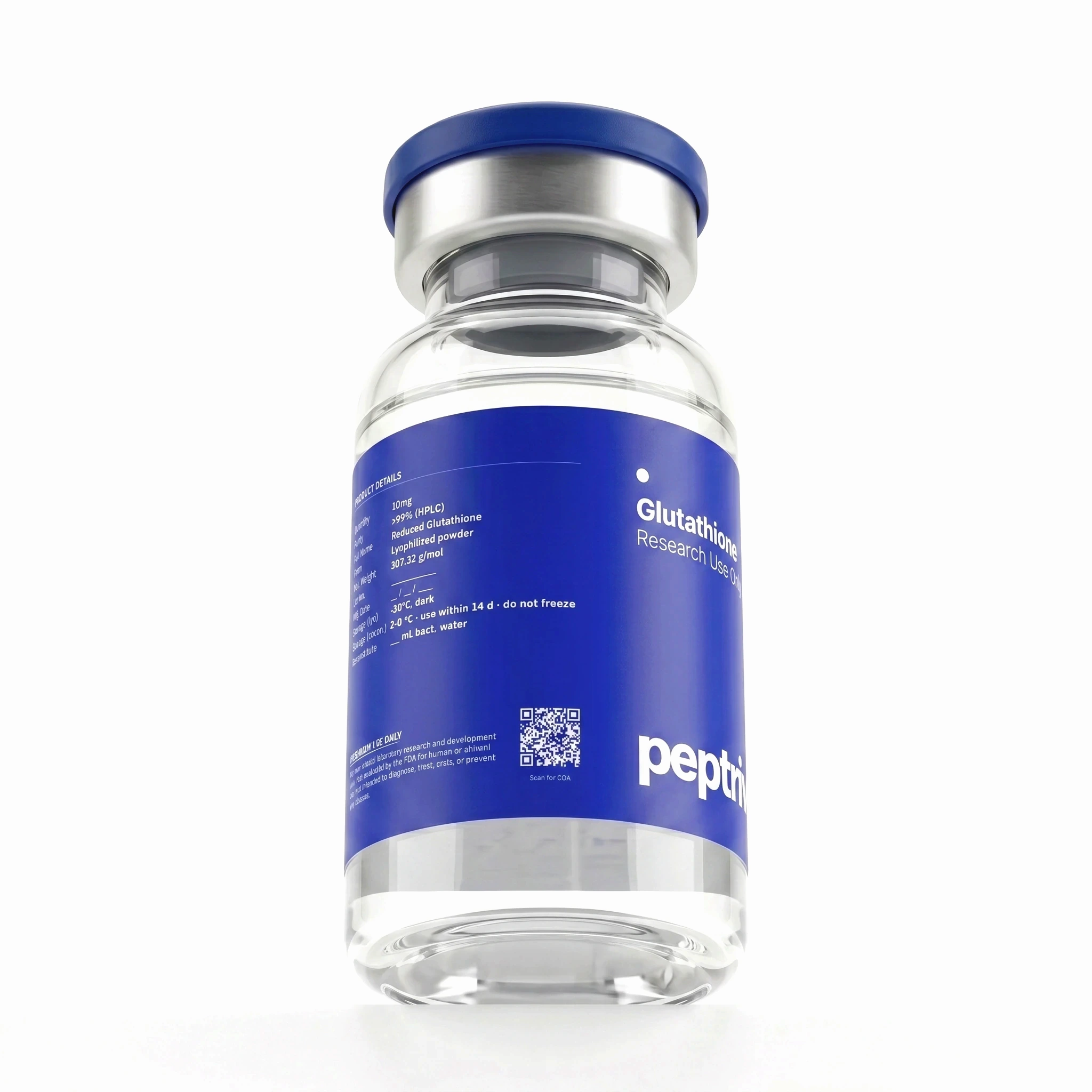
Glutathione
The same compound referenced across the cited tyrosinase-pathway and skin-lightening studies. Lab-verified identity and purity.
What about IV glutathione?
This is where the marketing and the regulatory record diverge sharply. The IV glutathione skin-whitening market is the dominant commercial form of the cosmetic claim, particularly in the Philippines, Thailand, Indonesia, India, and other markets with cultural premiums on lighter skin tone. Per-session pricing, multi-session protocols, and the volume of providers all reflect a multi-billion-dollar market.
The clinical reality is that IV glutathione for skin whitening has formal regulatory warnings due to documented serious adverse events. The Philippines FDA has issued formal warnings citing reports of:
- Stevens-Johnson syndrome. A severe skin reaction with widespread epidermal detachment, requiring intensive care and with significant mortality.
- Toxic epidermal necrolysis (TEN). The more severe end of the Stevens-Johnson spectrum, with mortality rates that can exceed 30%.
- Hepatotoxicity and nephrotoxicity. Acute liver and kidney injury from IV GSH.
- Anaphylactic reactions. Severe immediate hypersensitivity to IV preparations.
- Loss of skin barrier function. Reported in chronic IV GSH cosmetic-use cases.
- Death. Documented in case reports across multiple jurisdictions.
The US FDA has also issued warnings about unapproved IV glutathione products, particularly for cosmetic skin-whitening use. Zero major Western regulators have approved IV glutathione for skin lightening. The cosmetic use is, by definition, off-label use of a tripeptide with documented capacity for serious adverse reactions when injected.
Where this falls short. The IV route summary, in one block: the Philippines FDA has issued formal warnings against IV glutathione for skin whitening, citing Stevens-Johnson syndrome, toxic epidermal necrolysis, kidney injury, liver injury, anaphylaxis, and death. The US FDA has issued similar warnings about unapproved IV products. No medical condition requires intravenous glutathione for lightening. The risk-benefit calculation doesn’t support a route with documented serious adverse events for a non-medical cosmetic outcome.
What about oral glutathione?
Oral glutathione has the opposite problem from IV. It is much safer but pharmacologically harder to make work. Glutathione is rapidly hydrolyzed by gut peptidases (especially gamma-glutamyltransferase) to its constituent amino acids. Oral bioavailability of intact tripeptide GSH is poor.
GSH is biosynthesized from cysteine, glutamate, and glycine, with cysteine as the rate-limiting substrate. Oral cysteine supplementation (or, more typically, N-acetylcysteine / NAC) raises intracellular GSH more efficiently than oral GSH itself, because the intact tripeptide is largely degraded before absorption.
That bioavailability problem is the reason NAC has the established pharmacology oral GSH does not. NAC has been FDA-approved for over 50 years for acetaminophen overdose and as a mucolytic. NAC raises intracellular GSH by providing the rate-limiting cysteine substrate, and its bioavailability is far better than oral GSH’s. From a pharmacological perspective, oral NAC is the better-characterized route for raising systemic glutathione status.
A 2025 veterinary pharmacokinetic study by Zhang et al. in Poultry Science characterized oral NAC bioavailability in chickens at 17–22%, with rapid absorption. The principle — that high oral doses are needed for clinical effect — applies in humans too.
Whether oral GSH itself produces a cosmetically meaningful lightening effect rests on the Wahab 2021 trial, where topical + oral was the active arm. The design does not permit clean separation of the topical contribution from the oral contribution — which is one reason the topical-only and oral-only arms showed smaller effects than the combination.
What about the cultural framing?
An honest discussion can’t skip the cultural framing. The global market for skin-whitening cosmetics is concentrated in specific regions where lighter skin tone carries social, economic, and marital premiums. Public-health researchers and dermatologists in those regions have written extensively about this. The IV-glutathione market is one part of a much larger ecosystem (topical bleaching agents, hydroquinone formulations, kojic acid products, “glutathione drips”) that the WHO and regional regulators track.
Saying that out loud is not moralizing. It is acknowledging that the “does glutathione lighten skin” question does not fully capture what the market actually is. The regulatory record tracks this market closely; the IV route carries serious safety warnings; and the controlled evidence for the cosmetic effect consists of one small RCT plus observational data.
Glutathione
Reduced form (γ-Glu-Cys-Gly) for in-vitro redox research. The same reference compound referenced in the cited tyrosinase-pathway studies. COA available with each lot.
What the evidence supports, by route.
The evidence-based picture differs substantially by administration route.
Topical glutathione, studied as a cosmetic ingredient at concentrations consistent with mainstream skincare formulations, has a modest controlled-evidence signal supporting incremental lightening and an acceptable safety profile based on the published literature.
Oral glutathione presents a bioavailability challenge. Published pharmacokinetic research indicates NAC is a better-characterized oral route for raising systemic GSH, given superior bioavailability of the cysteine precursor compared to the intact tripeptide.
Intravenous glutathione for cosmetic skin whitening has been the subject of formal FDA and Philippines FDA warnings citing serious adverse events. The published regulatory and safety record does not support this route for cosmetic applications.
Researchers and clinicians evaluating the glutathione skin-lightening literature have identified several key methodological questions in the published evidence base:
- Route and bioavailability. Topical administration has the strongest controlled evidence; IV administration is associated with the most serious documented adverse events.
- Outcome measurement. Studies that have used objective endpoints — melanin index and L* score — have yielded more reproducible findings than those relying on subjective assessment.
- Comparator context. Standard depigmenting agents (hydroquinone, kojic acid, retinoids, laser therapy) have larger and more replicated evidence bases than glutathione for most specific pigmentary indications.
- Indication specificity. Melasma, post-inflammatory hyperpigmentation, and general tone reduction have distinct first-line treatment pathways in the published dermatology literature.
- Regulatory record. The Philippines FDA and US FDA documents on IV glutathione are publicly available primary sources for researchers reviewing the safety profile.
What to know now
- Mechanism: glutathione inhibits tyrosinase, the rate-limiting enzyme of melanin synthesis. Biologically plausible basis for lightening.
- Controlled evidence: Wahab 2021 RCT (n=46) is the strongest single piece. Topical-plus-oral combination over placebo with modest effect sizes.
- IV route: formal Philippines FDA warning and US FDA warnings. Stevens-Johnson syndrome, toxic epidermal necrolysis, hepatotoxicity, nephrotoxicity, anaphylaxis, and deaths reported.
- Oral bioavailability: poor. Intact tripeptide is rapidly hydrolyzed by gut enzymes. NAC is the better-validated route for raising systemic GSH.
- Standard agents: hydroquinone, kojic acid, retinoids, and laser therapy have stronger evidence than glutathione for specific pigmentary concerns.
- Cultural framing: the global IV-glutathione market sits inside a larger skin-whitening commercial ecosystem that public-health and regulatory bodies track closely.
What we’re watching
Three things over the next 24 months. First, whether a methodologically larger RCT of topical glutathione for a defined concern (melasma, post-inflammatory hyperpigmentation) is published. The Wahab 2021 trial is the right starting point, but a larger replication would meaningfully change the evidence base. Second, whether the US FDA escalates enforcement against unapproved IV glutathione products marketed for skin whitening. The warnings exist but enforcement varies. Third, whether public-health bodies in the Philippines, India, Indonesia, and other high-volume markets expand consumer education around IV-glutathione safety risks.
References
- Wahab, S., Anwar, A. I., Zainuddin, A. N., et al. (2021). Combination of topical and oral glutathione as a skin-whitening agent: A double-blind randomized controlled clinical trial. International Journal of Dermatology, 60(8), 1013–1018. https://doi.org/10.1111/ijd.15573
- He, Y., Bu, Y., Chiang, C. F., et al. (2025). Multi-plant concentrated powder improved skin whitening: A double-blinded, randomized, and placebo-controlled clinical study. Journal of Cosmetic Dermatology, 24(2), e70011. https://doi.org/10.1111/jocd.70011
- Xie, Y., Zhu, G., Yi, J., et al. (2021). A new product of multi-plant extracts improved skin photoaging: An oral intake in vivo study. Journal of Cosmetic Dermatology, 21(8), 3406–3415. https://doi.org/10.1111/jocd.14620
- Zhang, Y., Chen, J., Lin, W., et al. (2025). Quantitative LC-MS/MS profiling of N-acetylcysteine in chicken plasma: Method validation and pharmacokinetic characterization. Poultry Science, 104(11), 105777. https://doi.org/10.1016/j.psj.2025.105777