Epithalon is the most heavily marketed peptide in consumer “anti-aging”, and one of the most evidence-uneven. A single Russian lab has produced roughly 75% of the efficacy literature. Zero modern Western controlled trials exist. Where to buy epithalon in 2026 comes down to three things: verify the four-amino-acid identity on the Certificate of Analysis, find a vendor honest about the single-source evidence base, and don’t pay longevity-marketing premium for what’s a cheap peptide to make.
Epithalon (also spelled epitalon) is a 4-amino-acid peptide with the sequence Ala-Glu-Asp-Gly (AEDG). Look for CAS number 307297-39-8 and molecular weight 390 g/mol on the CoA. The Khavinson group in Saint Petersburg developed it in the 1990s from a pineal-gland extract. It’s legal to buy as a research compound and isn’t FDA-approved. Expect to pay $60–$100 per 10 mg vial or $100–$150 per 20 mg vial. The big caveat: most of the human evidence comes from one Russian lab and hasn’t been replicated under Western trial standards.
Quick answer: Pay $60–$150 per vial depending on size. Demand a CoA from an ISO 17025 lab (an international testing-quality standard) showing HPLC purity above 98%, mass-spec at 391.2, and water under 8%. The chemistry is simple, so unusually high prices reflect marketing premium, not synthesis cost. Treat the Khavinson clinical literature as Russian clinical practice, not Western trial-grade data.
What you’re actually buying
Epithalon’s sequence is four amino acids: Ala-Glu-Asp-Gly (AEDG). The Khavinson group synthesized it in the 1990s based on the amino-acid composition of epithalamin, a bovine pineal-gland extract they’d been working with since the 1970s.
The play was simple. Take an active extract. Reduce its bioactivity down to the smallest peptide fragment that still worked. That fragment turned out to be a four-amino-acid sequence you could synthesize at scale (Araj et al., 2025).
The research lineage is real and deep. The cell-culture evidence base supporting consumer marketing is narrower than that lineage suggests. A vendor parroting Khavinson efficacy claims without acknowledging the single-source story is either uninformed or selling marketing. For the full evidence walk-through, see our complete epithalon guide and telomerase mechanism article.
Four buyer checks for epithalon
The general eight peptide-buyer criteria all apply. These four matter more for epithalon:
1. The CoA must show CAS 307297-39-8 and mass-spec at 391.2
The four-amino-acid sequence is unambiguous to a peptide chemist. But the synthesis simplicity creates a counterintuitive risk: epithalon is one of the easiest peptides on the market to fake. Crude or partially purified material can pass casual inspection.
A credible CoA shows:
- Sequence Ala-Glu-Asp-Gly on the identity line.
- CAS 307297-39-8.
- Mass-spec at observed [M+H]+ 391.2, within 0.3 Da of the theoretical 390.4 g/mol.
Cross-check the CAS against PubChem in 30 seconds. Missing CAS, missing sequence, or wrong mass means the wrong molecule.
2. The Western trial base is thin
Vendor marketing copy is itself a signal. The honest framing is straightforward: real cell-culture biology exists, mostly from the Khavinson group, with one important independent confirmation from Brunel University London in 2025 (Al-Dulaimi et al., 2025). Russian-language clinical literature exists but hasn’t been replicated under Western methodology. Zero modern Western controlled trials have been published.
Vendors making strong human-efficacy claims — “telomere extension in humans,” “clinically proven aging reversal” — are either unaware of the evidence base or copying marketing that doesn’t track it. Either way, look elsewhere.
3. Pricing should match the chemistry, not the marketing
Four amino acids, no modifications, well-established synthesis route. Epithalon is one of the lowest-cost research peptides to make. The 2026 retail bands:
- 10 mg vial: $60–$100 ($6–$10 per mg).
- 20 mg vial: $100–$150 ($5–$7.50 per mg).
- 50 mg vial: $130–$170 ($2.60–$3.40 per mg). Best per-mg value.
- Multi-vial tiers: 10–25% off for 3- or 6-pack orders.
Above $200 per 20 mg is longevity-marketing premium, not chemistry. “Biohacking”-positioned vendors often price 2–3x above the synthesis-anchored range. The four-amino-acid chemistry doesn’t support that markup.
Below $40 per 10 mg deserves a question in the other direction. HPLC purification has a real cost, and the cheap end usually skips it.
4. “Russian-sourced” or “Khavinson-grade” is marketing language
Most authentic epithalon in the Western research market comes from Chinese custom-peptide manufacturers synthesizing against the published AEDG sequence. There’s no Khavinson-affiliated Russian supply chain exporting to Western buyers. The Russian regulatory framework under which Khavinson peptides are clinically prescribed does not extend to research-grade export.
Vendors using “Russian-sourced” positioning aren’t describing a real supply-chain difference. They’re using marketing language. What matters is whether the four-amino-acid identity is verified by mass-spec on a third-party CoA.
Where this falls short: The 2025 Brunel paper that confirmed normal-cell telomerase activation also flagged something rarely discussed in consumer marketing: epithalon activates the ALT pathway in cancer cells. ALT (Alternative Lengthening of Telomeres) is a backup telomere-maintenance pathway some cancers exploit to survive. The cancer-cell finding raises theoretical concerns about telomere extension in cells you don’t want to keep alive. The headline is real biology, in either direction. Buy epithalon for in-vitro research, not as a validated longevity therapeutic.
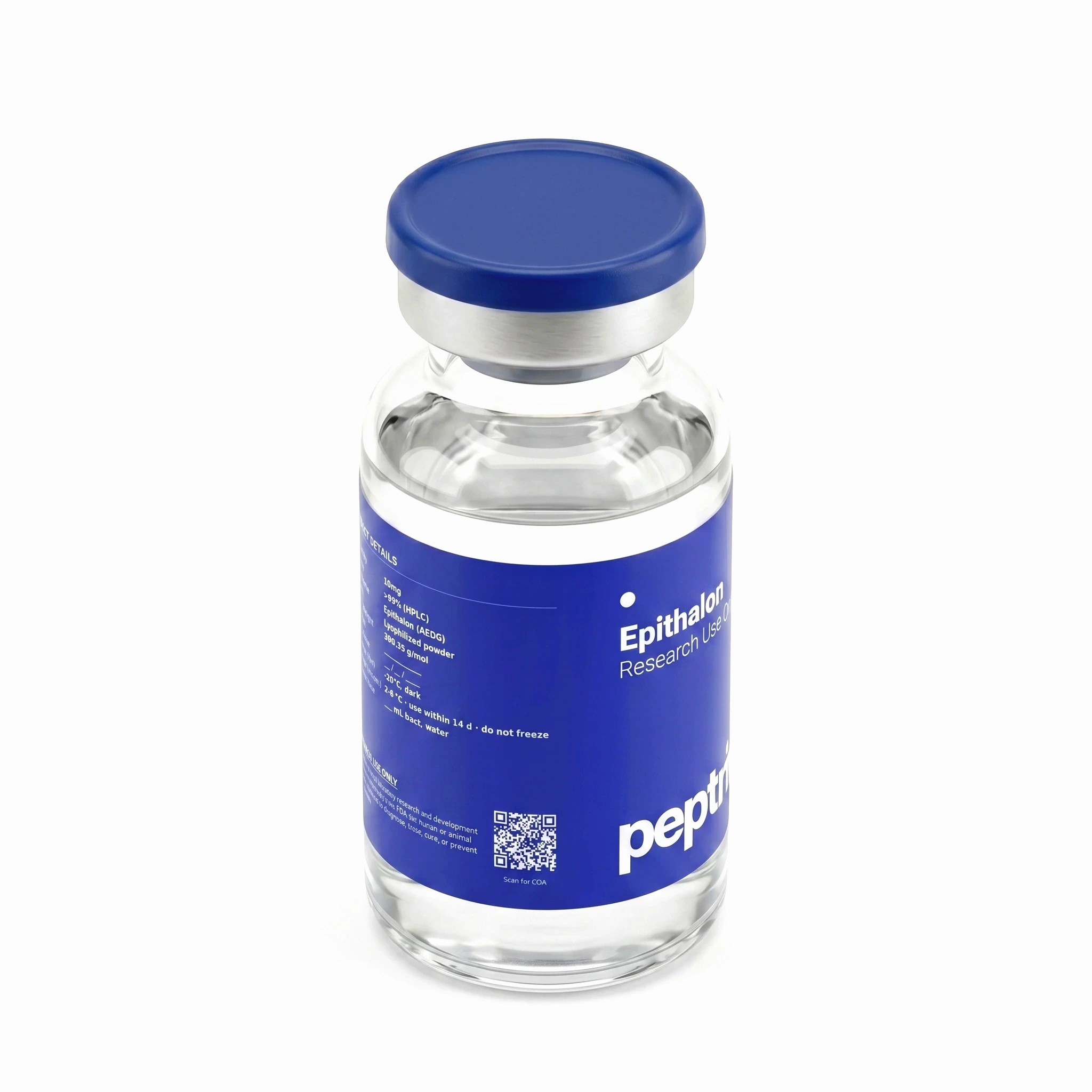
Epithalon
The four-residue Ala-Glu-Asp-Gly (AEDG) tetrapeptide cited across the 2025 25-year AEDG review and the 2025 Brunel telomerase paper. CAS 307297-39-8, observed mass [M+H]+ 391.2, ≥99% HPLC purity, ISO 17025 third-party CoA on every lot.
Is epithalon legal to buy?
Yes, as a research reference compound. Epithalon isn’t FDA-approved for any therapeutic use. It isn’t recognized as a drug in the U.S. There’s no 503A compounding categorization either — the FDA has effectively treated it as a non-issue because the molecule has no FDA-engaged sponsor and no compounding-pharmacy interest. The practical picture:
- Research-compound sales are legal under 21 CFR § 809.10(b)(9) Research Use Only labeling.
- Sales for human consumption are illegal. That would be an unapproved drug entering interstate commerce.
- EMA hasn’t approved epithalon for any indication.
- Russia uses epithalon and related Khavinson peptides clinically under a different regulatory framework.
- WADA hasn’t listed epithalon as prohibited as of 2026, but the broader peptide-bioregulator category is increasingly monitored.
Red flags specific to epithalon
Nine warning signs we’d skip:
- “Telomere extension proven in humans” or “clinically proven anti-aging.” No modern Western trial supports these claims.
- “Russian-sourced” or “Khavinson-grade” positioning. No Khavinson-affiliated supply chain exports to the Western market. Marketing language.
- “Epithalon Plus”, “Advanced”, or “Pineal Complex” variants. Anything without a disclosed structural change isn’t the published AEDG sequence.
- Missing CAS 307297-39-8 on the CoA. The CAS is the molecule’s ID. Its absence is a critical gap.
- Mass-spec result not at 391.2. Wrong mass means wrong molecule.
- Pre-mixed liquid at room temperature. Powder survives shipping. Liquid degrades fast.
- Capsules, sublingual sprays, or patches. None validated in any published study.
- Clinical claims about cancer prevention or treatment. Especially concerning given the 2025 Brunel ALT-activation finding in cancer cells.
- Vendor’s in-house QC instead of third-party testing. Independent ISO 17025 verification is the standard.
Epithalon
Ala-Glu-Asp-Gly tetrapeptide, CAS 307297-39-8. The same reference compound used across the cited cell-culture studies and the Khavinson-group mechanistic literature. COA with HPLC trace and mass-spec ships with every order.
Frequently asked questions
Is epithalon legal to buy in the USA?
Yes, as a research reference compound under 21 CFR § 809.10(b)(9). It’s not FDA-approved and not recognized as a drug. Selling for human consumption is illegal. Buying as research material isn’t. Unlike BPC-157, epithalon has no FDA 503A categorization. WADA hasn’t listed it as prohibited.
How much should research-grade epithalon cost?
$60–$100 for a 10 mg vial, $100–$150 for 20 mg, $130–$170 for 50 mg. Below that range, purity is the trade-off. Above it, you’re paying longevity-marketing premium instead of synthesis cost.
Does epithalon actually extend human lifespan?
No modern Western trial has shown that. The lifespan claims trace to Russian-language reports from the Khavinson group, which haven’t been replicated under Western methodology and aren’t in PubMed. The 2025 Brunel paper independently confirmed telomerase activation in normal cells, but cell-culture activation isn’t validated human lifespan extension. The same paper flagged ALT-pathway activation in cancer cells.
How credible are the Khavinson Russian aging trials?
The Khavinson group has published Russian-language clinical reports on epithalon in elderly cohorts since the 1980s. They claim mortality reduction and age-related disease improvements. The studies ran under the Russian regulatory framework, which has different approval standards than FDA or EMA. The papers are largely not indexed in PubMed and not accessible in English. Real Russian clinical experience exists. Western replication doesn’t. After several decades, that absence is itself a signal. See our epithalon Russian aging trials article.
How does the telomerase mechanism work?
AEDG is proposed to boost hTERT mRNA and telomerase activity, which extends telomeres in normal cells. The 2025 Brunel paper reported dose-dependent extension in normal epithelial cells and fibroblasts. It also flagged ALT-pathway activation in two breast cancer cell lines (21NT and BT474). The cancer-cell finding raises theoretical concerns consumer marketing rarely discusses.
How should epithalon be stored?
Store the freeze-dried powder at −20°C for long-term storage. It’s stable at 2–8°C for shorter periods. After reconstitution in bacteriostatic water, in-use stability at 2–8°C is 1–4 weeks. The four-amino-acid sequence is more stable than longer peptides but should still be protected from light and freeze-thaw cycles.
What to know now
- CAS 307297-39-8, MW 390.4, observed [M+H]+ 391.2. The numbers a credible CoA shows.
- $60–$150 per vial depending on size. Four amino acids with no modifications keeps synthesis cheap.
- Single-source evidence is the dominant caveat. ~75% of efficacy literature traces to the Khavinson group. Western replication doesn’t exist.
- The 2025 Brunel paper is the key independent reference. Confirmed normal-cell telomerase activation. Also flagged cancer-cell ALT activation.
- No FDA 503A categorization. Unlike BPC-157, never reviewed. Research-compound legal, human-use illegal.
- “Russian-sourced” or “Khavinson-grade” is marketing language. No Russian supply chain exports to Western buyers.
- Lyophilized powder is the form used across the published literature. Capsule and spray formulations have not been used in published studies.
What we’re watching
The big signal: whether any Western group ever runs a controlled trial of epithalon for a specific aging-relevant outcome — cognitive function, sleep quality, frailty measures, or peripheral telomere length in elderly cohorts. That’s the missing piece in the clinical-evidence story, and the absence has persisted for decades. We’re also watching follow-up to the 2025 Brunel cancer-cell ALT finding: whether other independent groups replicate it, and whether in-vivo implications get characterized. Until that body of work exists, epithalon stays what it is: a real cell-culture biology compound whose human-evidence story rests entirely on Russian clinical practice that hasn’t been validated outside Russia.
References
- Araj, S. K., Brzezik, J., Mądra-Gackowska, K., & Szeleszczuk, Ł. (2025). Overview of epitalon — Highly bioactive pineal tetrapeptide with promising properties. International Journal of Molecular Sciences, 26(6), 2691. https://doi.org/10.3390/ijms26062691
- Al-Dulaimi, S., Thomas, R., Matta, S., & Roberts, T. (2025). Epitalon increases telomere length in human cell lines through telomerase upregulation or ALT activity. Biogerontology, 26(5), 178. https://doi.org/10.1007/s10522-025-10315-x
- Yue, X., Liu, S. L., Guo, J. N., et al. (2022). Epitalon protects against post-ovulatory aging-related damage of mouse oocytes. Aging (Albany NY), 14(7), 3191–3202. https://doi.org/10.18632/aging.204007
- Ullah, S., Haider, Z., Perera, C. D., et al. (2025). Epitalon-activated telomerase enhances bovine oocyte maturation rate and post-thawed embryo development. Life Sciences, 362, 123381. https://doi.org/10.1016/j.lfs.2025.123381
- Khavinson, V., Diomede, F., Mironova, E., et al. (2020). AEDG peptide (epitalon) stimulates gene expression and protein synthesis during neurogenesis: Possible epigenetic mechanism. Molecules, 25(3), 609. https://doi.org/10.3390/molecules25030609
- U.S. Food and Drug Administration. (2024). Research Use Only labeling under 21 CFR § 809.10(b)(9). https://www.ecfr.gov/current/title-21/chapter-I/subchapter-H/part-809/subpart-B/section-809.10
- International Organization for Standardization. (2017). ISO/IEC 17025:2017 — General requirements for the competence of testing and calibration laboratories. https://www.iso.org/standard/66912.html