There are two molecules sold under the name CJC-1295, and they aren’t the same drug. One has a 30-minute half-life. The other lasts 6–8 days. The difference is a small chemical add-on called DAC. If a vendor labels a vial just “CJC-1295” without telling you which form you’re getting, that’s the first red flag. We’ll walk you through the rest.
CJC-1295 mimics the body’s growth-hormone-releasing hormone. Two forms exist. No-DAC, also called Modified GRF 1-29, has a 30-minute window of action. DAC adds a chemical linker that binds blood albumin and stretches the window to 6–8 days. The DAC program shut down in 2007. Pay $50–$100 per 5 mg for no-DAC and $80–$150 per 5 mg for DAC. WADA bans both. The common buying mistake: grabbing a vial labeled only “CJC-1295.”
Quick answer: Pay $50–$150 per vial. Confirm the label says “no-DAC” or “DAC” explicitly. Demand a Certificate of Analysis (CoA) from an ISO 17025 lab (an international testing-quality standard) with HPLC purity above 98% and a mass-spec result matching the variant. For no-DAC, that’s 3367.9 g/mol.
What you’re actually buying
CJC-1295 mimics the first 29 amino acids of human growth-hormone-releasing hormone — the brain signal that triggers GH pulses. ConjuChem developed it in the early 2000s as a once-weekly drug candidate (Rahman et al., 2026).
It activates the GH pathway in the pituitary. It does not bind the ghrelin pathway — that’s ipamorelin’s job. That’s why researchers stack the two together rather than choose one.
The thing that decides which CJC-1295 you have is the DAC group. DAC stands for Drug Affinity Complex. It’s a small chemical linker that covalently bonds to albumin in your blood (Memdouh et al., 2021). Albumin acts like a slow-release shuttle. Once the peptide is bound to it, the kidneys can’t filter it out fast.
- No-DAC (Modified GRF 1-29): 29 amino acids, half-life ~30 minutes, produces natural GH pulses.
- DAC: 30 amino acids plus the linker, half-life 6–8 days, produces sustained GH elevation.
Four buyer checks for CJC-1295
The general eight peptide-buyer criteria all apply. These four matter more for CJC-1295:
1. The label must say DAC or no-DAC
This is the single most important check. The vial and the CoA both have to tell you which variant you bought. No-DAC has CAS number 863288-34-0. DAC has a separate CAS registration.
A vendor selling “CJC-1295” without disambiguating is failing the most basic identity disclosure. Walk away.
2. The discontinuation history matters
ConjuChem halted CJC-1295 DAC clinical development around 2007. Public reporting attributes the decision in part to broader scrutiny of ConjuChem’s DAC pipeline after a fatal adverse event in a separate trial of CJC-1131, a different DAC-modified peptide.
The program was never revived. CJC-1295 has no current pharmaceutical sponsor. A vendor making clinical claims (“treats GH deficiency,” “reverses aging”) is in FDA enforcement territory.
3. Mass-spec must match the variant
For no-DAC, the theoretical mass is 3367.9 g/mol. The formula is C152H252N44O42. Peptides this big usually show up in mass-spec as multi-charge ions: observed [M+2H]2+ near 1684.9, or [M+3H]3+ near 1123.6. The calculated neutral mass should land at 3367.9 within standard tolerance.
The DAC variant has a different molecular weight because the linker adds mass. A CoA that reports 3367.9 for a vial labeled DAC is internally inconsistent — don’t buy from that vendor.
4. Storage and shipping are unforgiving
CJC-1295 ships lyophilized (freeze-dried) and stores at −20°C long-term. Once you reconstitute it, the no-DAC form has a usable window of about 30 days refrigerated at 2–8°C. That’s shorter than BPC-157 because CJC-1295 degrades faster in solution.
Vendors who sell pre-mixed liquid at room temperature are selling a product with a shelf life measured in days. The powder is what ships reliably.
Where this falls short: The published CJC-1295 evidence is thinner than vendors imply. Recent (2020–2026) PubMed literature is dominated by anti-doping detection methods, not efficacy trials. The DAC clinical program halted in 2007 and never produced a Phase III readout. There’s a small 2026 mouse-model paper on the CJC-1295 + ipamorelin stack reducing glucocorticoid-induced muscle loss, but no controlled human study has confirmed it. Buy CJC-1295 for what it is: a research GHRH analog with a stalled clinical history and a strong WADA detection profile.
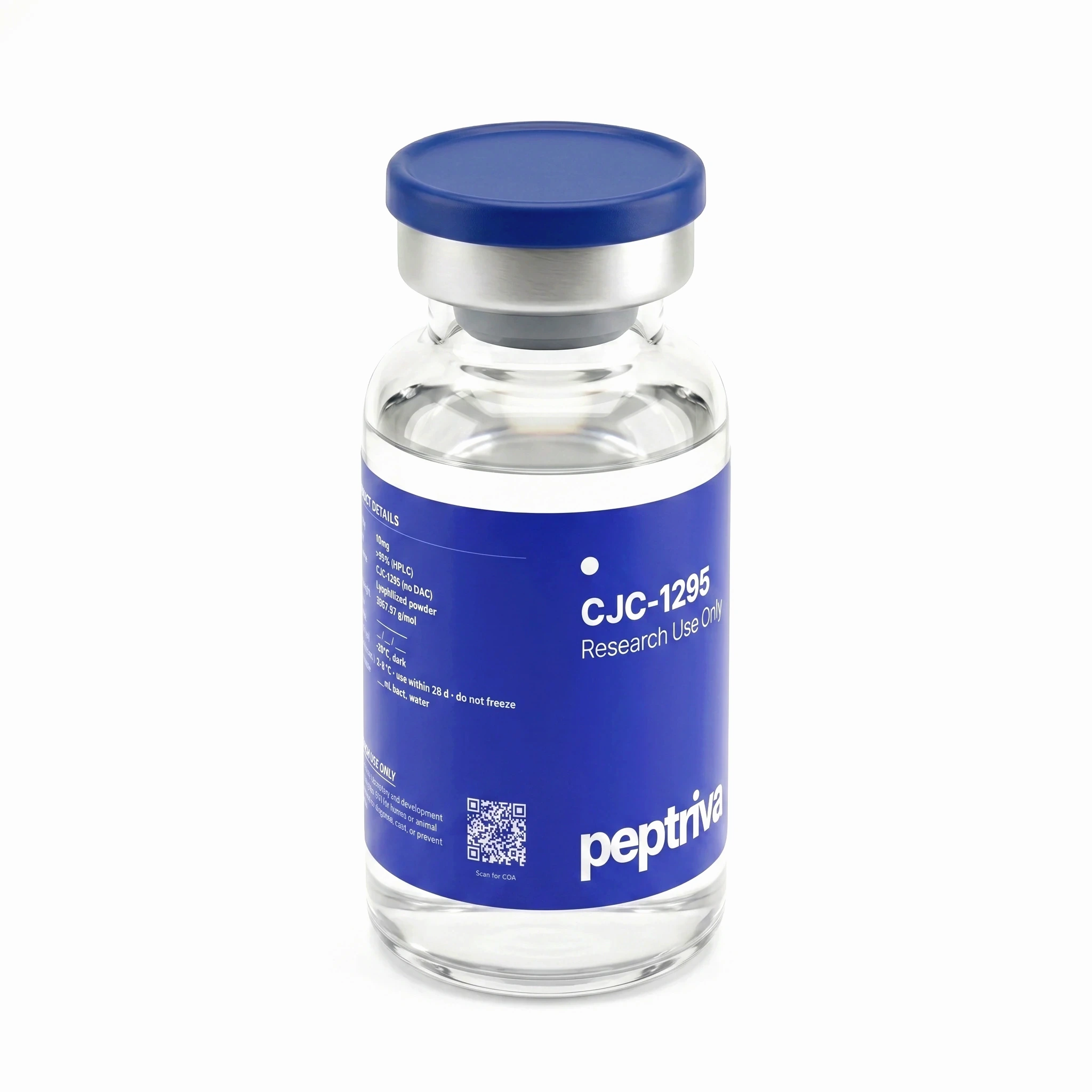
CJC-1295 (no DAC)
The no-DAC variant cited across the 2021–2024 anti-doping detection literature including Memdouh et al., 2021 and the 2026 JAAOS therapeutic peptides review. CAS 863288-34-0, MW 3367.9 g/mol, ≥99% HPLC purity, ISO 17025 third-party CoA on every lot.
2026 pricing benchmarks
CJC-1295 sits in the middle of the research-peptide cost curve. It’s longer than BPC-157 (15 aa) but shorter than tesamorelin (44 aa). The DAC modification adds synthesis cost on top of the no-DAC form. Research-grade retail in 2026:
- No-DAC, 5 mg vial: $50–$100 ($10–$20 per mg). Standard retail size.
- No-DAC, 10 mg vial: $80–$150 ($8–$15 per mg). Better per-mg value.
- DAC, 5 mg vial: $80–$150 ($16–$30 per mg). The conjugation step adds complexity.
- DAC, 10 mg vial: $130–$220 ($13–$22 per mg). Less commonly stocked.
- Multi-vial tiers: 10–25% off for 3- or 6-pack orders.
Below $40 per 5 mg no-DAC, or below $60 per 5 mg DAC, deserves a question. Each additional coupling step in a 29-amino-acid peptide is an opportunity for incomplete reaction. That means more impurities at the cheap end, where the purification step gets shortcut.
Is CJC-1295 legal to buy?
Yes, as a research reference compound. It’s not FDA-approved, never finished clinical development, and lives on the FDA’s bulks-not-eligible-for-503A-compounding lists. That closes the compounding-pharmacy channel for human use. It doesn’t affect research sales.
Three more things the legal status does:
- It tells you about the evidence base. No active pharmaceutical sponsor means no ongoing trials. Recent PubMed literature from 2020 to 2026 is dominated by anti-doping detection methods.
- It closes the compounding pharmacy channel. Pharmacies can’t prepare CJC-1295 for human use.
- It triggers WADA prohibition under Category S2. Validated LC-MS/MS methods detect CJC-1295 at sub-ng/mL in urine (Memdouh et al., 2021; Coppieters et al., 2022). Athletes are reliably detectable for no-DAC within hours and DAC for days.
Research-use sales operate under 21 CFR § 809.10(b)(9). Laboratory research stays legal. See peptides and the 2023 503A categorization for the deeper regulatory context.
Red flags specific to CJC-1295
Seven warning signs we’d skip:
- “CJC-1295” without DAC/no-DAC on the label. The single most basic identity disclosure.
- “CJC-1295 Pro,” “Long-Acting,” or branded variant names. The two real molecules are no-DAC and DAC. Anything else without a published structure is marketing.
- Pre-mixed liquid at room temperature. Shelf life in days, not weeks.
- Clinical claims on the product page. “Treats GH deficiency” or “reverses aging” are FDA enforcement territory for a discontinued-program compound.
- Missing CAS number. 863288-34-0 (no-DAC) should resolve in PubChem in 30 seconds.
- Mass-spec result that doesn’t match the variant. No-DAC = 3367.9, or [M+2H]2+ near 1684.9.
- Vendor’s in-house QC instead of third-party testing. Independent ISO 17025 verification is the research-grade standard.
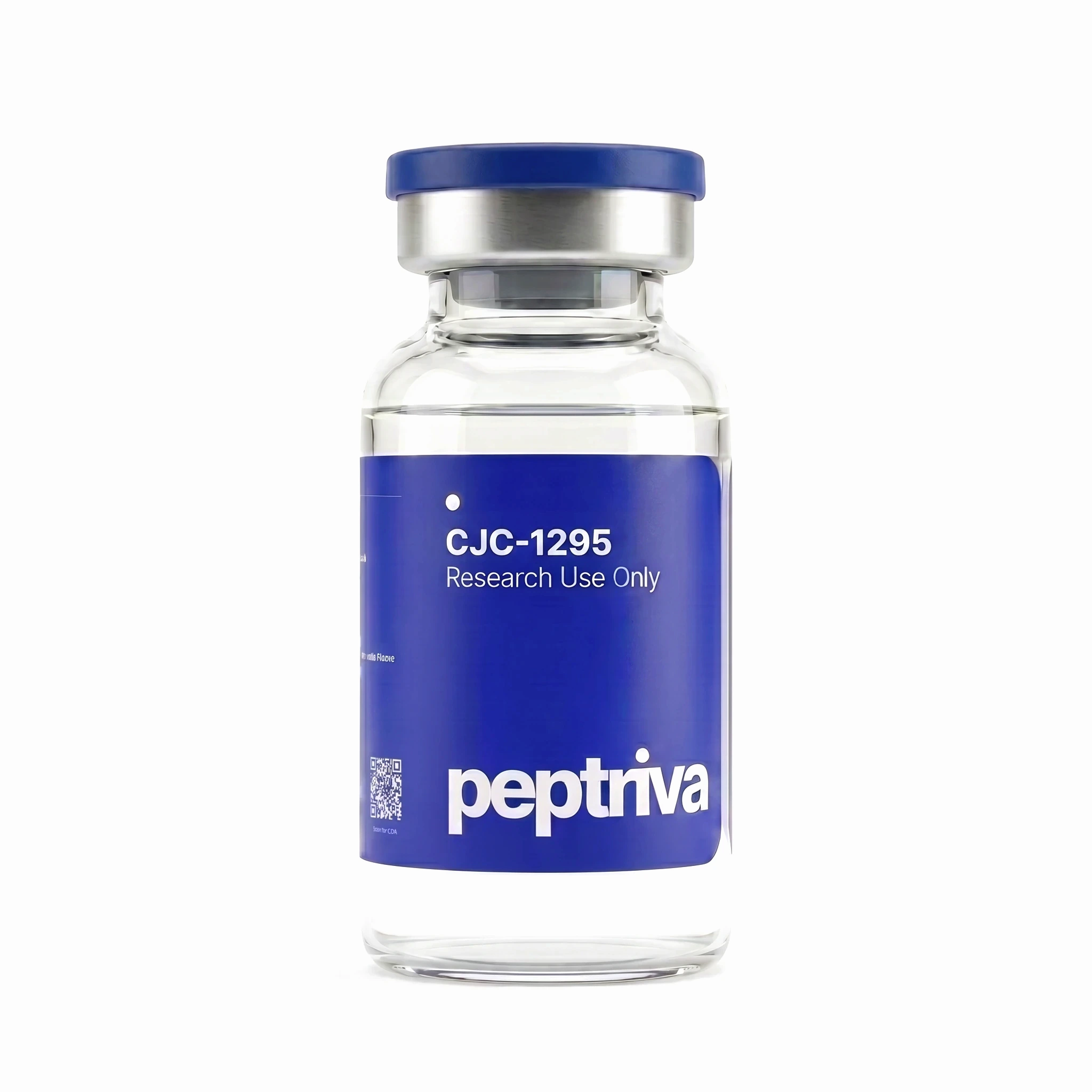
CJC-1295 (no DAC)
Modified GRF 1-29, CAS 863288-34-0, MW 3367.9 g/mol. The same reference compound used across the 2020–2024 anti-doping detection literature and grouped in the 2026 Sports Medicine review of unapproved peptide therapies. COA with HPLC trace and mass-spec ships with every order.
Frequently asked questions
Is CJC-1295 legal to buy?
Yes, as a research reference compound. It’s not FDA-approved, never finished clinical development, and sits on the FDA’s bulks-not-eligible-for-503A list. That closes compounding pharmacies. It doesn’t close research sales. It’s also on the WADA Prohibited List (S2).
DAC vs no-DAC — which one?
Two different molecules. DAC adds an albumin-binding linker that stretches the half-life to 6–8 days. No-DAC (Modified GRF 1-29) has a 30-minute half-life. Most current research use is the no-DAC form because it preserves pulsatile GH release. If the listing says only “CJC-1295,” ask before you buy.
How much does CJC-1295 cost?
No-DAC: $50–$100 for 5 mg, $80–$150 for 10 mg. DAC: $80–$150 for 5 mg, $130–$220 for 10 mg. The DAC variant costs more because the linker-conjugation step adds synthesis complexity. Below those ranges, purity is the trade-off.
Why was CJC-1295 DAC discontinued?
ConjuChem halted clinical development around 2007. Public reporting attributes the decision in part to scrutiny of the broader DAC pipeline after a fatal adverse event in a separate trial of CJC-1131. The program never restarted and CJC-1295 has no current sponsor.
CJC-1295 vs Ipamorelin
Different signaling pathways, complementary effects. CJC-1295 acts on the GH-releasing pathway. Ipamorelin acts on the ghrelin pathway and also blocks somatostatin, the brake on GH. Researchers stack them because the two pathways combine well. A 2026 review showed the combination improved muscle force in mouse models of glucocorticoid-induced muscle loss (Mayfield et al., 2026). See the CJC-1295 vs Ipamorelin comparison.
What should a CJC-1295 CoA show?
For no-DAC: CAS 863288-34-0, HPLC purity above 98% with chromatogram, mass-spec at MW ~3367.9 g/mol. The mass usually shows as multi-charge ions [M+2H]2+ near 1684.9 or [M+3H]3+ near 1123.6. Water content should be 2–8% by Karl Fischer titration. Counterion content is usually TFA at 5–15%. The DAC variant has a different MW because of the linker. The lab should be ISO 17025-accredited and named.
What to know now
- Two variants, not one. Confirm DAC vs no-DAC before purchase. Different half-lives, prices, pharmacology.
- No-DAC: CAS 863288-34-0, MW 3367.9 g/mol. The numbers a credible CoA shows for Modified GRF 1-29.
- $50–$150 per 5 mg vial depending on variant. DAC costs more because the linker adds synthesis steps.
- Clinical development halted around 2007. No current pharmaceutical sponsor.
- WADA S2 with validated detection. Athletes are reliably detectable at sub-ng/mL.
- Lyophilized powder is the literature form. Room-temperature liquid has a much shorter window.
- Recent literature is dominated by detection methods. No new efficacy RCTs in the 2020–2026 window.
What we’re watching
The big signal: whether any developer revives a clinical program for CJC-1295. Two decades after the ConjuChem halt, no sponsor has emerged. Without one, efficacy data won’t accumulate and the literature stays anchored on analytical chemistry. A secondary signal: whether the longer-acting GHRH-analog class (which includes tesamorelin) finds any new approved indication beyond HIV-associated lipodystrophy. That would shift the regulatory framing for the entire receptor target. We’re also watching FDA enforcement against vendors making clinical claims about CJC-1295 — the discontinued-program status and bulks-list placement put those vendors at higher risk.
References
- Memdouh, S., Gavrilović, I., Ng, K., Cowan, D., & Abbate, V. (2021). Advances in the detection of growth hormone releasing hormone synthetic analogs. Drug Testing and Analysis, 13(11–12), 1871–1887. https://doi.org/10.1002/dta.3183
- Rahman, M., Mojica, E. S., Vasireddi, N., et al. (2026). Therapeutic peptides in orthopaedics: Applications, challenges, and future directions. JAAOS: Global Research and Reviews. https://doi.org/10.5435/JAAOSGlobal-D-25-00236
- Sinha, D. K., Balasubramanian, A., Tatem, A. J., et al. (2020). Beyond the androgen receptor: the role of growth hormone secretagogues in the modern management of body composition in hypogonadal males. Translational Andrology and Urology, 9(Suppl 2), S149–S159. https://doi.org/10.21037/tau.2019.11.30
- Coppieters, G., Deventer, K., Polet, M., Van Eenoo, P., & Judák, P. (2022). An antibody-free, ultrafiltration-based assay for the detection of growth hormone-releasing hormones in urine at low pg/mL concentrations using nanoLC-HRMS/MS. Journal of Pharmaceutical and Biomedical Analysis, 214, 114726. https://doi.org/10.1016/j.jpba.2022.114726
- Mayfield, C. K., Bolia, I. K., Feingold, C. L., et al. (2026). Injectable peptide therapy: A primer for orthopaedic and sports medicine physicians. The American Journal of Sports Medicine. https://doi.org/10.1177/03635465251357593
- Mendias, C. L., & Awan, T. M. (2026). Safety and efficacy of approved and unapproved peptide therapies for musculoskeletal injuries and athletic performance. Sports Medicine. https://doi.org/10.1007/s40279-026-02437-0
- Coutinho, D., Reis, M., Carvalho, M., et al. (2026). A new era of doping? Use of peptide and peptide-analog drugs in recreational and professional sport and bodybuilding: a critical review. The Journal of Sports Medicine and Physical Fitness. https://doi.org/10.23736/S0022-4707.26.17773-1
- U.S. Food and Drug Administration. (2023). Section 503A of the Federal Food, Drug, and Cosmetic Act. https://www.fda.gov/drugs/human-drug-compounding/section-503a-federal-food-drug-and-cosmetic-act
- World Anti-Doping Agency. (2026). The Prohibited List. https://www.wada-ama.org/en/prohibited-list
- International Organization for Standardization. (2017). ISO/IEC 17025:2017 — General requirements for the competence of testing and calibration laboratories. https://www.iso.org/standard/66912.html