Tesamorelin vs sermorelin is not a comparison between two rival molecules. It's a comparison between two generations of the same molecule — the original GHRH fragment and the stabilized full-length version that replaced it in regulated medicine.
Both compounds are synthetic GHRH analogs that activate the same receptor on pituitary GH cells. Sermorelin is GHRH (1-29) — the shortest sequence that retains full biological activity of native GHRH, unmodified. It was FDA-approved as Geref for pediatric growth hormone deficiency and discontinued in 2008 for commercial reasons, not safety. It survives today mainly through compounding pharmacies. Tesamorelin is the full GHRH (1-44) sequence with a trans-3-hexenoyl tail that resists enzyme breakdown. It was FDA-approved as Egrifta in 2010 for HIV-associated lipodystrophy, backed by multiple Phase III trials, and remains on the market at roughly $3,500–5,000/month. One molecule has the modern evidence. The other has the longer history and the shorter half-life.
On mechanism, the two are nearly interchangeable — same pituitary GHRH receptor, same endogenous pulsatile GH release, same downstream IGF-1 rise.
What separates them is time. Sermorelin's human data dates to the pediatric-GHD era that ended with Geref; tesamorelin's comes from a modern Phase III program still publishing — six RCT-based papers from 2020–2026 alone.
This comparison maps that asymmetry — sequence, stability, half-life, evidence depth, regulatory status, cost, and typical research protocols — without pretending either molecule is something it isn't.
Quick comparison table
| Attribute | Sermorelin | Tesamorelin (Egrifta) |
|---|---|---|
| Sequence | 29 aa — GHRH (1-29), the shortest fully active fragment of native GHRH, unmodified | 44 aa — full GHRH (1-44) + trans-3-hexenoyl N-terminal modification |
| Stability modification | None. The parent fragment, degraded rapidly by DPP-4 | Fatty-acid moiety that resists DPP-4 degradation and extends half-life |
| Half-life | ~10–20 minutes; requires frequent dosing | Longer than native GHRH; daily dosing in the approved regimen |
| Receptor target | GHRH receptor on pituitary GH cells | GHRH receptor on pituitary GH cells |
| FDA status | Formerly approved (Geref, pediatric GHD). Discontinued 2008 for commercial reasons. No approved product today; compounding restricted. | Approved 2010 (Egrifta). SV reformulation 2019. HIV lipodystrophy indication. Still marketed. |
| Pivotal trial evidence | Historical pediatric-GHD trials (pre-2020, approval era). No 2020–2026 RCTs for adult body composition. | Multiple Phase III RCTs in HIV lipodystrophy; 1-year HIV-NAFLD RCT with published substudies; 2024 integrase-inhibitor subanalysis. |
| Indication | Originally pediatric GH deficiency (diagnosis and treatment). Current compounded use is off-label. | Reduction of excess visceral abdominal fat in HIV-associated lipodystrophy. |
| Cost / access (US) | Historically the low-cost entry point via 503A/503B compounding; access tightening under FDA restrictions. | ~$3,500–5,000/month retail; insurance generally limited to the approved indication. |
| WADA status | Prohibited (S2); validated detection incl. metabolite panels. | Prohibited (S2); validated detection methods. |
Mechanism: the parent fragment and its stabilized successor
The shared mechanism is the GHRH receptor on anterior pituitary GH cells. Both compounds bind it, stimulate endogenous GH pulses, and elevate downstream IGF-1 through liver GH-receptor signaling — while preserving the pulsatile release pattern and negative-feedback brakes (somatostatin, elevated GH) that injected recombinant GH bypasses.
The structural relationship is unusually direct. Sermorelin is GHRH (1-29) — the minimum sequence that retains full activity of the native 44-residue hormone, with nothing added. Tesamorelin took the opposite approach: keep the entire GHRH (1-44) sequence and bolt a trans-3-hexenoic acid group onto the N-terminus so dipeptidyl peptidase-4 (DPP-4) can't chew it up. We cover that chemistry in detail in the tesamorelin stabilized-GHRH mechanism deep-dive.
Three practical consequences fall out of that design difference:
- Half-life. Unprotected sermorelin survives roughly 10–20 minutes in plasma before DPP-4 and related enzymes degrade it. Tesamorelin's hexenoyl shield gives it a meaningfully longer window — long enough to support once-daily dosing in the approved regimen.
- Dosing cadence. Sermorelin protocols historically leaned on frequent, often nightly, administration timed to the sleep-onset GH pulse. Tesamorelin is a once-daily injection in its approved use.
- Design lineage. CJC-1295 — the third GHRH analog in this family — starts from the same 1-29 fragment as sermorelin and adds different stabilizing chemistry. We compare that molecule against tesamorelin in the CJC-1295 vs tesamorelin comparison.
The Memdouh 2021 review treats sermorelin, tesamorelin, and CJC-1295 as one analytical family of GHRH synthetic analogs — which is exactly how the pharmacology reads. Mechanistically, choosing between them is choosing a stability strategy, not a mechanism.
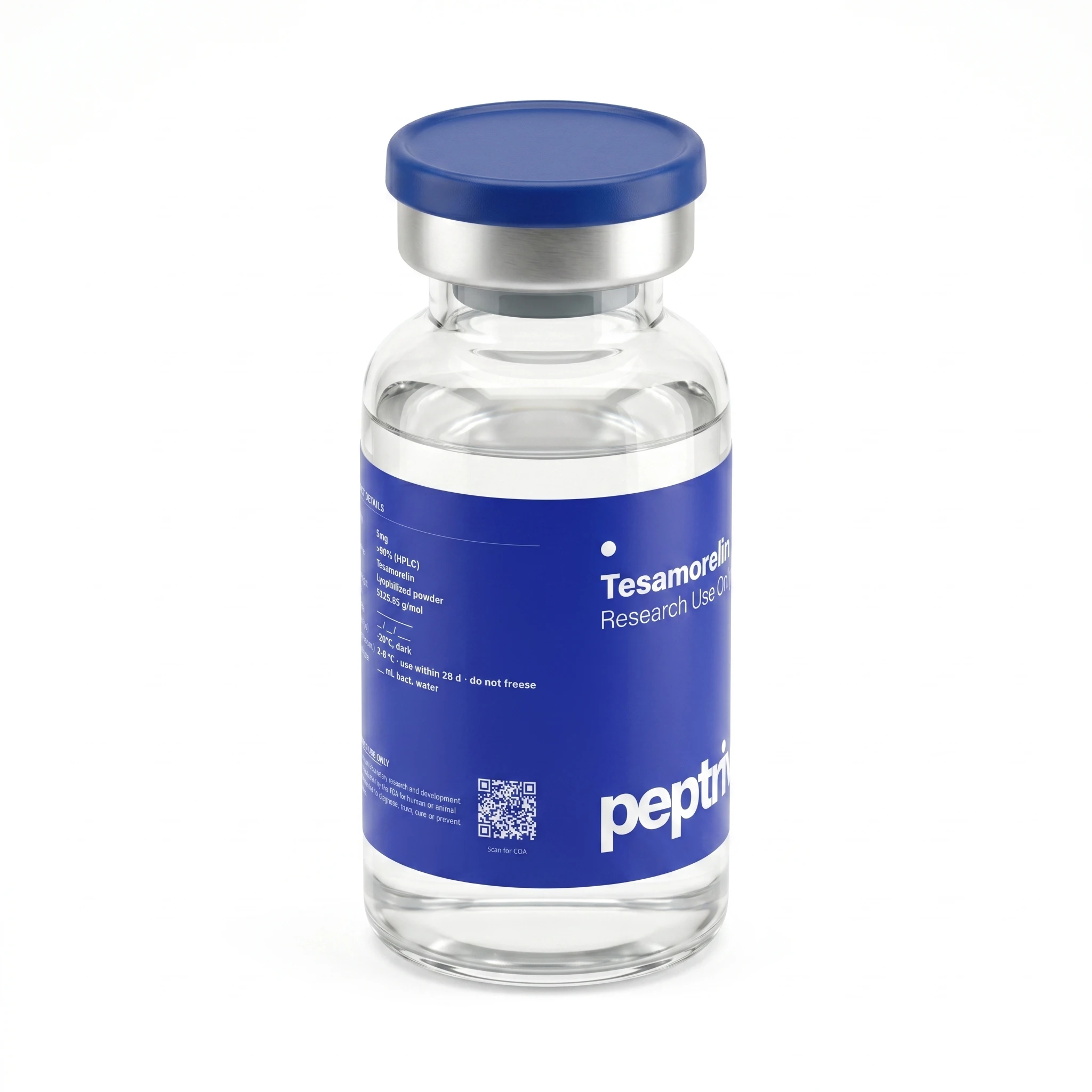
Tesamorelin
The same molecule cited across the eight studies in this comparison — the stabilized full-length GHRH analog. Lab-verified identity and purity.
Evidence base: modern trials vs a historical file
This is where the symmetry ends. Tesamorelin's evidence base is the deepest of any peptide in this category; sermorelin's is real but old — and thin exactly where today's readers want it thick.
Tesamorelin's record: two pivotal Phase III RCTs in HIV lipodystrophy demonstrated significant visceral fat reduction and produced the 2010 approval. A double-blind 1-year RCT in 61 patients with HIV-associated NAFLD showed reduced liver fat and prevented fibrosis progression — and its Fourman 2020 paired-biopsy substudy showed tesamorelin switched on oxidative-phosphorylation genes and switched off inflammation and fibrosis pathways in liver tissue.
The Lake 2021 post-hoc analysis of 341 trial participants showed tesamorelin improved fat quality (CT density, a marker of healthier adipocytes) independent of fat quantity. The Russo 2024 subanalysis in people on modern integrase-inhibitor regimens showed visceral fat change of −25 vs +14 cm² against placebo and hepatic fat reduction of −4.2% vs −0.5%.
Honesty requires the negative result too: the Ellis 2025 Phase II trial found tesamorelin did not improve neurocognitive outcomes in people with HIV and abdominal obesity. Even the best-evidenced GHRH analog fails when pushed beyond its lane. The full trial-by-trial record lives in the tesamorelin complete guide.
Sermorelin's record is a different shape: its human efficacy data comes from the pediatric-GHD trials behind Geref's original approval — solid for its era, but decades old and aimed at a pediatric indication, not adult body composition. No 2020–2026 randomized controlled trial of sermorelin exists for adult body composition or performance. The Mendias & Awan 2026 Sports Medicine review classifies sermorelin among peptides whose claimed benefits are mechanism-based rather than trial-validated.
What sermorelin does have is a lively academic afterlife as a target rather than a therapeutic. A 2023 PNAS study showed the sermorelin-related GHRH agonist MR-409 protected pancreatic β-cells in a type 1 diabetes model. A 2021 drug-sensitivity screen flagged sermorelin itself as a candidate against recurrent glioma. Interesting biology — but preclinical, and none of it validates the off-label adult use case the compounding market sells.
Sermorelin has a longer pedigree as a real human therapeutic than almost any research peptide — a genuine FDA approval until 2008, abandoned commercially, not because it stopped working. Its modern resurrection in adult off-label compounding rests on old pediatric data and mechanism, not trials. Tesamorelin is the mirror image: a narrow, indication-specific approval backed by modern Phase III evidence that keeps publishing.
— peptriva research, synthesizing the GHRH-analog literature
Regulatory status: discontinued pioneer vs current drug
Both molecules have been FDA-approved. Only one still is.
Sermorelin was marketed as Geref for the diagnosis and treatment of pediatric growth hormone deficiency until 2008, when it was withdrawn from the US market for commercial reasons. That nuance cuts both ways: the molecule wasn't pulled for safety, but no approved sermorelin product exists anywhere today — not at FDA, not at EMA. Its survival channel is 503A/503B compounding pharmacies, and recent FDA actions have restricted compounding of GHRH analogs. The full history is in the sermorelin complete guide.
Tesamorelin went the other way. Approved by FDA in 2010 as Egrifta (SV reformulation 2019), it remains the only FDA-approved GHRH analog for adult therapeutic use — and the indication is deliberately narrow: reduction of excess abdominal fat in adults with HIV-associated lipodystrophy. Health Canada approved a similar indication; the sponsor withdrew from the EU market in 2020, again commercially.
The practical asymmetry: tesamorelin's approval is indication-specific and doesn't certify recomposition or longevity use; sermorelin's former approval is reassuring history, but it buys nothing at the pharmacy counter without a compounder.
Cost and access: two different bottlenecks
Egrifta carries a US retail price around $3,500–5,000/month, and insurance coverage almost always requires the HIV-lipodystrophy diagnosis. Outside that indication, access routes through compounding — a pathway FDA has been narrowing for tesamorelin as well.
Sermorelin's economics are the reverse image. Off-patent and unmodified, it has historically been the cheapest legitimate entry into GH-axis therapy via compounding — which is why longevity-medicine clinics standardized on it after Geref disappeared. Its bottleneck isn't price; it's the tightening regulatory ceiling over GHRH-analog compounding.
In research-chemical channels both molecules trade at typical peptide-vendor pricing, with the usual caveat: research-grade material carries no pharmaceutical manufacturing oversight, so verified identity and purity documentation is the minimum bar.
Protocol patterns: half-life drives everything
The most practical difference is pharmacokinetic. Sermorelin's ~10–20 minute half-life means its GH pulse is brief; protocols compensate with frequent administration, classically a nightly subcutaneous dose timed to amplify the natural sleep-onset GH pulse. Tesamorelin's DPP-4-resistant design supports the once-daily schedule used across its Phase III program.
That difference also shapes stacking logic: short-acting GHRH fragments are commonly studied alongside ghrelin-mimetic secretagogues (ipamorelin-class) that amplify the same pulse through a second receptor — the architecture we map in the GH-axis triple stack explainer — while tesamorelin was developed and approved strictly as monotherapy.
Safety: same class effects, different monitoring depth
Because both molecules raise GH and IGF-1 through the same receptor, the adverse-event picture is shared GH-axis territory:
- Glucose effects. GH antagonizes insulin; hyperglycemia and worsening glucose tolerance are documented for tesamorelin and expected class-wide. Glucose monitoring is standard in the approved setting.
- Injection-site reactions. The most common adverse event in tesamorelin's pivotal trials.
- Arthralgias, edema, paresthesias. Classic GH-axis effects reported across the class.
- IGF-1 elevation. Carries theoretical oncologic concern; tesamorelin is contraindicated in active malignancy.
- GHRH-receptor biology. GHRH-R is expressed in some tumors — a theoretical concern for any agonist — though the 2021 glioma screen finding sermorelin anti-tumor activity complicates the simple story.
Where this falls short. Tesamorelin's safety profile is characterized by an FDA-monitored Phase III program and 15+ years of regulated use — in an HIV population, for one indication. Sermorelin's safety record comes from an older approval era and general GH-axis pharmacology; modern dose-specific risk data for adult use simply doesn't exist. Neither profile transfers cleanly to unmonitored, off-label, or research-chemical contexts.
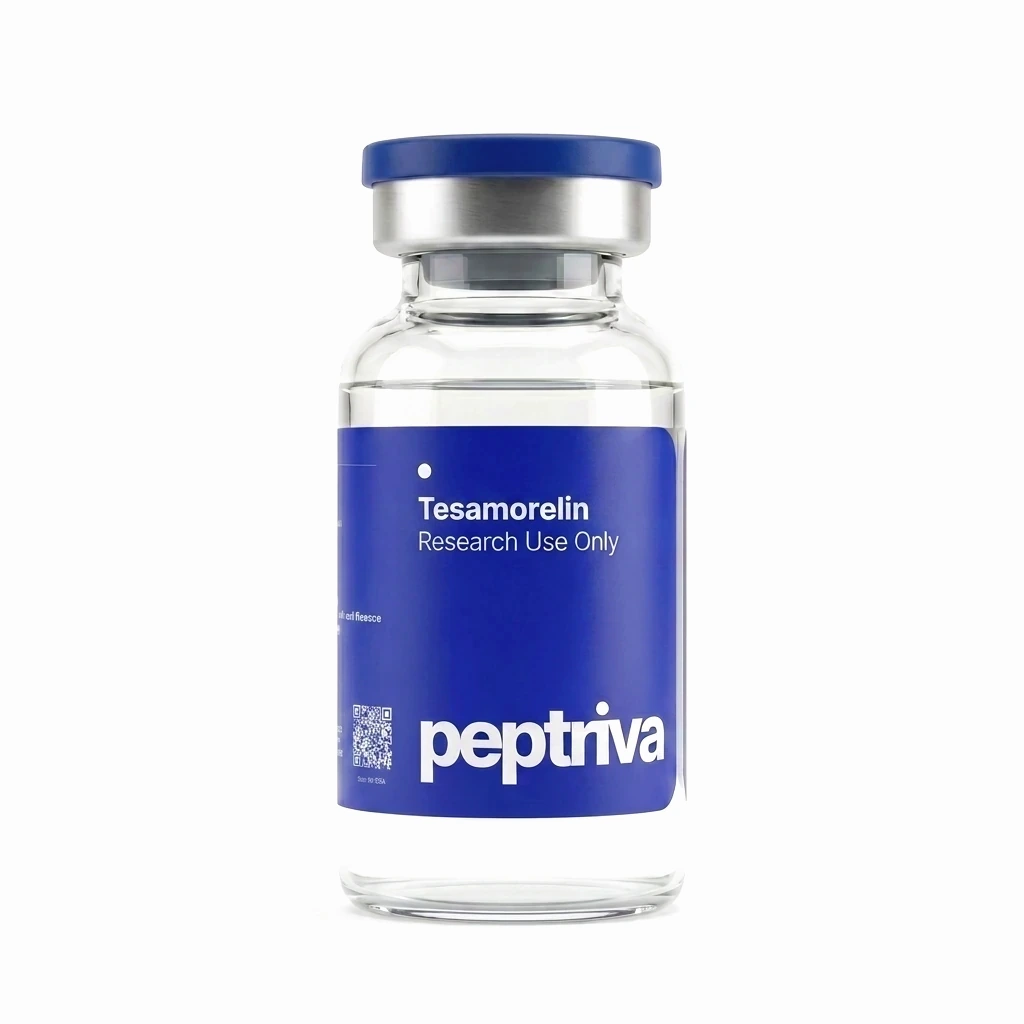
Tesamorelin
Synthetic GHRH (1-44) analog with the trans-3-hexenoyl stabilizing modification — the same reference compound cited across the trials in this comparison. COA available with each lot.
Athletic and doping context
Neither molecule is a loophole. Both sit on the WADA Prohibited List under S2 (peptide hormones, growth factors), and both are detectable by validated methods — sermorelin including its 1-11, 13-20, and 22-29 metabolite fragments in urine and blood. The Memdouh 2021 review documents the detection landscape for the whole GHRH-analog family. Athletes subject to testing should treat both as definitively prohibited and detectable.
Comparative framing: which one, for what question
The literature supports the following distinctions:
- Modern RCT evidence: tesamorelin, decisively. Six RCT-based publications from 2020–2026 versus zero for sermorelin.
- Approved clinical use today: tesamorelin only — and only for HIV-associated lipodystrophy. Neither molecule holds an approval for general body-composition or age-related use.
- Historical human track record: sermorelin — a genuine former FDA approval, discontinued commercially, with well-characterized pharmacology from its Geref era.
- Low-cost regulated access: sermorelin via compounding, while that channel lasts. Egrifta's price point structurally limits off-indication use.
- Anti-doping status: a tie — both S2-prohibited, both detectable.
What to know now
- Same receptor: both sermorelin and tesamorelin are GHRH-receptor agonists producing pulsatile, feedback-regulated GH release.
- Different scaffolds: sermorelin is unmodified GHRH (1-29); tesamorelin is full GHRH (1-44) plus a trans-3-hexenoyl stabilizer.
- Different half-lives: ~10–20 minutes for sermorelin vs a DPP-4-resistant, once-daily-capable profile for tesamorelin.
- Different regulatory presents: Geref was discontinued in 2008 (commercial, not safety); Egrifta has been FDA-approved since 2010 and is still marketed.
- Different evidence depth: tesamorelin has modern Phase III RCTs and published substudies; sermorelin's human data predates 2020 and targeted pediatric GHD.
- The approval is indication-specific: tesamorelin's FDA status covers HIV lipodystrophy — not recomposition, not longevity. Its one off-indication RCT (neurocognition) was negative.
- Same WADA status: both prohibited (S2), both detectable by validated methods.
What we're watching
Three things over the next 24 months. First, whether tesamorelin's non-HIV MASH/NAFLD development advances into an indication expansion — that would move it from a niche HIV drug into the broader metabolic-liver market. Second, how far FDA's restrictions on compounding GHRH analogs go. Sermorelin's entire legitimate access channel runs through compounding; a hard restriction would functionally retire the molecule in the US. Third, the GHRH-receptor target renaissance — agonists for β-cell protection, antagonists in oncology. That research may ultimately matter more for this receptor family than either legacy molecule.
References
- Russo, S. C., Ockene, M. W., Arpante, A. K., et al. (2024). Efficacy and safety of tesamorelin in people with HIV on integrase inhibitors. AIDS, 38(12), 1758–1764. https://doi.org/10.1097/QAD.0000000000003965
- Fourman, L. T., Billingsley, J. M., Agyapong, G., et al. (2020). Effects of tesamorelin on hepatic transcriptomic signatures in HIV-associated NAFLD. JCI Insight, 5(16). https://doi.org/10.1172/jci.insight.140134
- Lake, J. E., La, K., Erlandson, K. M., et al. (2021). Tesamorelin improves fat quality independent of changes in fat quantity. AIDS, 35(9), 1395–1402. https://doi.org/10.1097/QAD.0000000000002897
- Ellis, R. J., Vaida, F., Hu, K., et al. (2025). Effects of tesamorelin on neurocognitive impairment in persons with HIV and abdominal obesity. Journal of Infectious Diseases, 231(5), 1230–1238. https://doi.org/10.1093/infdis/jiaf012
- Memdouh, S., Gavrilović, I., Ng, K., Cowan, D., & Abbate, V. (2021). Advances in the detection of growth hormone releasing hormone synthetic analogs. Drug Testing and Analysis, 13(11–12), 1871–1887. https://doi.org/10.1002/dta.3183
- Louzada, R. A., Blandino-Rosano, M., Flores, S., et al. (2023). GHRH agonist MR-409 protects β-cells from streptozotocin-induced diabetes. Proceedings of the National Academy of Sciences, 120(25), e2209810120. https://doi.org/10.1073/pnas.2209810120
- Chang, Y., Huang, R., Zhai, Y., et al. (2021). A potentially effective drug for patients with recurrent glioma: sermorelin. Annals of Translational Medicine, 9(5), 406. https://doi.org/10.21037/atm-20-6561
- Mendias, C. L., & Awan, T. M. (2026). Safety and efficacy of approved and unapproved peptide therapies for musculoskeletal injuries and athletic performance. Sports Medicine. https://doi.org/10.1007/s40279-026-02437-0