Search sermorelin before and after and you get transformation photos. The trial record tells a quieter story: a genuine biomarker change inside two weeks, and almost nothing measured after that.
The honest sermorelin before-and-after is biochemical, not photographic. In 1990s controlled studies, GHRH 1-29 returned IGF-1 to the young-adult range within 14 days in older men — roughly a one-third rise — and nightly dosing held the elevation through 16 weeks without the axis desensitizing. That is where the measured record largely ends: 0 RCTs (2020–2026) have tested sermorelin for adult body composition, and no controlled trial anywhere supports the dramatic recomposition photos used to sell it.
Quick answer
What changes on sermorelin, per the published literature: GH pulses increase from the first dose, serum IGF-1 rises within days and plateaus around weeks 2–4, and the elevation holds with continued dosing. Body composition has never been measured in a modern sermorelin RCT. Sleep, recovery, and “axis restoration” claims are mechanism-based, not outcome-trial-validated.
What “before and after” can honestly mean here
No sermorelin trial ever photographed anyone. The before-and-after that exists in the literature is a set of measured endpoints: growth hormone pulse profiles, serum IGF-1, and — in the broader GHRH-analog class — CT-measured fat area and DEXA-measured lean mass. Sermorelin is the unmodified first 29 amino acids of native GHRH, acting one step upstream of GH at the pituitary, with a half-life of roughly 10–20 minutes (Memdouh et al., 2021). Identity, regulatory history, and mechanism are covered in our complete sermorelin guide; this article is only about the time-course.
Sermorelin occupies an unusual evidence position: FDA-approved (as Geref) from 1997 to 2008, so the pharmacology is settled — but the approval was pediatric, and the adult-use claims were never taken through controlled trials. The result is a molecule with real measured “afters” on biomarkers, and essentially none on the outcomes the marketing photos imply.
Weeks 1–2: the biomarker moves first
The earliest change is pharmacological. A GHRH-receptor agonist triggers a GH pulse within the first hour — that acute response is why sermorelin served as a diagnostic stimulation agent under the Geref label.
The most direct before-and-after experiment ever run on this molecule came in 1992: Corpas and colleagues gave healthy older men GHRH 1-29 subcutaneously twice daily for 14 days and measured the GH axis before and after. The finding is stated in the paper’s own title:
Growth hormone (GH)-releasing hormone-(1-29) twice daily reverses the decreased GH and insulin-like growth factor-I levels in old men.
— trial title, Corpas et al., J Clin Endocrinol Metab, 1992
Two weeks of dosing lifted 24-hour GH secretion and raised IGF-1 by roughly a third, back into the range typical of young adults (Corpas et al., 1992). That is the strongest honest “after” in the entire sermorelin literature — and it is a blood test, not a mirror. At day 14 subjects looked identical to day 0; the only noticeable changes in this window are the common early side effects (injection-site redness, transient flushing, mild water retention).
Weeks 2–4: the rise plateaus — by design
IGF-1 does not keep climbing. Because sermorelin works through the intact hypothalamic–pituitary feedback loop, rising IGF-1 and somatostatin push back on further GH release, and the elevation levels off near the young-adult range rather than escalating the way exogenous GH can. That physiologic ceiling is both the strongest argument for the GHRH-analog approach and the reason the “after” is inherently modest.
The longest well-controlled time-course comes from Khorram and colleagues, who gave older men and women a nightly GHRH 1-29 analog for 16 weeks. The IGF-1 elevation appeared early and held through the full study — the pituitary did not desensitize — while the accompanying endocrine and metabolic effects were modest rather than transformative (Khorram et al., 1997).
Tesamorelin
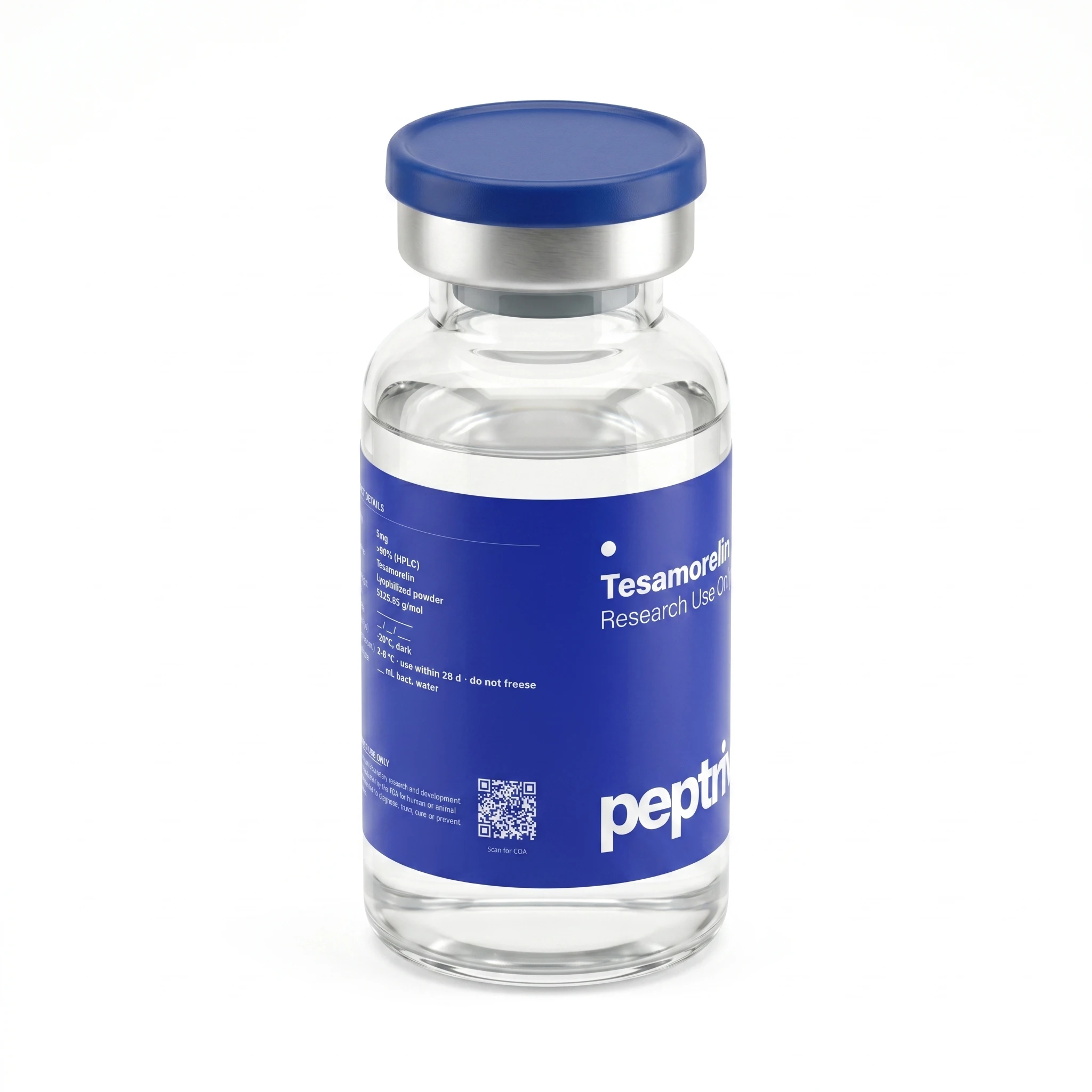
Sermorelin itself is not currently stocked at Peptriva. Tesamorelin is the closest stocked GHRH analog — the stabilized descendant whose measured 6-month readouts anchor the class comparisons in this review. Lab-verified identity and purity.
Weeks 4–12: body composition — where sermorelin’s own data runs out
This is the window every before-and-after photo implies, and it is exactly where the sermorelin-specific evidence stops. There are 0 randomized controlled trials (2020–2026) of sermorelin for adult body composition, performance, or senescence endpoints; a 2026 Sports Medicine review classifies its claimed benefits as mechanism-based rather than trial-validated (Mendias & Awan, 2026). The adult literature that does exist is conceptual — reviews grouping GH secretagogues as candidate tools for body-composition management, not interventional data (Sinha et al., 2020).
To calibrate expectations, look at the one GHRH analog with modern instrumented trials. In a 2024 randomized, double-blind substudy, six months of tesamorelin reduced CT-measured visceral fat by a median of 25 cm² while the comparison group gained 14 cm², and cut liver fat by 4.2 percentage points (Russo et al., 2024). That is what a real GHRH-analog “after” looks like at 6 months: meaningful on a CT scan, invisible across a room. If sermorelin — a shorter-acting agonist at the same receptor — moves body composition at all, the plausible effect size is that scale or smaller (see our tesamorelin vs sermorelin comparison).
For unapproved peptides marketed for body composition and performance — sermorelin among them — the claimed benefits rest on mechanism and biomarker change, not on randomized-trial outcomes.
— summary of Mendias & Awan, Sports Medicine, 2026
Week 12 and beyond: sleep, recovery, and the “axis restoration” idea
Three longer-horizon claims dominate sermorelin marketing. Each deserves its own honesty check.
Sleep. The mechanism is real: GHRH itself promoted slow-wave sleep in controlled polysomnography studies of healthy men (Kerkhofs et al., 1993), and altered sleep is among the most commonly reported subjective effects. But that study used native GHRH in young adults; no modern sermorelin trial has quantified sleep-architecture outcomes in the populations the marketing targets.
Recovery and healing. Mechanism-only. GH and IGF-1 participate in tissue repair, but no controlled sermorelin trial has measured recovery, injury, or musculoskeletal endpoints (Mendias & Awan, 2026).
“GH-axis restoration.” The idea that sustained sermorelin use re-trains a flagging somatotropic axis traces largely to a 2006 opinion piece proposing sermorelin as a more physiologic alternative to recombinant GH (Walker, 2006). It is a coherent hypothesis — pulsatility preserved, feedback intact — that has never been tested as a long-term outcome trial. Treat it as a rationale, not a result.
The class also offers a sharp caution against assuming biomarker change cascades into felt outcomes. In a 2025 randomized trial of 73 patients, tesamorelin moved the measurable endpoints — waist circumference fell 2.7 cm versus standard of care — yet the cognitive outcomes it was testing did not improve (Ellis et al., 2025). The biomarker moving is the beginning of the question, not the answer.
The before-and-after claims no trial supports
Claims that appear routinely in sermorelin promotions and are supported by no controlled trial, anywhere, at any date:
- Dramatic transformation photos. No sermorelin RCT has measured fat mass in adults; the only instrumented GHRH-analog fat data belongs to tesamorelin, and it is CT-modest.
- Visible lean-mass claims. No trial has shown appreciable lean-mass gain in healthy adults on any sermorelin protocol.
- “Look 10 years younger” skin reversal. No sermorelin study has measured skin endpoints.
- Guaranteed sleep transformation. Mechanistically plausible, never quantified for sermorelin in a modern trial.
- “Clinically proven” longevity-clinic claims. The clinical proof is a pediatric GHD approval that ended in 2008 plus two small 1990s biomarker studies — not an adult outcomes base.
Transformation photos carry a second, structural problem: they are unverifiable and confounded. Training, diet, other compounds, lighting, and simple selection — only responders get photographed — all travel with the image. Questions worth asking of any sermorelin before-and-after claim:
- Is the change instrument-measured (IGF-1 assay, CT, DEXA, polysomnography) or photographic?
- Was there a control group, in a comparable population?
- Is the effect from sermorelin itself, or borrowed from tesamorelin or GH data?
- Does the claimed timeline match the pharmacology — biomarkers in weeks, composition in months, if at all?
- Who benefits from the claim, and would it survive the trial that has never been run?
Patients seeking sermorelin in 2026 should know they are using a molecule whose original therapeutic indication was abandoned for commercial reasons, not because it stopped working — but also that contemporary efficacy data for adult use is essentially absent.
— Peptide Encyclopedia editorial summary, 2026
Where this leaves the stacking question
Because sermorelin’s own outcome data is thin, modern interest has migrated to combinations — pairing a GHRH analog with a ghrelin-receptor agonist like ipamorelin so two independent pathways drive a larger GH pulse. Our GH-axis triple stack review examines that case; the short version is that the combination logic is sound and the human outcome data has the same gap documented here.
Tesamorelin
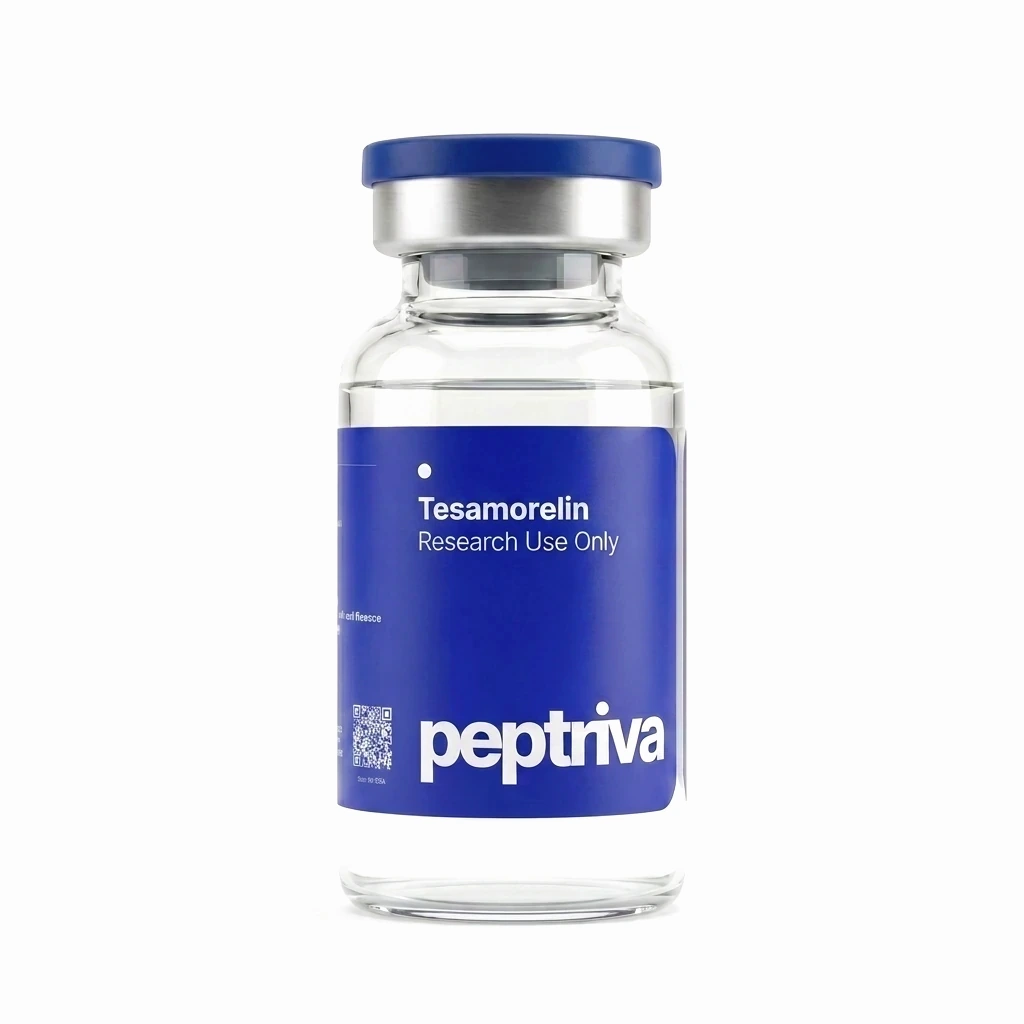
44-aa stabilized GHRH analog with a trans-3-hexenoyl modification — the reference compound behind the measured 6-month readouts cited in this review. COA from an ISO 17025 lab with each lot.
What to know now
- The real “after” is a blood test. Two weeks of GHRH 1-29 restored IGF-1 to the young-adult range in older men (Corpas 1992) — the strongest measured result in the sermorelin literature.
- The rise plateaus by design. Intact feedback caps IGF-1 near the physiologic range; 16 weeks of nightly dosing sustained it without desensitization (Khorram 1997).
- Body composition was never measured in a modern sermorelin RCT. The class reference — tesamorelin’s -25 cm² visceral fat at 6 months — is CT-modest, not photo-dramatic.
- Sleep and recovery claims are mechanism-tier. Sermorelin-specific adult sleep and recovery outcomes are unquantified.
- “Axis restoration” is a hypothesis from a 2006 opinion piece, never tested as a long-term outcome trial.
- Biomarker change is not outcome change. The 2025 Ellis trial moved the measurable endpoints and still missed its clinical one.
What we’re watching
Two developments would rewrite this timeline. First: any registered randomized trial of sermorelin with adult body-composition or sleep endpoints — a single instrumented 12-week study would replace most of this article’s inference with data. Nothing of the kind is in active enrollment. Second: FDA compounding policy, which is narrowing the very channel that generated two decades of unmeasured adult use; if it closes, the before-and-after question may be answered by regulation rather than by a trial.
References
- Corpas, E., Harman, S. M., Piñeyro, M. A., et al. (1992). Growth hormone (GH)-releasing hormone-(1-29) twice daily reverses the decreased GH and insulin-like growth factor-I levels in old men. The Journal of Clinical Endocrinology & Metabolism, 75(2), 530–535. https://doi.org/10.1210/jcem.75.2.1379256
- Khorram, O., Laughlin, G. A., & Yen, S. S. C. (1997). Endocrine and metabolic effects of long-term administration of [Nle²⁷]growth hormone-releasing hormone-(1-29)-NH₂ in age-advanced men and women. The Journal of Clinical Endocrinology & Metabolism, 82(5), 1472–1479. https://doi.org/10.1210/jcem.82.5.3943
- Kerkhofs, M., Van Cauter, E., Van Onderbergen, A., et al. (1993). Sleep-promoting effects of growth hormone-releasing hormone in normal men. American Journal of Physiology-Endocrinology and Metabolism, 264(4), E594–E598. https://doi.org/10.1152/ajpendo.1993.264.4.e594
- Walker, R. F. (2006). Sermorelin: A better approach to management of adult-onset growth hormone insufficiency? Clinical Interventions in Aging, 1(4), 307–308. https://doi.org/10.2147/ciia.2006.1.4.307
- Russo, S. C., Ockene, M. W., Arpante, A. K., et al. (2024). Efficacy and safety of tesamorelin in people with HIV on integrase inhibitors. AIDS, 38(12), 1758–1764. https://doi.org/10.1097/QAD.0000000000003965
- Ellis, R. J., Vaida, F., Hu, K., et al. (2025). Effects of tesamorelin on neurocognitive impairment in persons with HIV and abdominal obesity. The Journal of Infectious Diseases, 231(5), 1230–1238. https://doi.org/10.1093/infdis/jiaf012
- Sinha, D. K., Balasubramanian, A., Tatem, A. J., et al. (2020). Beyond the androgen receptor: the role of growth hormone secretagogues in the modern management of body composition in hypogonadal males. Translational Andrology and Urology, 9(Suppl 2), S149–S159. https://doi.org/10.21037/tau.2019.11.30
- Memdouh, S., Gavrilović, I., Ng, K., Cowan, D., & Abbate, V. (2021). Advances in the detection of growth hormone releasing hormone synthetic analogs. Drug Testing and Analysis, 13(11–12), 1871–1887. https://doi.org/10.1002/dta.3183
- Mendias, C. L., & Awan, T. M. (2026). Safety and efficacy of approved and unapproved peptide therapies for musculoskeletal injuries and athletic performance. Sports Medicine. https://doi.org/10.1007/s40279-026-02437-0