The unusual feature of Selank's mechanism of action is anxiolysis without the sedation profile typical of benzodiazepine-class compounds. The whole benzodiazepine class — Xanax, Valium, and its relatives — produces sedation, cognitive blunting, and a withdrawal pattern as part of its mechanism. Preclinical and Russian-regulatory evidence suggests Selank does not. That pharmacological distinction is why the molecule has attracted research interest.
Selank is a 7-amino-acid peptide (a heptapeptide) built off tuftsin, a natural human immune-signaling fragment. Russia approved it as an anxiety drug in 2009. The proposed mechanism touches four systems at once: GABA (the brain's main calming neurotransmitter), serotonin and dopamine (mood regulators), IL-6 (a stress-driven inflammatory signal), and the HPA axis (the cortisol-release loop). The single best human study is a 2020 brain-scan trial in 52 healthy adults.
This is a mechanism deep-dive for researchers. We're not pitching Selank as a generic nootropic. We're walking through the molecular biology: where the molecule came from, what receptors it touches, and what the 2020 fMRI study actually showed. If you want the consumer framing, this isn't that article.
Where Selank came from: the tuftsin scaffold
Start with the parent molecule. Tuftsin is a natural 4-amino-acid peptide the body produces when immunoglobulin G antibodies are cleaved by immune cells. Its function: signal white blood cells to increase phagocytic activity. Pure immune signaling, no identified brain effects.
Selank takes that 4-amino-acid backbone and bolts on three more amino acids at the tail: Pro-Gly-Pro. It then caps the front end with an acetyl group (a small chemical "lock"). The point of both moves is the same: protect the peptide from getting digested.
Why this matters: your blood is full of enzymes called peptidases whose job is to chew up loose peptides. The tail extension blocks the back-end enzymes (carboxypeptidases). The acetyl cap blocks the front-end enzymes (aminopeptidases). Without those tricks, Selank wouldn't survive long enough to cross from the nose into the brain.
The 2020 Panikratova fMRI work confirms it gets there. But Selank's receptor is still officially unknown. Researchers can see the brain change. They haven't yet pinned down the lock the molecule is opening.
How Selank touches the GABA system
The first proposed mechanism is GABAergic modulation. GABA is your brain's main "slow down" neurotransmitter. When GABA fires, neurons quiet down. Benzodiazepines work by amplifying that signal. Selank seems to nudge it, but differently.
The 2022 Konstantinopolsky paper in Bulletin of Experimental Biology and Medicine tested Selank in a rat morphine-withdrawal model. At a 0.3 mg/kg dose, Selank cut the withdrawal-symptom index by 39.6%. It calmed convulsions, eased drooping eyelids, and raised the touch-sensitivity threshold 9-fold. Diazepam at 2 mg/kg did slightly better. Selank came close.
That gap matters. Morphine withdrawal is essentially a GABA-system stress test. Benzodiazepines win these tests because they bind GABA-A receptors directly. Selank approached diazepam without binding the benzodiazepine site at all. So whatever Selank does to GABA, it's working through a side door. Maybe GABA synthesis. Maybe release. Maybe cross-talk with other systems entirely.
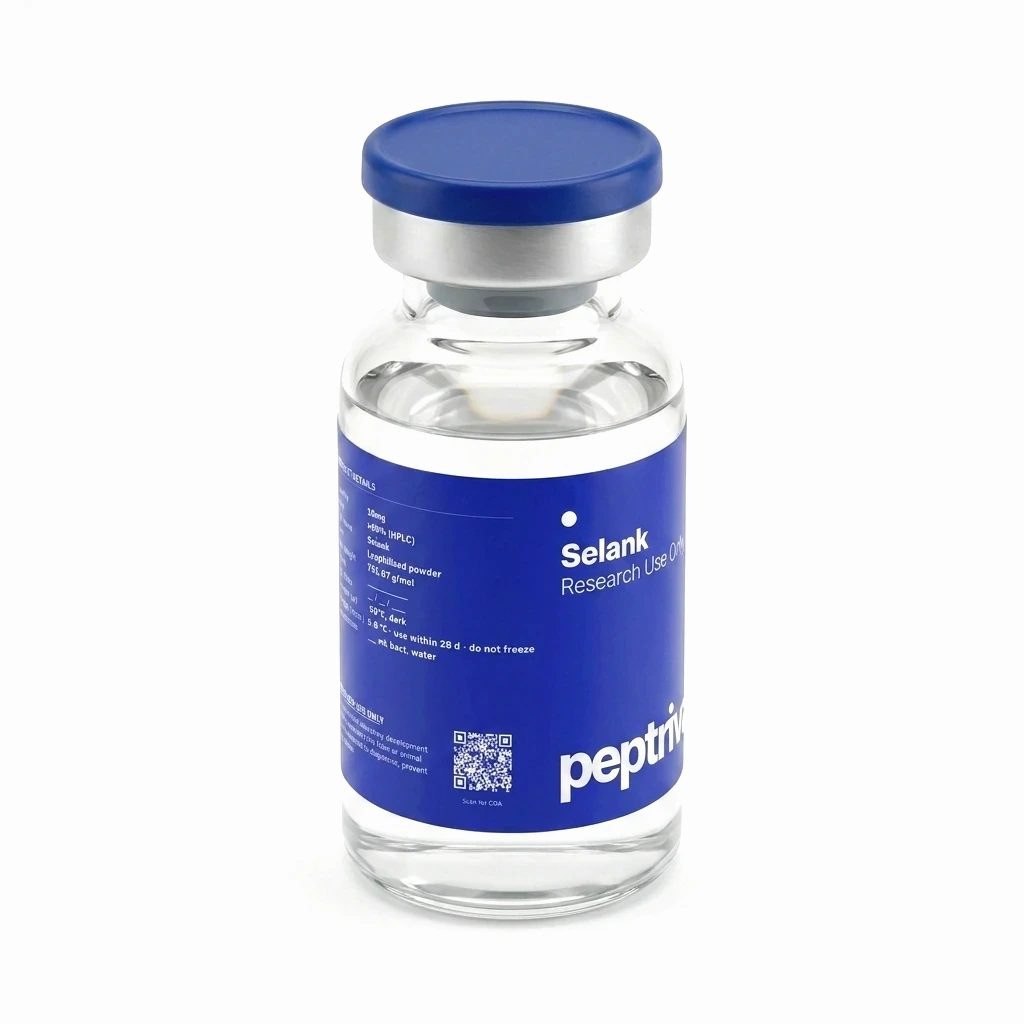
Selank
The same N-acetylated tuftsin analog cited across the 5 mechanism studies in this article — including the 2020 Panikratova fMRI work. Lab-verified identity and purity.
Why "anxiolytic without sedation" is a big deal
Benzodiazepines work. They also produce sedation as part of their mechanism. That trade-off isn't a quirk of one drug. It's baked into the receptor biology.
The GABA-A receptor has different subunits. The alpha-2 subunit drives anxiety relief. The alpha-1 subunit drives sedation. Benzodiazepines hit both. Drug companies have spent 40 years trying to make a clean alpha-2-only benzo. None has reached FDA approval.
Russian clinical reports describe Selank as effective for generalized anxiety disorder with no sedation, no measurable cognitive fog, and no withdrawal pattern. If true, that's the category Western pharma has been chasing for decades. The catch: the Russian trials underpinning the 2009 approval aren't PubMed-indexed and aren't Western RCT-grade. So treat the "no side effects" framing as a working hypothesis, not a proven claim.
The 2020 fMRI study: best human data we've got
The strongest Western-indexed human study on Selank is the 2020 Panikratova paper in Doklady Biological Sciences. It enrolled 52 healthy adults in a placebo-controlled three-arm design comparing Selank, Semax, and saline placebo.
The protocol was clean. Participants received a resting-state fMRI scan (brain imaging during passive rest without an active task) before dosing, then again at 5 minutes and 20 minutes after intranasal spray. The finding: Selank shifted functional connectivity between the right amygdala and the right temporal cortex.
Why this matters: the amygdala is the brain's primary fear and threat-detection hub. Its functional relationship with the temporal cortex shapes fear-memory encoding and emotional regulation. A compound that measurably alters that connectivity within 20 minutes of intranasal administration demonstrates two things: CNS penetration, and engagement with a network that is directly anxiety-relevant.
Don't oversell the result. The Panikratova study didn't show that Selank treats anxiety disorders. It showed that Selank changes brain connectivity in healthy people. That's evidence of "the drug reaches the brain and does something." It's not evidence of "the drug fixes anxiety." Those are different claims.
The inflammation angle: IL-6 suppression
Selank's second proposed mechanism is dampening stress-driven inflammation. This fits its tuftsin heritage. Tuftsin is an immune-signaling molecule, so Selank carrying immune effects isn't a stretch.
The 2021 Yasenyavskaya study in Current Reviews in Clinical and Experimental Pharmacology tested it. Researchers stressed rats with a 20-day "social confrontation" paradigm while dosing Selank at 100 µg/kg/day. The result: Selank knocked down four pro-inflammatory cytokines (IL-1β, IL-6, TNF-α, TGF-β1) and restored IL-4, an anti-inflammatory signal, back to normal.
This is relevant to anxiety research because there is a well-validated link between chronic stress, inflammation, and depression. Under chronic stress, the HPA axis elevates cortisol output, which over time drives up IL-6. IL-6 elevation is one of the most reproducible biological signatures of depression. Benzodiazepines do not address this pathway. Selank, based on preclinical data, apparently does.
This may be part of why Selank's profile feels different. It's not winning at any single mechanism. It's nudging four at once.
The cortisol angle: HPA-axis stabilization
The third proposed mechanism is attenuation of the cortisol-release loop. The HPA axis is the chain running from the hypothalamus to the pituitary to the adrenal glands — the primary driver of cortisol secretion under stress.
The 2020 Mukhina study in Bulletin of Experimental Biology and Medicine tested Selank at three doses (80, 250, and 750 µg/kg) in Wistar rats under restraint stress. Selank reduced corticosterone (the rat version of cortisol), eased visible damage to the colon wall, and helped the rats adapt faster to repeated stress.
Layered together: GABA modulation (the anxiety quieting), IL-6 suppression (the inflammation arm), HPA-axis stabilization (the cortisol arm), and the fMRI-proven CNS engagement. None of the four effects is huge on its own. The combination is what's unusual in the anxiolytic landscape.
Where this falls short. Selank has zero PubMed-indexed Western RCTs for anxiety, depression, or any other indication in the 2020–2026 window. The 2009 Russian approval rests on Russian-language clinical trials outside PubMed. The 2020 Panikratova fMRI is rigorous human science, but it's a brain-imaging study in healthy adults, not a treatment trial in research subjects with diagnosed anxiety disorders. Compared to SSRIs, buspirone, or hydroxyzine (all of which have FDA approval and large Western RCT bases), the Selank evidence base is thinner. The multi-mechanism story is biologically interesting. It is not yet clinically validated by Western standards.
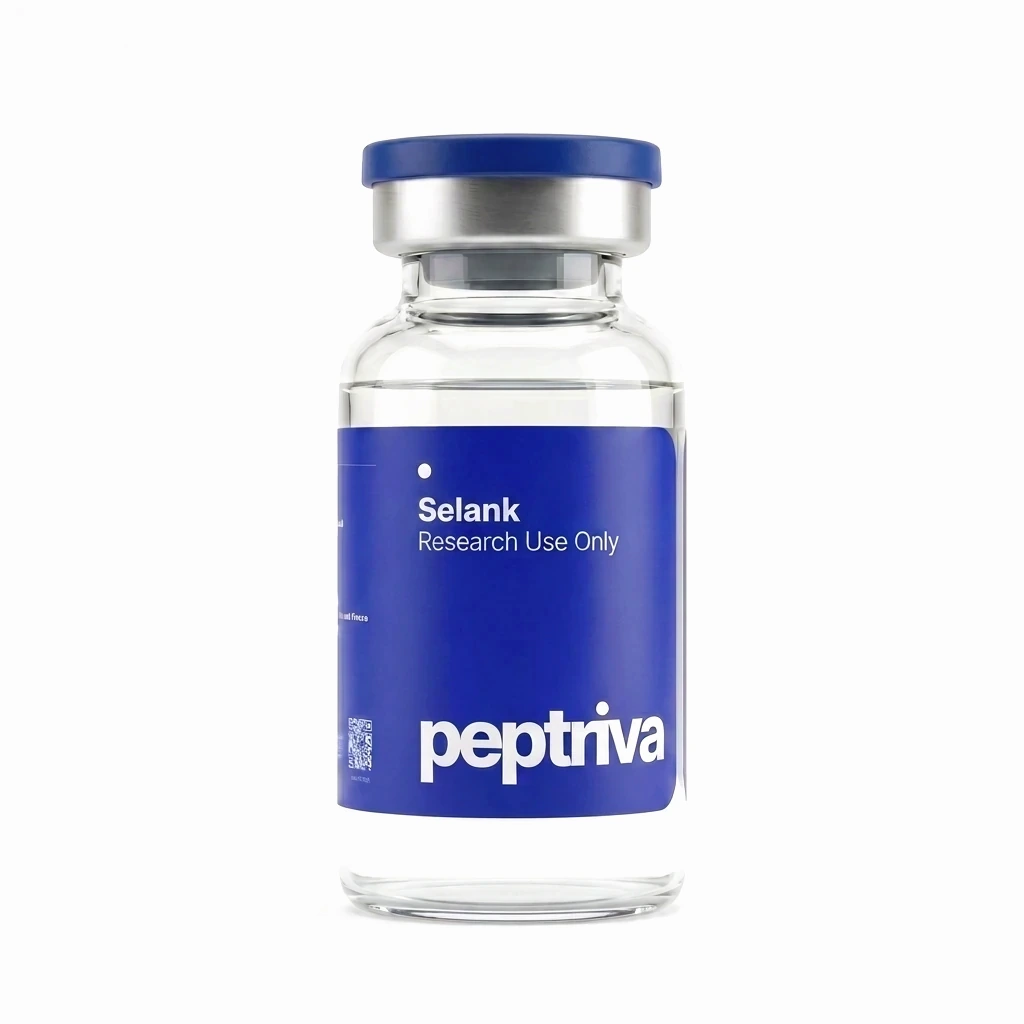
Selank
N-acetylated heptapeptide tuftsin analog. The same reference compound used across the cited Russian preclinical and Western fMRI mechanism studies. COA available with each lot.
Interpreting the Selank literature
Two positions coexist in the published record. Selank is one of the more mechanistically interesting peptides in the anxiolytic class: tuftsin scaffold, multi-system activity, rigorous human fMRI proof of CNS engagement, and a pharmacological profile that does not resemble a benzodiazepine. That is the stronger reading of the available data.
The weaker reading: its Western RCT evidence base is the thinnest of any anxiolytic in the literature. Both positions are well-supported. Researchers should hold both simultaneously rather than selectively applying one.
Selank and Semax modulated functional connectivity between the right amygdala and right temporal cortex regions including fusiform, inferior, middle temporal, and parahippocampal gyri — within 5 to 20 minutes of intranasal administration in 52 healthy human participants.
— Panikratova et al., Doklady Biological Sciences, 2020
What the literature supports: Selank as a multi-system anxiolytic modulator with measurable CNS activity and no classical GABA-A sedation. What it doesn't support: specific dose claims for cognitive enhancement in healthy people. That second framing is the dominant grey-market pitch and the one with the least evidence.
What to know now
- Structure: a 7-amino-acid peptide (Thr-Lys-Pro-Arg-Pro-Gly-Pro), capped with an acetyl group at the front end for stability.
- Tuftsin parent: the natural 4-amino-acid immune-signaling fragment Selank is built on. Explains the cytokine arm.
- GABA modulation: in rat morphine-withdrawal tests, Selank approached diazepam without binding the benzodiazepine site. Exact target still unknown.
- Serotonin and dopamine: reported as "stabilized" rather than agonized — a softer effect across multiple neurotransmitters.
- 2020 fMRI human study: 52 healthy adults. Selank shifted amygdala–temporal-cortex connectivity within 5–20 minutes of a nasal spray.
- IL-6 suppression: cut four pro-inflammatory cytokines in chronic-stress rat models.
- HPA-axis effect: reduced corticosterone (rat cortisol) and visible stress damage to colon tissue.
- No sedation, no withdrawal: the standout clinical claim. Real but unconfirmed by Western RCT.
- The big gap: no PubMed-indexed Western RCT for any indication. Russian clinical evidence sits outside PubMed.
What we're watching
Two questions over the next 24 months. First, will any group pin down Selank's actual receptor? A confirmed non-benzodiazepine GABA-system target would be a new pharmacological category. Second, will a Western RCT of Selank for generalized anxiety disorder finally land in PubMed? The 2020 fMRI proves CNS engagement. The treatment trial in research subjects with anxiety disorder diagnoses is still missing.
References
- Panikratova, Y. R., Lebedeva, I. S., Sokolov, O. Y., et al. (2020). Functional connectomic approach to studying Selank and Semax effects. Doklady Biological Sciences, 490(1), 9–11. https://doi.org/10.1134/S001249662001007X
- Konstantinopolsky, M. A., Chernyakova, I. V., & Kolik, L. G. (2022). Selank, a peptide analog of tuftsin, attenuates aversive signs of morphine withdrawal in rats. Bulletin of Experimental Biology and Medicine, 173(6), 730–733. https://doi.org/10.1007/s10517-022-05624-x
- Yasenyavskaya, A. L., Samotrueva, M. A., Tsibizova, A. A., Bashkina, O. A., Myasoedov, N. F., & Andreeva, L. A. (2021). The influence of Selank on the level of cytokines under the conditions of "social" stress. Current Reviews in Clinical and Experimental Pharmacology, 16(2), 162–167. https://doi.org/10.2174/1574884715666200704152810
- Mukhina, A. Y., Mishina, E. S., Bobyntsev, I. I., et al. (2020). Morphological changes in the large intestine of rats subjected to chronic restraint stress and treated with Selank. Bulletin of Experimental Biology and Medicine, 169(2), 281–285. https://doi.org/10.1007/s10517-020-04868-9
- Russian regulatory communications. (2009 onward.) Russian Ministry of Health approval of Selank as a nasal-drop formulation for generalized anxiety disorder. (Cited for regulatory context; primary trial documents are largely Russian-language and outside PubMed.) Russian Ministry of Health