The most useful question in the NAD IV vs NMN/NR debate isn't "which one works better." It's which one has actually been tested in randomized human trials for what people are paying to treat.
Oral NMN and NR (the two main NAD+ precursors) have real human-trial backing. Multiple peer-reviewed studies in middle-aged and older adults reported reliable blood NAD+ rises and modest gains in walking speed, grip strength, and sleep quality. IV NAD+ has essentially zero published RCTs for the marketed indications. A single drip costs roughly 100× a month of oral NMN.
This article walks through the comparison the way it should be done: cellular uptake, half-life, the human RCT evidence base, cost per treatment, and what each delivery route is actually best-evidenced for.
The NAD+ marketing landscape in 2026 is one of the strangest corners of the wellness market. Celebrities post about $1,000-per-session IV drips. Clinics in Beverly Hills, Manhattan, and Miami advertise NAD+ for "cellular rejuvenation," addiction recovery, jet lag, and cognitive enhancement.
Meanwhile, in journals like GeroScience and NPJ Aging, the actual peer-reviewed clinical evidence has been quietly piling up. The picture it draws is dramatically different from the IV-clinic pitch.
The cellular uptake problem with intact NAD+.
Intravenous NAD+ has a basic pharmacology problem. NAD+ itself doesn't cross cell membranes efficiently. The molecule is large, charged, and built from two nucleotide bases joined by a two-phosphate bridge.
Charged dinucleotides aren't well-suited to crossing the oily cell membrane. Researchers have argued for years about whether one specific transporter (called slc12a8) carries intact NAD+ into cells. Some groups report uptake. Others can't reproduce it under controlled conditions.
What actually happens when NAD+ is infused is that the molecule is degraded rapidly in the bloodstream by enzymes like CD38 (an enzyme that breaks down NAD+). The breakdown products (nicotinamide and ADP-ribose) enter cells readily. Nicotinamide is then recycled back into NAD+ inside the cell.
That means an IV NAD+ drip is a roundabout, expensive way to deliver nicotinamide.
The contrast with the oral precursors is sharp. Nicotinamide riboside (NR) is a small, neutral molecule that crosses cell membranes through normal nucleoside transporters. Nicotinamide mononucleotide (NMN) gets converted to NR by a surface enzyme called CD73, then taken up and converted back to NMN inside the cell, then to NAD+ by enzymes called NMNAT.
Both oral routes have been better characterized than IV NAD+ uptake. Both reliably raise blood and tissue NAD+ in published human studies.
The pharmacology argument for IV NAD+ over oral precursors has never been clearly established. Intact NAD+ does not cross cell membranes efficiently; the breakdown products that reach the intracellular NAD+ pool are the same nicotinamide and nucleotide salvage intermediates that oral precursors deliver more efficiently and far less expensively.
— integrated mechanistic context, NAD+ biology literature
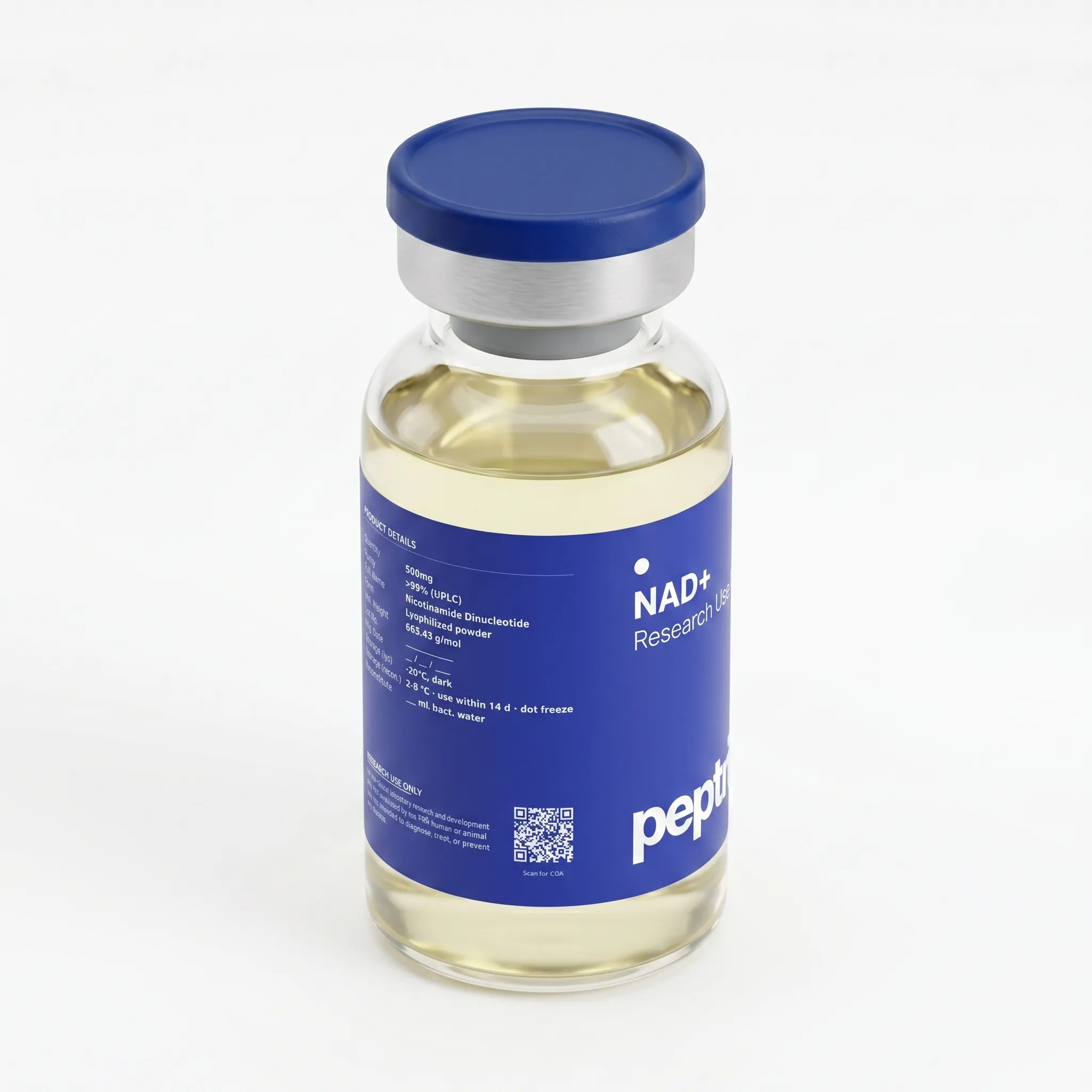
NAD+
The same NAD+ coenzyme cited across the in-vitro and pharmacology studies in this review. Lab-verified identity and purity for cellular redox and sirtuin-activity assays.
The human RCT evidence base, compared.
Here's where the comparison gets the most lopsided. Oral NMN and NR have a real published RCT evidence base in middle-aged and older adults. IV NAD+ for the commonly marketed indications has essentially nothing comparable.
Oral NMN. The 2023 GeroScience dose-response trial by Yi et al. randomized 80 middle-aged study participants to placebo or NMN supplementation for 60 days. Blood NAD+ rose significantly in every NMN group at days 30 and 60. Six-minute walking distance increased across all dose cohorts. Quality-of-life scores improved. The compound was well tolerated at all doses studied.
The 2024 GeroScience trial by Morifuji et al. enrolled 60 older study participants for 12 weeks. The trial reported faster 4-meter walking times and improved sleep quality on the Pittsburgh Sleep Quality Index. The 2022 NPJ Aging trial in older men (Igarashi et al.) reported higher blood NAD+ with modest gains in gait speed and grip strength.
Oral NR. The 2022 Frontiers in Cardiovascular Medicine protocol from Freeberg et al. enrolled 94 midlife and older study participants with above-normal blood pressure. The MIB-626 program at Washington University has run additional NR Phase II trials. The pattern reported across these trials is consistent with the NMN data: reliable blood NAD+ rises, modest functional gains, and an acceptable tolerability profile.
Direct IV NAD+. A PubMed search for "NAD+ intravenous infusion clinical trial randomized" returns essentially nothing for the marketed indications. No anti-aging RCT. No addiction recovery RCT. No cognitive enhancement RCT. The published material is overwhelmingly observational, uncontrolled, or in non-peer-reviewed sources.
The asymmetry matters. The IV-NAD+ market has built itself on legitimate oral-precursor research. It borrows the "NAD+ matters for aging" biology that NMN and NR trials established, then applies it to a delivery format (IV infusion) that nobody has comparably tested.
Side-by-side: the comparison.
If we lay out the comparison on the axes that matter, the gap is clear.
What the numbers say
Cellular uptake. NR: efficient. NMN: efficient. IV NAD+: contested; most reaches cells as breakdown products.
Route. NR: oral capsule. NMN: oral capsule or sublingual. IV NAD+: intravenous infusion administered over multiple hours in clinical settings.
Half-life. NR: rapid absorption, t½ about 3-5 hours. NMN: similar. IV NAD+: parent molecule degraded rapidly in plasma.
Human RCT evidence. NR: multiple Phase II trials. NMN: 4+ published RCTs in roughly 230 adults. IV NAD+: essentially none for marketed indications.
Best-evidenced for. NR/NMN: walking speed, grip strength, sleep quality (modest gains reported in published RCTs). IV NAD+: no validated indication with published RCT support.
Tolerability. NR/NMN: well tolerated across dose ranges studied in published RCTs. IV NAD+: chest tightness, flushing, headache, and anxiety reported; requires slow infusion administration.
Cost per treatment. NR: roughly $30-60/month. NMN: $40-80/month. IV NAD+: $500-1,500 per single infusion.
What "celebrity NAD IV" is and isn't supported by.
Celebrity-driven NAD+ IV marketing produces a distinct vocabulary. "Reset my cellular age." "Feel like myself again." "The best I've felt in years." None of those phrases match validated outcome measures in any published NAD+ trial.
The endpoints that actually moved in NMN trials are different. They're centimeter-scale walking-speed changes. Single-digit-point sleep-quality improvements. Modest grip-strength gains. None of those translate to the dramatic transformations the marketing language implies.
That gap matters. The most expensive intervention with the weakest evidence is also the one marketed with the most dramatic claims. We've seen this pattern before in other consumer-medicine markets.
The mechanistic read on reported subjective effects from IV NAD+ sessions is likely a mix of high-dose nicotinamide delivered through the breakdown products, a placebo response in a high-cost clinical setting, the saline volume itself, and extended quiet rest during the infusion. None of those mechanisms require the "intact NAD+ delivered to the mitochondria" narrative the marketing implies.
Oral precursors vs. IV: the evidence comparison.
On the axes that matter for research evaluation — evidence base, mechanistic characterization, tolerability profile, and cost — oral precursors are better-characterized across all of them.
Two factors differentiate NMN from NR in the literature:
- Regulatory status. The FDA rejected NMN as a dietary supplement in 2022 on the grounds that it is being studied as a drug. NR (sold mainly as NIAGEN by ChromaDex) is sold as a regular dietary supplement. International availability varies by jurisdiction.
- Trial cohort characteristics. The Yi 2023 trial enrolled middle-aged adults. The Morifuji 2024 and Igarashi 2022 trials enrolled older adults. The Freeberg NR trial focused on adults with above-normal blood pressure. Cohort selection shapes which endpoints were measured and reported.
The mechanistic difference between NR and NMN is small. NR converts to NMN, which converts to NAD+. No head-to-head trial has demonstrated a clinically meaningful difference between them on shared endpoints.
When IV NAD+ might be defensible.
An honest article requires acknowledging the narrow contexts where IV NAD+ might still make sense despite the evidence gap.
Addiction-recovery research. The NAD+ infusion protocols used in some recovery clinics (usually paired with vitamin and amino-acid infusions over several days) have a longer clinical history than the recent anti-aging marketing. Whether NAD+ is doing the work, or whether the supportive care and fluid replacement is, hasn't been rigorously sorted out. There's ongoing legitimate research here.
Severe niacin deficiency (pellagra). Acute high-dose nicotinamide has a small medical history in severe deficiency contexts. But oral nicotinamide is the standard, and IV NAD+ in that setting is just delivering nicotinamide via an indirect and expensive route.
Outside those narrow contexts, the case for IV NAD+ over oral precursors is weak. The clinic landscape that's grown up around "general wellness" infusions runs well ahead of any published evidence that would support the premium pricing or the dramatic claims.
Glutathione
Tripeptide antioxidant · γ-Glu-Cys-Gly (reduced, GSH). The same reference compound used across the in-vitro redox and oxidative-stress assays. COA available with each lot.
Where this falls short
We didn't run the comparison ourselves. The NMN and NR evidence comes from manufacturer-funded trials and academic groups that have publicly disclosed industry ties. Effect sizes are modest. A 0.05 m/s gait-speed change isn't a transformation. We've based the IV NAD+ "zero RCTs" claim on PubMed searches; an unpublished or unindexed trial wouldn't show up. And we don't yet have long-term safety data past 60 days for oral NMN.
Key considerations when evaluating NAD+ delivery routes.
Researchers and clinicians evaluating NAD+ compounds across delivery formats may find the following comparators useful:
- Evidence base by delivery route. Oral NR and NMN have substantially better published RCT support than IV NAD+ for essentially every claimed indication.
- Trial-validated endpoints. Published NMN/NR RCTs reported modest gains in walking speed, grip strength, and sleep quality in middle-aged and older cohorts. Other endpoints have less published support.
- Cost differential. A single IV NAD+ infusion is roughly 100× the cost of a month of oral NMN, with weaker supporting evidence.
- Regulatory classification. NMN was rejected by FDA as a dietary supplement in 2022 (being investigated as a drug). NR is sold as a dietary supplement. IV NAD+ has no FDA approval for any indication.
- Interaction characterization. NAD+ precursor effects on chemotherapy agents, certain neurological drugs, and methylation pathways are not fully characterized in the literature.
- Reference compound quality. Reputable NR and NMN reference compounds ship with HPLC certificates of analysis. Grey-market material often lacks verified purity documentation.
- Endpoint selection for research. Standardized functional measures (gait speed, sit-to-stand) and blood NAD+ quantification have been used as primary endpoints in the published RCTs; these provide more reproducible readouts than subjective self-report.
The bottom line.
Published RCTs reported that oral NMN and NR reliably raised blood NAD+ and were well tolerated, with modest measurable gains in walking speed, grip strength, and sleep quality across more than 200 study participants.
IV NAD+ has essentially no comparable trial support for the marketed indications. Acute administration has been associated with uncomfortable reactions including flushing and chest tightness, requiring slow infusion rates. The pharmacology of intact NAD+ cellular uptake remains contested.
In the research literature, oral NMN or NR at doses studied in published RCTs represent the better-characterized route — taken consistently over durations matching the trial designs. IV infusion, by contrast, carries substantially higher cost, marginal-to-no published evidence for the marketed indications, and a less favorable acute tolerability profile than the oral alternatives.
What to know now
- Cellular uptake: oral NR via nucleoside transporters. Oral NMN via CD73/slc12a8 routes. IV NAD+ uptake of intact molecule contested.
- Best human RCT evidence: oral NMN, 4+ published trials, ~230 study participants. Reported outcomes: walking speed, grip strength, sleep quality.
- IV NAD+ for marketed indications: essentially no published RCT support for anti-aging, addiction recovery, energy, cognitive enhancement.
- Cost asymmetry: one IV NAD+ infusion is about 100× a month of oral NMN.
- Tolerability: oral precursors well tolerated. IV infusion needs multi-hour slow administration to manage flushing, chest tightness, and anxiety.
- Regulatory: NMN rejected as dietary supplement by FDA 2022 (being investigated as drug). NR sold as dietary supplement. IV NAD+ no FDA approval for any indication.
- Honest framing: the most-marketed NAD+ option is the one with the weakest published evidence.
What we're watching
Three things over the next 24 months. First, whether any IV NAD+ RCT for a specific approved indication reaches publication. Addiction-recovery research is the strongest candidate; a registered Phase II trial with proper controls would change the picture. Second, the next NMN/NR readouts from the MIB-626 program and the chronic-insomnia NMN trial. Larger cohorts and longer durations will refine the oral-precursor evidence. Third, the FDA position on NMN as a dietary supplement. The 2022 rejection signals that real Phase III work is moving, and how that gets resolved will shape both consumer access and the commercial market.
References
- Yi, L., Maier, A. B., Tao, R., et al. (2023). The efficacy and safety of β-nicotinamide mononucleotide (NMN) supplementation in healthy middle-aged adults: A randomized, multicenter, double-blind, placebo-controlled, parallel-group, dose-dependent clinical trial. GeroScience, 45(1), 29–43. https://doi.org/10.1007/s11357-022-00705-1
- Morifuji, M., Higashi, S., Ebihara, S., & Nagata, M. (2024). Ingestion of β-nicotinamide mononucleotide increased blood NAD levels, maintained walking speed, and improved sleep quality in older adults in a double-blind randomized, placebo-controlled study. GeroScience, 46(5), 4671–4688. https://doi.org/10.1007/s11357-024-01204-1
- Igarashi, M., Nakagawa-Nagahama, Y., Miura, M., et al. (2022). Chronic nicotinamide mononucleotide supplementation elevates blood nicotinamide adenine dinucleotide levels and alters muscle function in healthy older men. NPJ Aging, 8(1), 5. https://doi.org/10.1038/s41514-022-00084-z
- Katayoshi, T., Uehata, S., Nakashima, N., et al. (2023). Nicotinamide adenine dinucleotide metabolism and arterial stiffness after long-term nicotinamide mononucleotide supplementation. Scientific Reports, 13(1), 2786. https://doi.org/10.1038/s41598-023-29787-3
- Freeberg, K. A., Craighead, D. H., Martens, C. R., et al. (2022). Nicotinamide riboside supplementation for treating elevated systolic blood pressure and arterial stiffness in midlife and older adults. Frontiers in Cardiovascular Medicine, 9, 881703. https://doi.org/10.3389/fcvm.2022.881703
- Covarrubias, A. J., Perrone, R., Grozio, A., & Verdin, E. (2021). NAD+ metabolism and its roles in cellular processes during ageing. Nature Reviews Molecular Cell Biology, 22(2), 119–141. https://doi.org/10.1038/s41580-020-00313-x
- Rajman, L., Chwalek, K., & Sinclair, D. A. (2018). Therapeutic potential of NAD-boosting molecules: The in vivo evidence. Cell Metabolism, 27(3), 529–547. https://doi.org/10.1016/j.cmet.2018.02.011