The most-searched tirzepatide FAQs converge on a core set of questions: how the compound differs mechanistically from semaglutide, what the adverse-event profile looks like, the current state of cardiovascular outcomes data, and where retatrutide stands as the next-generation comparator. The answers below are drawn directly from the SURMOUNT and SURPASS Phase III trial data, with evidence strength noted where findings are pending.
Tirzepatide is the first FDA-approved dual GIP/GLP-1 agonist — the first approved compound to activate both gut hormone receptors simultaneously. Eli Lilly markets it as Mounjaro for type 2 diabetes (approved 2022) and Zepbound for obesity (approved 2023). SURMOUNT-1 reported 22.5% mean weight reduction at 72 weeks on the top dose. SURMOUNT-4 extended that to 25.3%. In the SURPASS-2 head-to-head against semaglutide, tirzepatide produced approximately 2× the weight reduction at every dose. Nausea was reported in approximately 33% of study participants on the 15 mg dose. Cardiovascular outcomes data remain pending from SURMOUNT-MMO.
Tirzepatide’s commercial run has been the fastest in metabolic medicine history. The questions people ask about it have scaled the same way. The molecule sits roughly where semaglutide was three years ago. It’s widely prescribed, broadly understood, and waiting on several outcome trials that’ll decide whether the long-term story holds.
What follows: the most-searched questions, each answered from peer-reviewed Phase III data. Where the evidence is strong, we say so. Where it’s pending (heart outcomes, multi-year durability), we flag that.
What is tirzepatide?
Tirzepatide is a 39-amino-acid synthetic peptide. A C20 fatty-diacid acyl chain enables albumin binding, extending circulatory half-life from minutes to approximately five days — the structural basis for once-weekly subcutaneous administration in the approved protocols. The compound's INN lab code was LY3298176. Eli Lilly markets it as Mounjaro (type 2 diabetes) and Zepbound (obesity).
Here’s the part that matters more than the chemistry. Tirzepatide’s a dual agonist. It activates two gut hormone receptors at once: GLP-1 (the same one Ozempic hits) and GIP (a sister receptor that handles insulin and fat-tissue signals). Two pathways, one molecule. That’s the single most important fact about why this drug behaves the way it does.
How is tirzepatide different from semaglutide?
Semaglutide (Ozempic and Wegovy) is a pure GLP-1 agonist, activating one receptor. Tirzepatide activates two: GLP-1 plus GIP. The GLP-1 pathway mediates delayed gastric emptying, appetite suppression, and glucose-dependent insulin secretion — effects shared by both compounds. The added GIP pathway further potentiates insulin secretion and is proposed to act on adipose tissue and central satiety circuits in the brainstem.
The mechanism predicts that stacking two receptors does more than one. The trial data confirms it. Tirzepatide beats semaglutide on both weight loss and blood-sugar control in head-to-head testing.
Did the head-to-head SURPASS-2 data favor tirzepatide?
Yes, clearly. Frías and colleagues randomized 1,879 adults with type 2 diabetes who couldn’t control blood sugar on metformin alone. They got tirzepatide 5 mg, 10 mg, 15 mg, or semaglutide 1 mg once a week for 40 weeks. The primary outcome was HbA1c (a 3-month blood-sugar average).
The HbA1c drops landed at −2.01% (tirzepatide 5 mg), −2.24% (10 mg), and −2.30% (15 mg). Semaglutide 1 mg came in at −1.86%. Every tirzepatide dose beat semaglutide. The 15 mg dose did so by nearly half a point.
Weight loss separated even further. Tirzepatide 15 mg dropped 11.2 kg on average. Semaglutide 1 mg dropped 5.7 kg. That’s nearly twice as much. SURPASS-2 ended the clinical debate. Hitting two incretin receptors really does outperform hitting one.
The success of tirzepatide validates the dual-incretin hypothesis. Hitting GIP and GLP-1 receptors at the same time produces consistently larger weight loss than GLP-1 alone, with side effects broadly similar to the established GLP-1 class.
— Melson et al., International Journal of Obesity, 2024 (paraphrased summary)
Where this falls short. SURPASS-2 compared tirzepatide to semaglutide 1 mg, not the 2.4 mg dose studied in the STEP program for obesity. The commonly cited figure contrasting tirzepatide's 22.5% vs semaglutide's 14.9% weight reduction stitches together two separate trials (SURMOUNT-1 and STEP-1) with different study populations and designs — this is suggestive, not a within-trial head-to-head comparison at matched doses.
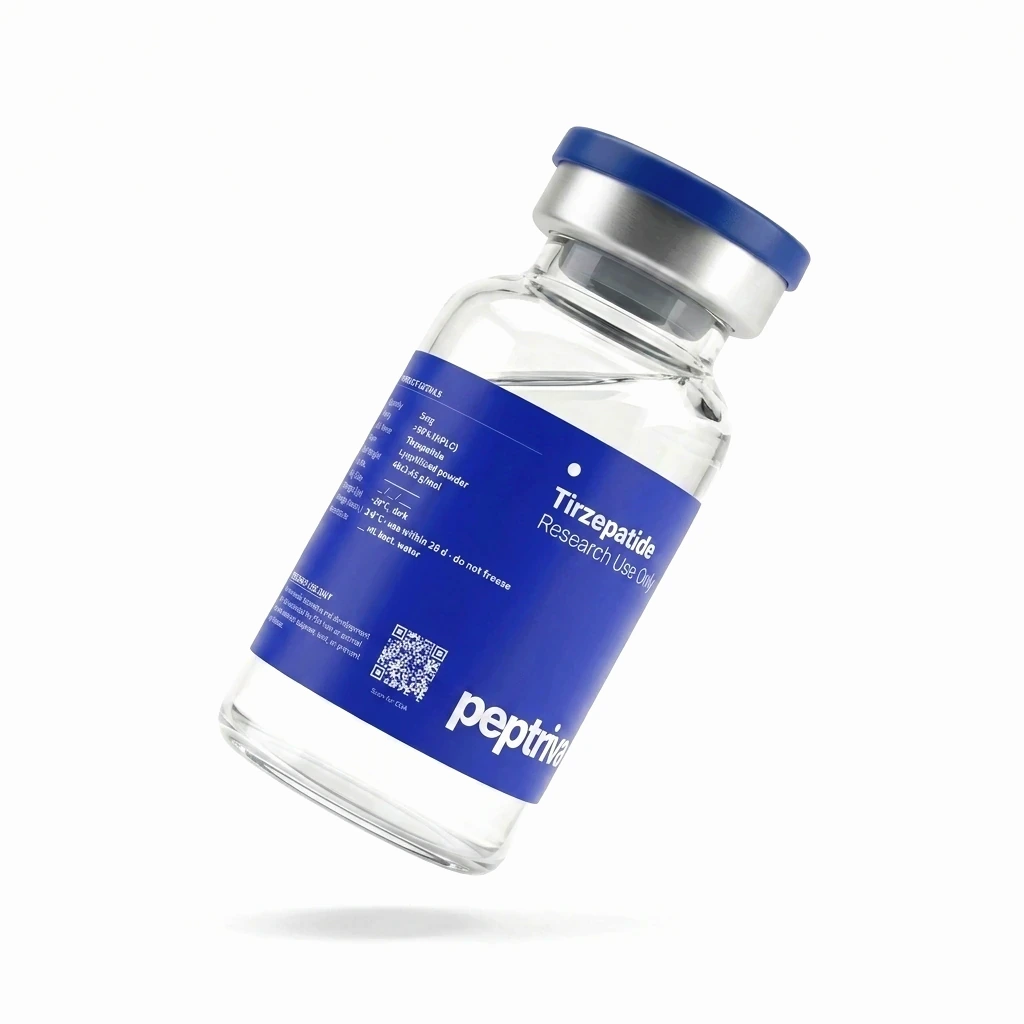
Tirzepatide
The same compound cited across the SURMOUNT and SURPASS trials in this FAQ. Lab-verified identity and purity.
What are the side effects?
SURMOUNT-1 investigators reported that adverse events were predominantly gastrointestinal, mostly mild-to-moderate in severity, and largely transient during the dose-escalation phase. On the 15 mg dose, the reported rates were:
- Nausea: ~33% (vs. ~10% on placebo)
- Diarrhea: ~22% (vs. ~9% on placebo)
- Constipation: ~17% (vs. ~6% on placebo)
- Vomiting: ~12% (vs. ~2% on placebo)
- Decreased appetite: ~10%
Events were generally mild to moderate in severity, peaking during dose-escalation intervals and attenuating thereafter. Between 4 and 7% of study participants in the active arms of SURMOUNT-1 discontinued due to adverse events, vs. 3% on placebo. Most participants who enrolled completed the 72-week trial on the assigned dose.
The SURMOUNT and SURPASS trial protocols incorporated gradual dose escalation; investigators noted that this approach was associated with a lower burden of GI adverse events relative to more rapid escalation.
Is tirzepatide FDA-approved?
Yes, under two brand names. Mounjaro got the type 2 diabetes approval in May 2022. Zepbound got the obesity approval in November 2023 for adults with BMI of 30 or more, or BMI of 27 plus a weight-related condition (high blood pressure, high cholesterol, type 2 diabetes, sleep apnea, or heart disease). Same molecule, same strength. The difference is the indication on the label.
It’s also approved in Europe (EMA), Canada (Health Canada), the UK (MHRA), and Japan (PMDA). That’s a key distinction from retatrutide, which is still investigational. No country has approved retatrutide for sale yet.
How was dose escalation studied in the clinical trials?
The SURMOUNT and SURPASS Phase III programs used a stepwise dose-escalation protocol. Participants advanced through successive dose levels at defined intervals, with the full approved prescribing schedule documented in the Mounjaro and Zepbound FDA labels. The trial design tested whether gradual escalation reduced the GI adverse-event burden during the initial exposure period.
Investigators observed that study participants who followed the protocol-defined titration schedule experienced fewer discontinuations due to GI adverse events than historical comparisons with more rapid escalation. The 5 mg, 10 mg, and 15 mg doses all served as maintenance levels in the trial arms; the approved labeling specifies which doses are indicated for maintenance based on the registered clinical data.
What does tirzepatide cost?
US list price for Zepbound launched at about $1,060 a month in November 2023. Most commercial insurance covers Mounjaro for diabetes more readily than Zepbound for obesity. Obesity coverage is patchy and remains the biggest access barrier.
In 2024, Eli Lilly launched LillyDirect, a direct pharmacy channel offering single-dose vials at $349 to $549 a month for the lower doses. International pricing varies widely. UK NHS pricing through NICE is substantially below US list price, and most national health systems negotiate closer to that range.
What do preclinical studies and the FDA label indicate about pregnancy?
Tirzepatide is contraindicated in pregnancy per the FDA prescribing information. The label specifies a washout interval prior to conception, based on the compound's extended half-life attributable to its C20 acyl chain. Animal studies demonstrated developmental toxicity at human-relevant exposures.
Investigators have noted that the metabolic effects of tirzepatide — including body-weight reduction — can restore ovulatory cycling in research subjects with obesity-related anovulation, a physiological effect documented in the clinical literature. The approved prescribing information addresses this in the context of contraception guidance for enrolled study populations.
Lactation data is limited. The prescribing information characterises benefit-risk assessment as individual. The molecular size of tirzepatide suggests low theoretical transfer into breast milk, though formal safety data in nursing infants has not been established.
Does it reduce cardiovascular events?
This is the open question. Two big outcome trials are still running:
- SURMOUNT-MMO: roughly 15,000 people with obesity plus existing heart disease. The endpoint is major heart events (heart attack, stroke, cardiovascular death). It’s the closest match to semaglutide’s SELECT trial.
- SURPASS-CVOT: the diabetes-indication cardiovascular safety trial, enrolling study participants with type 2 diabetes — fulfilling the FDA’s 2008 post-rosiglitazone cardiovascular outcomes requirement.
Tirzepatide already improves the things that drive heart events. Blood pressure drops. Cholesterol improves. Waist size shrinks. Liver fat goes down. That’s a strong reason to expect a SELECT-style benefit. But until SURMOUNT-MMO actually reads out, the official line is “highly plausible,” not “demonstrated.” Semaglutide carried that same caveat before its 2023 SELECT readout.
How does tirzepatide compare to retatrutide?
Retatrutide is Lilly’s next-generation molecule. It’s a triple agonist, hitting GIP, GLP-1, and a third receptor called glucagon. The Phase II trial (Jastreboff et al., NEJM 2023) showed roughly 24.2% mean weight loss at the top dose by 48 weeks. That beats tirzepatide’s SURMOUNT-1 result of 22.5% at 72 weeks, on paper.
A direct cross-trial comparison favours retatrutide on weight-loss magnitude in early data, though the two trials differ in study population composition, duration, and design — and Phase II results frequently differ from Phase III outcomes. The Phase III TRIUMPH program represents the definitive test for retatrutide. As of 2026, retatrutide remains investigational with no regulatory approval. Tirzepatide has 88-week maintenance data from SURMOUNT-4 and the largest published dataset in the approved incretin class.
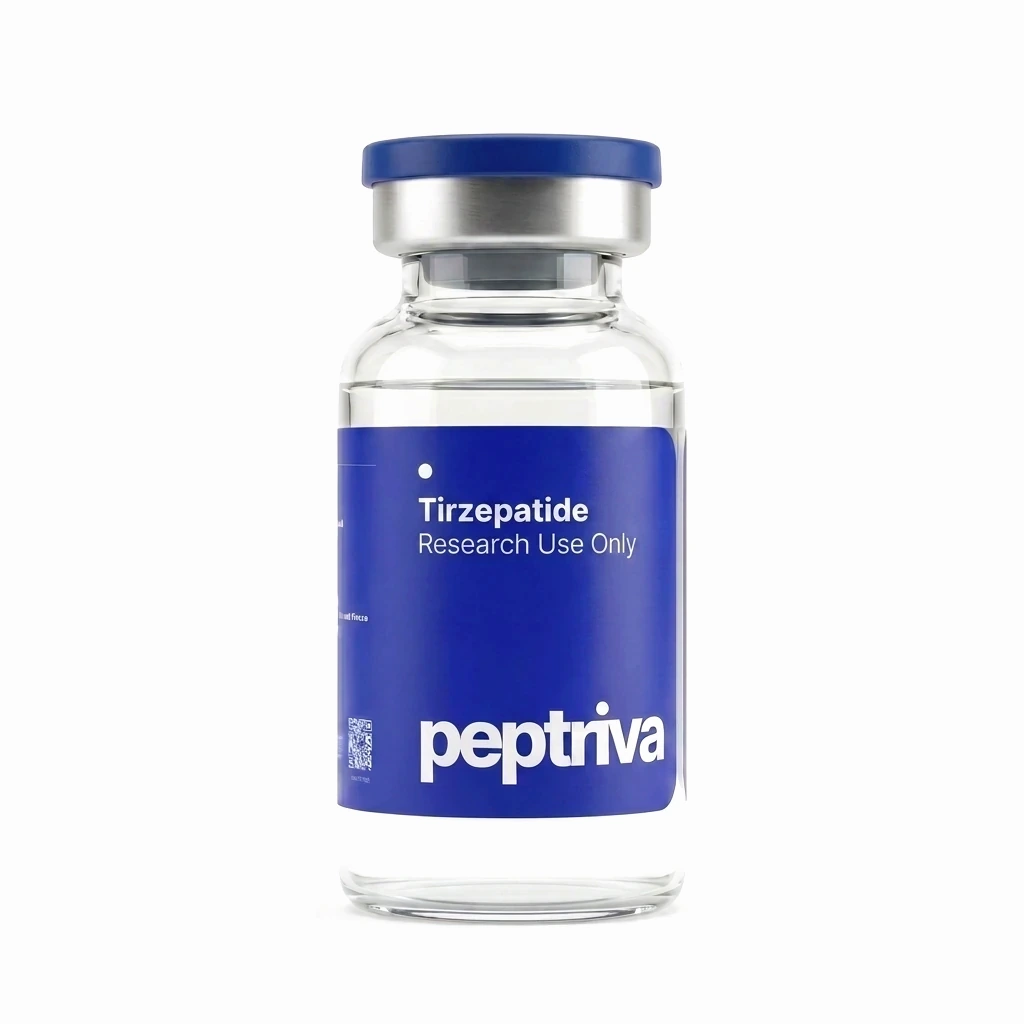
Tirzepatide
39-aa dual GIP/GLP-1 agonist with C20 fatty-diacid acyl chain. The same reference compound used across the cited SURMOUNT and SURPASS trials. COA available with each lot.
Key variables in tirzepatide research design
Researchers and clinicians reviewing tirzepatide trial data typically focus on several variables that the SURMOUNT and SURPASS programs directly addressed:
- Eligibility criteria: The Zepbound indication specifies BMI ≥30, or BMI ≥27 with at least one weight-related comorbidity — the same thresholds used to define SURMOUNT trial populations.
- Dose-escalation protocol: Trial designs incorporated stepwise escalation; investigators noted that protocol adherence was associated with lower GI adverse-event rates.
- Response assessment: SURMOUNT analyses used <5% weight reduction at week 16 as a pre-specified criterion for re-evaluating dose adequacy.
- Durability: SURMOUNT-4 demonstrated weight regain following discontinuation, supporting a chronic-treatment model; ongoing studies are characterising long-term durability.
- Reproductive status: Trial protocols addressed contraindication in pregnancy and the potential for restored ovulatory function with weight reduction.
- Access and cost: Market analyses note substantial variation in real-world access by insurance status and geographic region.
What to know now
- Mechanism: dual agonist at GIP and GLP-1 receptors. First approved drug to activate both gut-hormone pathways simultaneously.
- SURMOUNT-1 headline: studies reported 22.5% mean weight loss at 72 weeks on the 15 mg dose; 91% of study participants reached at least 5% weight reduction.
- SURPASS-2 head-to-head: tirzepatide outperformed semaglutide 1 mg at every dose on glycaemic control and produced approximately twice the weight reduction in type 2 diabetes study participants.
- Adverse events: SURMOUNT-1 reported ~33% nausea, ~22% diarrhoea, ~12% vomiting on 15 mg; mostly mild to moderate. Discontinuation due to adverse events occurred in 4–7% of active-arm participants.
- Regulatory status: FDA-approved for type 2 diabetes (Mounjaro, 2022) and obesity (Zepbound, 2023); approved by EMA, Health Canada, MHRA, and PMDA.
- Pregnancy: contraindicated per FDA prescribing information; animal studies demonstrated developmental toxicity.
- Cardiovascular outcomes: SURMOUNT-MMO is ongoing; a SELECT-equivalent cardiovascular benefit has not yet been demonstrated.
What we’re watching
Four things over the next 18 to 24 months. First, the SURMOUNT-MMO readout. That’s the move from “plausible heart benefit” to “proven.” Second, retatrutide’s Phase III TRIUMPH readouts. Tirzepatide’s position shifts a lot depending on whether it stays best-in-class or gets bumped. Third, oral incretins like orforglipron. A pill could rearrange the prescribing order. Fourth, durability past two years. The longest published data is 88 weeks. Multi-year sustainability is the next frontier.
References
- Jastreboff, A. M., Aronne, L. J., Ahmad, N. N., et al. (2022). Tirzepatide once weekly for the treatment of obesity. New England Journal of Medicine, 387(3), 205–216. https://doi.org/10.1056/NEJMoa2206038
- Frías, J. P., Davies, M. J., Rosenstock, J., et al. (2021). Tirzepatide versus semaglutide once weekly in patients with type 2 diabetes. New England Journal of Medicine, 385(6), 503–515. https://doi.org/10.1056/NEJMoa2107519
- Aronne, L. J., Sattar, N., Horn, D. B., et al. (2024). Continued treatment with tirzepatide for maintenance of weight reduction in adults with obesity: The SURMOUNT-4 randomized clinical trial. JAMA, 331(1), 38–48. https://doi.org/10.1001/jama.2023.24945
- Jastreboff, A. M., Kaplan, L. M., Frías, J. P., et al. (2023). Triple-hormone-receptor agonist retatrutide for obesity — A Phase 2 trial. New England Journal of Medicine, 389(6), 514–526. https://doi.org/10.1056/NEJMoa2301972
- Melson, E., Ashraf, U., Papamargaritis, D., & Davies, M. J. (2024). What is the pipeline for future medications for obesity? International Journal of Obesity, 49(3), 433–451. https://doi.org/10.1038/s41366-024-01473-y
- Lincoff, A. M., Brown-Frandsen, K., Colhoun, H. M., et al. (2023). Semaglutide and cardiovascular outcomes in obesity without diabetes. New England Journal of Medicine, 389(24), 2221–2232. https://doi.org/10.1056/NEJMoa2307563