The Selank + Semax combination is the most-discussed peptide pairing in the cognitive-research literature. Two Russian-developed heptapeptides from the same Moscow institute, one anxiolytic and one nootropic, investigated together as a complementary pairing. Both compounds are actual approved pharmaceuticals in Russia — which makes this pairing different from most peptide combinations on the research market. But Russian approval is not FDA approval. The gap matters more than most researchers realize. We'll walk through it.
Selank and Semax are both synthetic seven-amino-acid peptides developed at one Moscow institute (now part of the Kurchatov Institute). Selank is a tuftsin analog approved in Russia since 2009 for generalized anxiety. Semax is an ACTH(4-7) analog approved for ischemic stroke and cognitive disorders. The pairing is complementary: Selank reduces anxiety without sedation; Semax supports cognition through brain-cell growth factor signaling. The most rigorous Western study (52 adults, fMRI, Panikratova 2020) showed both peptides shift brain connectivity within 5–20 minutes of intranasal dosing. Zero PubMed-indexed Western RCTs exist for either peptide or the combination.
Where did the stack come from?
The Selank + Semax pairing didn't emerge from a marketing campaign or a clinical trial. It emerged from a shared lab origin.
Both peptides came out of the Institute of Molecular Genetics (Russian Academy of Sciences, now part of the Kurchatov Institute). Same research program. Same time frame: the 1980s and 1990s. Same lead scientists — N.F. Myasoedov and L.A. Andreeva — across decades of publications.
Both peptides share a heptapeptide design with a C-terminal Pro-Gly-Pro stabilizing tail grafted onto different parent sequences (tuftsin for Selank, ACTH(4-7) for Semax). Both were designed for nasal-drop delivery.
That shared origin is why the stack feels coherent. The Western literature formalized the pairing when Panikratova et al. (2020) ran a placebo-controlled fMRI study in 52 healthy adults comparing Selank, Semax, and placebo head-to-head — the first methodologically rigorous Western study to test both peptides in the same protocol.
Why pair calm and cognition?
The logic rests on two complementary brain effects: anxiety reduction without sedation (Selank) and cognitive and neuroprotective support (Semax).
Anxiety and impaired cognition often co-occur. Chronic anxiety taxes working memory and executive function. High cognitive demand amplifies anxiety. The two peptides hit different parts of that biology.
Selank: anxiety without the benzo trade-offs
Selank's sequence is Thr-Lys-Pro-Arg-Pro-Gly-Pro — structurally a stabilized tuftsin analog. Its anxiety-reducing profile is attributed to modulation of GABA, serotonin, and dopamine without the sedation or tolerance you see with benzodiazepines (Konstantinopolsky et al., 2022).
A 2021 stress-immunology study showed Selank reduces IL-1β, IL-6, TNF-α, and TGF-β1 (four inflammatory signaling molecules) under chronic social stress. That suggests a stress-protective immunomodulatory action (Yasenyavskaya et al., 2021).
Semax: BDNF, NGF, and copper chelation
Semax's sequence is Met-Glu-His-Phe-Pro-Gly-Pro. It's an analog of the ACTH(4-7) fragment but described as "noncorticotropic" — it doesn't trigger cortisol release despite the ACTH lineage.
The proposed mechanism centers on BDNF and NGF (brain-cell survival and growth factors), with additional modulation of multiple inflammatory pathways documented in stroke models from the Kurchatov Institute group (Sudarkina et al., 2021).
Independent Italian groups have shown Semax also binds copper ions and prevents copper-amyloid complexes from forming. That protects nerve cells from oxidative damage — a mechanism potentially relevant to Alzheimer's pathology (Sciacca et al., 2022).
The pairing rationale is structurally clean: Selank takes down acute anxiety load without sedating, Semax supports the brain-cell biology underlying cognition. Whether the combination beats either peptide alone has never been tested in a controlled clinical study.
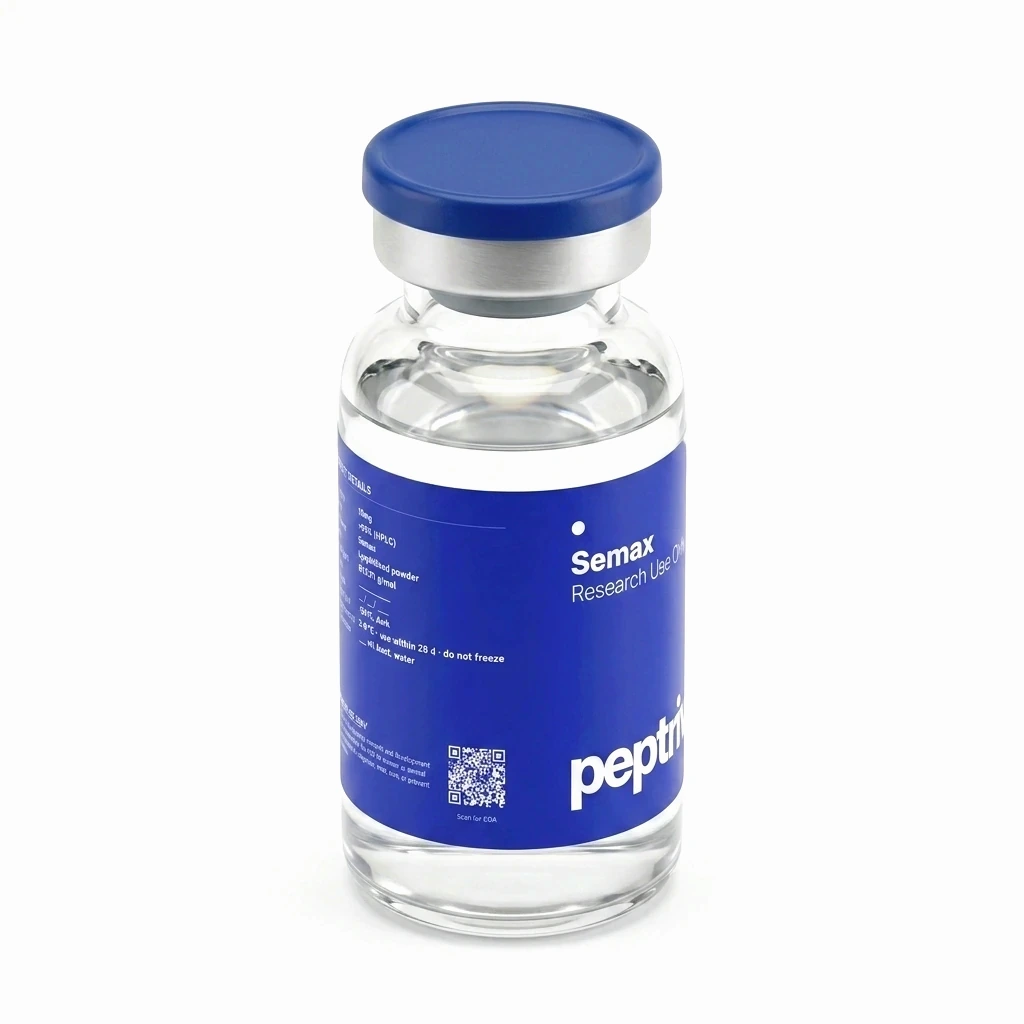
Semax
The same compound cited across the Kurchatov Institute stroke-genomics series (Sudarkina 2021, Filippenkov 2024) and the 2020 fMRI study in this review. Lab-verified identity and purity.
What does Russian regulatory approval actually mean?
Both peptides have something almost no other research peptide can claim: real regulatory approval somewhere.
Selank has been approved in Russia since 2009 for generalized anxiety disorder. Semax is approved for ischemic stroke and certain cognitive disorders. Both are licensed pharmaceuticals in Russian pharmacies, prescribed by Russian physicians.
That puts the stack ahead of most peptide pairings on the evidentiary ladder. These are real pharmaceuticals, not chemicals invented by online forums. But the gap to FDA approval is meaningful.
- Different evidentiary bar. Russian approval rests on Russian-language clinical trials not indexed in PubMed and not subject to the same RCT design standards as FDA pivotal trials.
- No PubMed-indexed Western RCTs. No randomized placebo-controlled trial of Selank or Semax for anxiety, cognition, stroke, or any other indication published in 2020–2026.
- No WADA listing. Neither peptide is explicitly listed on the WADA Prohibited List. Athletes should still consult sport-specific anti-doping rules.
- Not FDA-approved. In the US, both are sold only as research peptides on the grey market and aren't legal for human use.
"
Selank is one of the few peptides that has actual regulatory approval somewhere for an actual therapeutic indication — putting it ahead of most 'research peptides' in evidentiary status, while clearly behind Western FDA-approved drugs like tesamorelin or bremelanotide.
What does the published evidence actually show?
Three categories of evidence sit under the stack. Each carries different weight.
1. Preclinical data on each peptide alone
Semax has the deeper bench. The Kurchatov Institute group has published a coordinated series of gene-expression studies in stroke models (tMCAO rats) — suppressing inflammatory genes at 4.5 hours and compensating ischemia-disrupted gene expression at 24 hours across 1,171 differentially expressed genes (Filippenkov et al., 2024).
A 2025 British Journal of Pharmacology study extended Semax to spinal-cord injury (Liu et al., 2025). Selank's preclinical bench is thinner but includes morphine-withdrawal, cytokine-modulation, and restraint-stress models (Mukhina et al., 2020).
2. Human data on each peptide alone
The 2020 Panikratova fMRI study is the single most rigorous indexed Western study of either peptide. It enrolled 52 healthy adults in a placebo-controlled three-way design, with brain imaging before, 5 minutes after, and 20 minutes after intranasal dosing.
Both peptides shifted functional connectivity between the right amygdala and right temporal cortex. That's biological imaging evidence that the peptides have measurable effects on the brain within the acute dosing window.
3. Data on the combination itself
Effectively zero. No published study has tested the combination as a stack with controlled efficacy outcomes. The Panikratova design tested both peptides in the same participants but as a within-subject comparison, not as a co-administered stack.
Where this falls short. The combination rests on Russian regulatory approval of each individual peptide, sound Western imaging evidence that both act on the brain acutely, and zero published controlled trials of the combination. Research use of this pairing operates ahead of the evidence on combination specifics — even though the individual peptides are real pharmaceuticals in Russia.
How does this stack sit against other named stacks?
The Selank + Semax pairing has a distinct position among named research-peptide stacks. It's the only pairing where both individual peptides have regulatory approval somewhere in the world.
Other co-investigated pairings are either FDA-approved combinations (the GLP-1 dual agonists), entirely off-label combinations studied in the literature (BPC-157 + TB-500, mitochondrial peptide combinations), or longevity-leaning Khavinson protocols. The chart below ranks the most-discussed research pairings by published evidence depth for the combination itself.
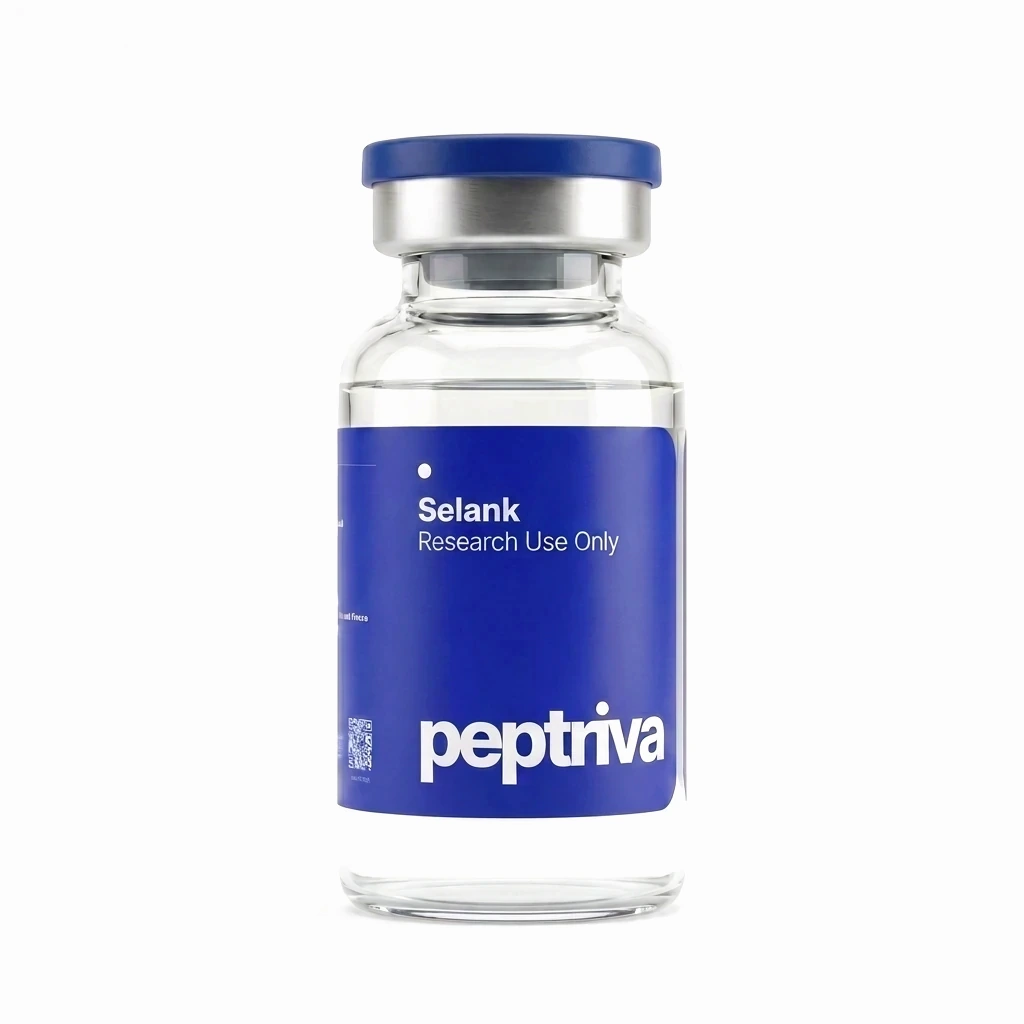
Selank
Synthetic heptapeptide, tuftsin analog with C-terminal Pro-Gly-Pro stabilizing extension. The same reference compound used across the cited preclinical studies (Konstantinopolsky 2022, Yasenyavskaya 2021) and the 2020 fMRI study. COA available with each lot.
Administration routes studied in the literature
The published literature on both peptides is concentrated on intranasal delivery. The 2020 Panikratova fMRI study used an intranasal route consistent with the Russian licensed formulations. The Russian regulatory framework approved both peptides as nasal-drop solutions for their respective indications.
Intranasal route. The dominant route in published studies, matching the approved Russian formulation format. Both peptides were designed with a C-terminal Pro-Gly-Pro stabilizing extension that improves metabolic stability across mucosal routes.
N-acetyl analogs. N-Acetyl Selank and N-Acetyl Semax have appeared in the research market as structurally modified variants with claimed differences in metabolic stability. No PubMed-indexed human data have been published for either acetylated analog.
No published dose-response study has characterized either peptide's pharmacology across varying concentrations in a controlled Western trial design.
"
The 2020 fMRI study by Panikratova and colleagues showed that both Selank and Semax modulated functional connectivity between the right amygdala and right temporal cortex within 5–20 minutes of intranasal administration — one of the most credible pieces of Western human evidence for any peptide in this encyclopedia.
Safety, side effects, and regulatory framing
- Mild side-effect profile in Russian clinical experience. Nasal irritation from the intranasal formulation is the dominant reported side effect. No major preclinical safety flags.
- Limited Western human safety data. Long-term safety in healthy research subjects has not been characterized in controlled Western studies.
- Theoretical drug interactions. Selank with GABA-active drugs (alcohol, benzodiazepines). Semax with SSRIs or opioids, given its broad receptor modulation. Neither has been formally studied for interactions in Western RCT designs.
- Identity verification matters. Russian pharmacy products are licensed pharmaceuticals. Western research-peptide market products aren't. A third-party Certificate of Analysis via mass spectrometry and HPLC is the only reliable identity check.
- Not on the WADA Prohibited List as of the 2026 list. Athletes should still consult sport-specific anti-doping rules.
What to know now
- Two Russian-developed heptapeptides, one institute. Selank and Semax both came out of the Institute of Molecular Genetics (now Kurchatov), designed by the same group under the same design philosophy.
- Russian regulatory approval is real but a lower bar than FDA. Selank approved since 2009 for GAD. Semax approved for stroke and cognitive disorders. Both sold as licensed nasal-drop pharmaceuticals in Russia.
- The mechanistic logic is real. Selank for anxiety without sedation; Semax for cognition and neuroprotection.
- One rigorous Western human study. The 2020 Panikratova fMRI study (n=52) showed amygdala connectivity changes within 5–20 minutes of intranasal dosing for both peptides.
- Zero Western RCTs of either peptide or the combination. The Western base is one fMRI study plus extensive Russian preclinical literature, mostly from the Kurchatov Institute.
- Not FDA-approved. US grey-market sale only. Not legal for human use under FDA rules.
- WADA-unlisted but athletes should check sport-specific rules.
What we're watching
The biggest development to track is whether any Western RCT of Selank, Semax, or the combination ever publishes. The Kurchatov Institute group continues to produce reasonable Russian preclinical work, and independent Italian groups have replicated the Semax-copper-amyloid findings without authorial overlap. We're also watching the N-acetyl analogs, which have started appearing in the grey market with claimed bioavailability improvements but no published human data. Until properly designed clinical investigation runs, the Russian nootropic stack stays where it is: regulator-approved elsewhere, Western-evidence-light, and popular because the actual-pharmaceutical status outpaces the Western RCT data.
References
- Panikratova, Y. R., Lebedeva, I. S., Sokolov, O. Y., et al. (2020). Functional connectomic approach to studying Selank and Semax effects. Doklady Biological Sciences, 490(1), 9–11. https://doi.org/10.1134/S001249662001007X
- Konstantinopolsky, M. A., Chernyakova, I. V., & Kolik, L. G. (2022). Selank, a peptide analog of tuftsin, attenuates aversive signs of morphine withdrawal in rats. Bulletin of Experimental Biology and Medicine, 173(6), 730–733. https://doi.org/10.1007/s10517-022-05624-x
- Yasenyavskaya, A. L., Samotrueva, M. A., Tsibizova, A. A., Bashkina, O. A., Myasoedov, N. F., & Andreeva, L. A. (2021). The influence of Selank on the level of cytokines under the conditions of “social” stress. Current Reviews in Clinical and Experimental Pharmacology, 16(2), 162–167. https://doi.org/10.2174/1574884715666200704152810
- Mukhina, A. Y., Mishina, E. S., Bobyntsev, I. I., et al. (2020). Morphological changes in the large intestine of rats subjected to chronic restraint stress and treated with Selank. Bulletin of Experimental Biology and Medicine, 169(2), 281–285. https://doi.org/10.1007/s10517-020-04868-9
- Sudarkina, O. Y., Filippenkov, I. B., Stavchansky, V. V., et al. (2021). Brain protein expression profile confirms the protective effect of the ACTHPGP peptide (Semax) in a rat model of cerebral ischemia-reperfusion. International Journal of Molecular Sciences, 22(12), 6179. https://doi.org/10.3390/ijms22126179
- Filippenkov, I. B., Remizova, J. A., Stavchansky, V. V., et al. (2023). Synthetic adrenocorticotropic peptides modulate the expression pattern of immune genes in rat brain following the early post-stroke period. Genes, 14(7), 1382. https://doi.org/10.3390/genes14071382
- Filippenkov, I. B., Shpetko, Y. Y., Stavchansky, V. V., et al. (2024). ACTH-like peptides compensate rat brain gene expression profile disrupted by ischemia a day after experimental stroke. Biomedicines, 12(12), 2830. https://doi.org/10.3390/biomedicines12122830
- Sciacca, M. F. M., Naletova, I., Giuffrida, M. L., & Attanasio, F. (2022). Semax, a synthetic regulatory peptide, affects copper-induced abeta aggregation and amyloid formation in artificial membrane models. ACS Chemical Neuroscience, 13(4), 486–496. https://doi.org/10.1021/acschemneuro.1c00707
- Tomasello, M. F., Di Rosa, M. C., Naletova, I., et al. (2025). Semax, a copper chelator peptide, decreases the Cu(II)-catalyzed ROS production and cytotoxicity of aβ by metal ion stripping and redox silencing. Bioinorganic Chemistry and Applications, 2025, 4226220. https://doi.org/10.1155/bca/4226220
- Liu, R., Chen, Y., Huang, H., et al. (2025). Semax peptide targets the μ opioid receptor gene Oprm1 to promote deubiquitination and functional recovery after spinal cord injury in female mice. British Journal of Pharmacology, 182(22), 5489–5516. https://doi.org/10.1111/bph.70122
- Inozemtseva, L. S., Yatsenko, K. A., Glazova, N. Y., et al. (2024). Antidepressant-like and antistress effects of the ACTH(4-10) synthetic analogs Semax and Melanotan II on male rats in a model of chronic unpredictable stress. European Journal of Pharmacology, 984, 177068. https://doi.org/10.1016/j.ejphar.2024.177068
- Vyunova, T. V., Andreeva, L. A., Shevchenko, K. V., et al. (2023). Synthetic corticotropins and the GABA-receptor system: Direct and delayed effects. Chemical Biology & Drug Design, 101(6), 1393–1405. https://doi.org/10.1111/cbdd.14221
- World Anti-Doping Agency. (2026). The Prohibited List. https://www.wada-ama.org/en/prohibited-list