The KPV ulcerative colitis preclinical literature spans nearly 20 years of mechanistically coherent rodent data alongside zero Western RCTs in humans. This article walks through what the published studies show and why translation has stalled.
The Dalmasso 2008 and Kannengiesser 2008 papers showed that oral KPV in pH-sensitive nanoparticles reduces inflammation in DSS-induced mouse colitis. The PepT1 transporter (a peptide-uptake pump that’s upregulated in inflamed gut tissue) selectively concentrates KPV at the disease site. The 2021 Sun hydrogel work extended this to rectal delivery in rats. The delivery architecture is conceptually similar to how mesalamine formulations work. The Western RCT count in humans is zero.
For most peptide-research molecules, the opening question is what the human evidence looks like. For KPV in IBD, the question starts one step earlier: what does the preclinical literature actually show, and why hasn’t it progressed to human trials in 18 years?
The four foundational papers anchoring the IBD case are reviewed below, alongside the conceptual fit with mesalamine, the microbiome connection that has emerged in recent years, and the structural and commercial reasons a tripeptide with reasonable preclinical data has not advanced into Phase I.
What ulcerative colitis actually involves.
Before walking through what KPV does to it, here’s the disease. Ulcerative colitis is a chronic inflammatory disease of the colonic mucosa (the inner lining of the large intestine). Inflammation starts at the rectum and extends upward to varying degrees.
Microscopically, you see neutrophil infiltration, crypt abscess formation, depleted mucus-producing cells, and distorted crypt architecture. Clinically, the features are bloody diarrhea, urgency, abdominal cramping, and varying degrees of systemic inflammation including fatigue and anemia.
The disease involves dysregulated mucosal immunity, an imbalanced colonic microbiome (called dysbiosis), defects in the colonic epithelial barrier, and genetic susceptibility. The downstream inflammatory signaling involves NF-κB activation, TNF-α production by lamina propria macrophages, IL-6 and IL-23 signaling driving Th17 responses, and a chronic feedback loop between epithelial barrier breakdown and microbial translocation.
Current standard of care includes 5-aminosalicylates (mesalamine, sulfasalazine), corticosteroids, immunomodulators, anti-TNF biologics, anti-integrin biologics, anti-IL-12/23 biologics, JAK inhibitors, and S1P receptor modulators. Each has Phase III RCT evidence in thousands of study participants.
What Dalmasso and Kannengiesser established in 2008.
The foundational KPV-IBD papers are both from 2008. They’re referenced in essentially every subsequent review. They sit just outside the 2020–2026 PubMed search window we usually focus on, but they’re the necessary starting point.
The Dalmasso et al. 2008 paper, published in Gastroenterology, established two key findings. First, KPV is transported into colonic cells via PepT1 — the gut peptide-uptake pump. Second, PepT1-mediated KPV uptake reduces intestinal inflammation in DSS-induced colitis mice, with a measurable ~50% reduction in disease activity index, histological inflammation scores, and pro-inflammatory cytokine levels.
The DSS-induced colitis model is a workhorse of IBD preclinical research. Dextran sulfate sodium in drinking water damages the colonic epithelium and induces a colitis phenotype that mimics aspects of human ulcerative colitis. The model is well-validated as a screening tool.
The Kannengiesser et al. 2008 paper, published in Inflammatory Bowel Diseases, extended this with oral nanoparticle delivery. The team used pH-sensitive polymeric nanoparticles to deliver KPV through the upper GI tract intact and release it in the colonic lumen. This addressed the major translational obstacle for oral KPV. The tripeptide is otherwise degraded by gastric and pancreatic enzymes before reaching the colon. In murine IBD models, the nanoparticle-delivered KPV reduced colitis severity.
Together, these two papers established the conceptual architecture for the field: oral delivery in pH-sensitive carriers, colonic-lumen release, PepT1-mediated uptake into inflamed tissue, and intracellular suppression of NF-κB-driven inflammation.
What the 2021 Sun hydrogel work added.
The 2021 paper by Sun and colleagues advanced the delivery story with a different strategy. Instead of oral nanoparticles, the team developed a hydrogel designed for rectal administration. The hydrogel both protects KPV from enzymatic degradation and provides sustained release in the rectum and lower colon.
The model was TNBS-induced ulcerative colitis in rats. TNBS administered into the rectum induces a colitis with a different inflammatory profile than DSS, which complements DSS and broadens the preclinical evidence base. In the Sun study, the KPV hydrogel produced 5 concrete effects: reduced disease activity index, prevention of colon shortening, decreased myeloperoxidase activity (a neutrophil marker), restored epithelial barrier morphology, and decreased TNF-α and IL-6 expression.
What this study added: an alternative delivery vehicle (hydrogel instead of nanoparticle), a different colitis model (TNBS instead of DSS), and a different administration route (rectal instead of oral). The fact that the anti-inflammatory effects replicated across these conditions supports the broader case that KPV’s pharmacology is robust to formulation details.
The 2023 review by Gravina and colleagues summarises this entire literature in the context of the broader melanocortin-system case for IBD, including KPV alongside ACTH, α-MSH, and KdPT. By their count, the published preclinical case spans ~20 studies.
The KPV hydrogel reduced colitis disease activity, prevented colon shortening, decreased myeloperoxidase, restored epithelial barrier morphology, and decreased TNF-α and IL-6 expression. The therapeutic effects support KPV stabilization strategies for IBD intervention.
— Sun et al., ACS Biomaterials Science & Engineering, 2021
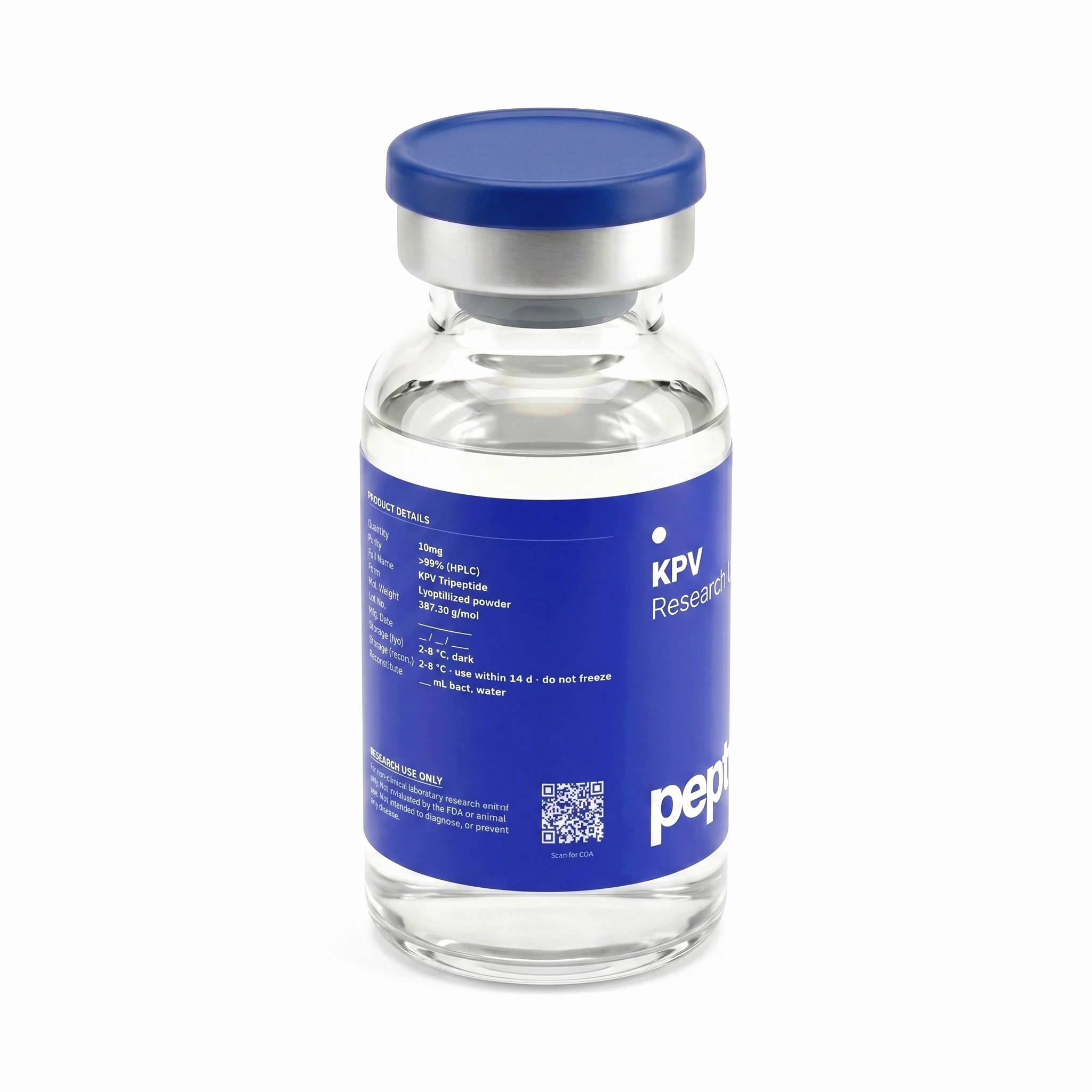
KPV
The same C-terminal α-MSH tripeptide cited across the Dalmasso, Kannengiesser, and Sun preclinical colitis studies. Lab-verified identity and purity.
Why PepT1 selectivity matters.
This is the part of the KPV story that fits most cleanly into modern IBD-pharmacology thinking. Worth dwelling on.
PepT1 is an intestinal peptide-uptake pump normally expressed at low levels on colonic cells. In inflamed colonic mucosa, PepT1 expression is upregulated — reports range from 3–5x baseline. The functional consequence: an orally delivered KPV preparation that reaches the colonic lumen gets selectively taken up into inflamed tissue at higher rates than into healthy tissue.
This is a form of pseudo-targeting that doesn’t depend on the molecule having a disease-specific receptor. Instead, the disease state alters the transporter availability, and the molecule rides that altered expression to concentrate at the disease site. It’s the same conceptual principle that makes pH-sensitive mesalamine formulations work. The drug doesn’t bind a disease-specific target, but the delivery system and local intestinal physiology cooperate to concentrate it at the inflamed mucosa.
The mesalamine analogy is useful. Mesalamine is a relatively non-specific anti-inflammatory that works because of where it’s delivered, not because it has a unique mechanism unavailable to other anti-inflammatories. A delivery-engineered KPV formulation that releases in the colon and is selectively taken up via upregulated PepT1 has a similar architecture. Whether that’s sufficient to compete with mesalamine’s Phase III evidence base is the open clinical question.
What about the microbiome connection?
The IBD-microbiome literature has expanded considerably in the past decade. One interesting thread: how anti-inflammatory peptides interact with the colonic microbial community. Inflammation in ulcerative colitis alters the local microbial environment (reduced beneficial commensals, expansion of pro-inflammatory bacteria), and the altered microbiome feeds back into the inflammatory state.
KPV restores epithelial barrier integrity in preclinical models. The Sun 2021 hydrogel paper specifically showed restored barrier morphology. Improved barrier integrity reduces microbial translocation across the mucosa, which is one of the drivers of chronic immune activation in IBD. So a peptide that supports barrier biology and reduces local cytokine signaling has at least two leverage points on the IBD-microbiome feedback loop.
The honest framing: this is mechanistically interesting but not directly validated by human microbiome studies of KPV exposure. The human RCTs that would generate that data don’t exist. The conceptual fit is good. The clinical evidence isn’t there yet.
Why are there no human RCTs?
This is the question the literature has been quietly asking for 15 years. The answer is mostly structural, not scientific.
KPV is a three-amino-acid peptide that isn’t patentable as a chemical entity. The molecule is too small to claim novelty, and the sequence has been known since the 1970s as a fragment of α-MSH. The patentable IP is in the delivery formulation (a specific nanoparticle architecture, hydrogel composition, microneedle approach) rather than in the active. Patentable-formulation IP is harder to monetize than chemical-entity IP, and that has slowed pharma interest in tripeptide therapeutics.
The IBD market is dominated by patent-protected biologics with high per-patient revenue, often $50,000+/year, and the regulatory infrastructure for biosimilars has expanded their lifecycle. The economic gradient for a delivery-engineered tripeptide entering this market against existing biologics and the new oral small-molecule options (JAK inhibitors, S1P modulators) is unfavorable, even if the preclinical case is good.
There’s also a clinical-trial design challenge. A KPV trial for ulcerative colitis would have to demonstrate efficacy on Mayo endoscopic score, calprotectin, and clinical remission endpoints against a placebo arm in study participants with moderate disease. That population is increasingly being enrolled in biologic and small-molecule arms for ethical and clinical reasons. The trial-design and ethical framework for testing an unproven peptide in moderate-to-severe ulcerative colitis is non-trivial.
The result: the preclinical KPV literature has continued to accumulate quality work for ~20 years without crossing into Phase I. The molecule sits in a translational limbo common to small peptides without clear chemical-entity patent protection.
Translational context: KPV as a research compound in IBD.
KPV is available as a research-grade reference compound and has been used in the preclinical colitis models described above. Several methodological details bear on how those results translate to any future research application.
The published efficacy data uses delivery-engineered formulations — specifically, pH-sensitive nanoparticles or rectal hydrogels — rather than unformulated peptide. Studies have reported that bare KPV is susceptible to enzymatic degradation in the upper GI tract before reaching the colonic target site. This formulation dependency is a key variable when interpreting which preclinical results are delivery-agnostic versus formulation-specific.
The validated endpoints in the preclinical literature include disease activity index (DAI), histological inflammation scoring, myeloperoxidase activity as a neutrophil marker, and cytokine quantification (TNF-α, IL-6). These objective tissue-level readouts are the measures against which preclinical KPV efficacy has been characterized.
- Formulation matters: The Dalmasso and Kannengiesser 2008 results used pH-sensitive polymeric nanoparticles. The Sun 2021 results used a rectal hydrogel. Unformulated KPV represents a different exposure profile from the published study conditions.
- PepT1 upregulation is a preclinical observation: The 3–5x PepT1 upregulation in inflamed versus healthy mucosa has been characterized in rodent DSS-colitis tissue. Human mucosal PepT1 expression in IBD has been studied separately but is not directly validated as a delivery mechanism for KPV in human subjects.
- Model-to-indication mapping: DSS-colitis and TNBS-colitis are established rodent screening models with known similarities and differences relative to human ulcerative colitis histopathology. Extrapolation across species requires caution.
- No human RCT data: As of the 2026 literature review, no randomized controlled trials of KPV in human IBD study participants have been published. Current standard of care for ulcerative colitis — 5-ASAs, immunomodulators, biologics, JAK inhibitors, S1P modulators — is supported by Phase III RCT evidence in thousands of study participants that KPV does not yet approach.
- Research-use framing: KPV is supplied as a research-grade reference compound for in vitro and preclinical research use. It is not approved for therapeutic use in humans.
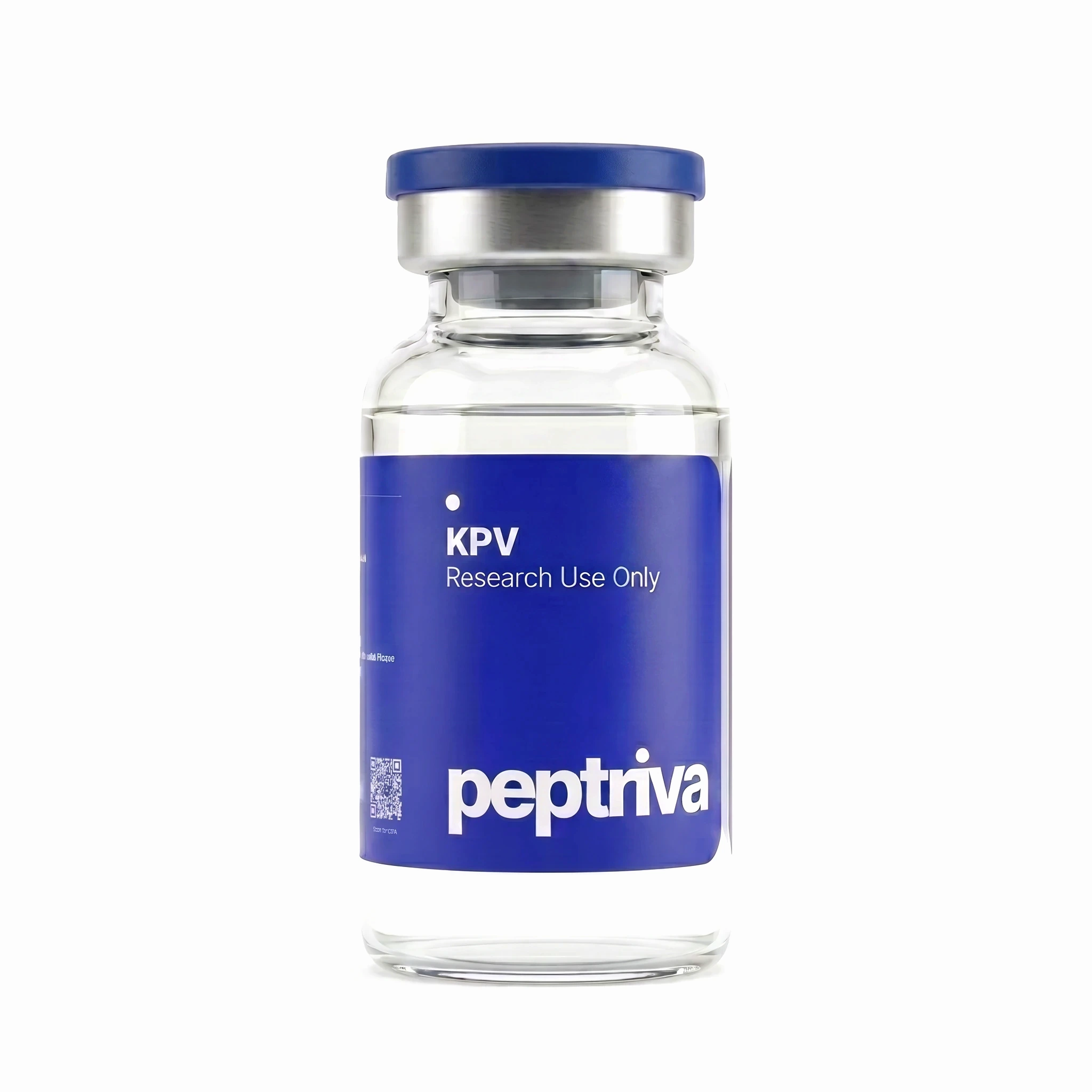
KPV
Lys-Pro-Val tripeptide · C-terminus of α-MSH. The same reference compound used across the cited DSS-colitis and TNBS-colitis preclinical studies. COA available with each lot.
Where this falls short. The published KPV IBD literature spans two decades and is mechanistically coherent. PepT1-mediated uptake selectively concentrating the peptide in inflamed mucosa. NF-κB suppression. Restored barrier integrity. Reduced TNF-α and IL-6 production. The delivery architecture is conceptually similar to mesalamine. But the Western RCT count in humans is zero, primarily for structural and IP reasons rather than safety concerns. Evidence-based standard care for ulcerative colitis has rigorous Phase III RCT support that KPV currently does not approach.
What to know now
- Foundational papers: Dalmasso 2008 (PepT1 uptake in DSS-colitis mice), Kannengiesser 2008 (oral nanoparticle delivery), Sun 2021 (rectal hydrogel in TNBS-colitis rats), Gravina 2023 review.
- Mechanism: NF-κB suppression in colonic epithelium, reduced TNF-α and IL-6, restored epithelial barrier integrity, reduced neutrophil infiltration.
- PepT1 selectivity: the colonic peptide-uptake pump is upregulated in inflamed mucosa, providing pseudo-targeting of orally delivered KPV to disease sites — similar to how mesalamine formulations work.
- Delivery is the limit: bare KPV is enzymatically labile. Published efficacy uses pH-sensitive nanoparticles or hydrogels. Unformulated KPV represents a different exposure profile from the published study conditions.
- No human RCTs: the 2020–2026 PubMed window returns zero RCTs in humans for IBD. Older topical work in atopic dermatitis was small and limited.
- Why no trials: structural, not scientific. Tripeptide IP isn’t patentable as a chemical entity, the IBD market is dominated by biologics, and trial design against standard of care is non-trivial.
- Standard of care: 5-ASAs, immunomodulators, anti-TNF biologics, anti-integrin biologics, anti-IL-12/23 biologics, JAK inhibitors, and S1P modulators all have rigorous Phase III RCT evidence in IBD study participants. KPV does not approach any of those evidence bases.
What we’re watching
Three things over the next 18 months. First, whether any biotech or academic group registers a Phase I trial of a delivery-engineered KPV formulation in mild-to-moderate ulcerative colitis. The obvious next translational step the literature has been pointing toward since 2008. Second, whether the PepT1-upregulation pseudo-targeting principle gets validated as a broader drug-delivery framework. Third, whether the existing oral small-molecule IBD drugs and biosimilar erosion of biologic margins change the commercial calculus enough to make a tripeptide-plus-delivery development program economically viable.
References
- Sun, J., Xue, P., Liu, J., et al. (2021). Self-cross-linked hydrogel of cysteamine-grafted γ-polyglutamic acid stabilized tripeptide KPV for alleviating TNBS-induced ulcerative colitis in rats. ACS Biomaterials Science & Engineering, 7(10), 4859–4869. https://doi.org/10.1021/acsbiomaterials.1c00792
- Gravina, A. G., Pellegrino, R., Durante, T., et al. (2023). The melanocortin system in inflammatory bowel diseases: Insights into its mechanisms and therapeutic potentials. Cells, 12(14), 1889. https://doi.org/10.3390/cells12141889
- Dalmasso, G., Charrier-Hisamuddin, L., Nguyen, H. T., Yan, Y., Sitaraman, S., & Merlin, D. (2008). PepT1-mediated tripeptide KPV uptake reduces intestinal inflammation. Gastroenterology, 134(1), 166–178. PMID 18061177
- Kannengiesser, K., Maaser, C., Heidemann, J., et al. (2008). Melanocortin-derived tripeptide KPV has anti-inflammatory potential in murine models of inflammatory bowel disease. Inflammatory Bowel Diseases, 14(3), 324–331. PMID 18092346
- Can, V. C., Locke, I. C., Kaneva, M. K., et al. (2020). Novel anti-inflammatory and chondroprotective effects of the human melanocortin MC1 receptor agonist BMS-470539 dihydrochloride and human melanocortin MC3 receptor agonist PG-990 on lipopolysaccharide activated chondrocytes. European Journal of Pharmacology, 872, 172971. https://doi.org/10.1016/j.ejphar.2020.172971